Placemat Ideas: Shape, Size and Layering on the Table
How to choose placemats that suit your table: which shapes fit round and rectangular tables, how big a mat should be, materials by look, and when a runner or tablecloth works better.

Good placemats do three jobs at once: they frame each setting, they shield the tabletop from plates and flatware, and they bring in a texture that a bare surface cannot offer. They are also the quickest table covering to lay down and lift away, which is why they work for a weekday breakfast as easily as for a sit-down dinner.
Choosing them gets simpler once you look at three things: the shape of your table, the room each person has, and what else needs to sit on the surface. The sections below walk through shape, size, material and layering, and help you decide when a runner or a tablecloth would do the job better.
What a placemat actually does
A mat draws a border around one person’s space. That border makes a table look organized even before the plates go down, and the same shape repeated at even intervals reads as calm and deliberate.
The second job is practical. A mat sits between the tabletop and anything that scrapes, drips or leaves a ring. The third is visual. A wood table with woven mats shows two textures instead of one, and you still see the wood between the settings, which a full cloth would hide.
Match the shape to your table
Shape matters more than color, because a mat that fights the table edge always looks slightly off. These four cover nearly every table:
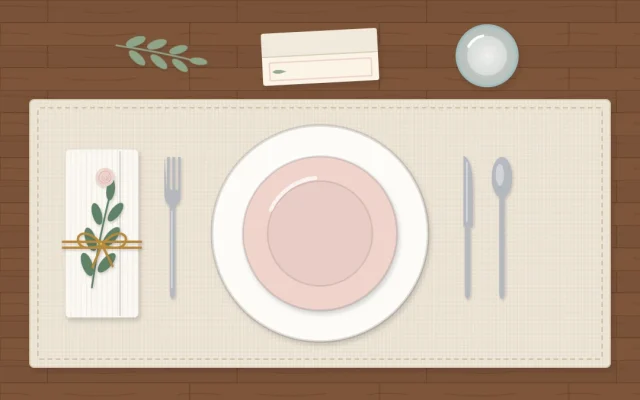
- Rectangle. The natural partner for square and rectangular tables. Its straight edges line up with the table edge and give you room for flatware beside the plate.
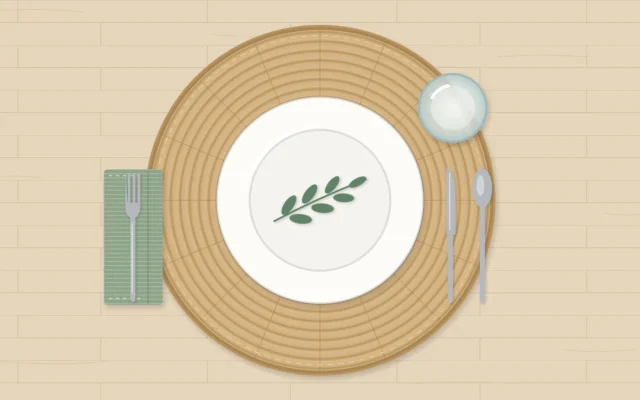
- Round. Echoes the plate and softens a table with hard corners. It takes less width, though flatware often rests partly on the bare surface.
- Oval. A middle path: curved like a round mat, wide enough to hold the flatware. It suits oval tables and softens long rectangular ones.
- Wedge. Wider at the outer edge and narrower toward the middle, so it follows the curve of a round table. Several wedges fit side by side without their corners overlapping.

Rectangular mats on a round table are the usual trouble spot, because their inner corners collide near the center. Round or wedge mats solve that, and there are more ways to handle a curved edge in these ideas for decorating a round table.
Size: the plate first, then the space per person
A common rectangular mat is roughly 12 by 18 in (30 by 45 cm), and a common round one is about 15 in (38 cm) across. Treat those as starting points rather than fixed sizes. What counts is how the mat relates to two things.
The plate
You want a visible border of mat around the dinner plate, about 2 in (5 cm) or more at the top and bottom. If the plate covers the mat almost completely, the mat stops framing anything.
The space each person has
As a loose rule of thumb, each setting is comfortable with about 24 in (60 cm) of table edge. Mats should sit inside that width with a strip of bare table between neighbors. If they touch or overlap, switch to a narrower shape or drop the mats and use a cloth.
The quickest test is to build one complete setting on one mat before you commit to a full set. Lay it out using the basic place setting layout, add the glass, and check whether everything sits on the mat or spills off the sides.
Materials, chosen by the look you want
- Woven (seagrass, rattan-style fiber, braided jute): the most texture, relaxed and warm. Round woven mats look especially good on bare wood. Crumbs settle into the weave, so shake them out after the meal.
- Linen or cotton: soft, flat and a little dressier. Creases are part of the look with linen; press them if you prefer crisp edges.
- Cork: thin, matte and quiet. It grips the table well and suits a simple, modern setting.
- Felt: soft color and clean cut edges, good for muting the clatter of plates on a hard table.
Care varies widely between materials and makers, so follow the care label that comes with your set.
Placemats, a runner or a tablecloth?
| Option | What it shows | Best when |
|---|---|---|
| Placemats | Most of the tabletop, with a frame at each seat | You like your table’s surface and want a fast, relaxed setup |
| Runner | A band of fabric down the middle, bare table at the seats | The centerpiece needs an anchor more than the settings do |
| Tablecloth | None of the tabletop | The table is crowded, the surface is worn, or the meal is dressier |
| Bare table | Everything | The surface is the feature and the dishes carry the color |
You can also combine two of them. A runner with placemats is the most useful pairing: the runner ties the center together and the mats frame the seats. Keep one of them plain so they do not compete, and leave a little bare table between the runner’s edge and each mat. The guide on how to use a table runner covers widths and placement.
Layering on top of the mat
One extra layer between mat and plate adds depth without adding clutter. Two approaches work well:
- A charger. This large decorative plate sits under the dinner plate and adds a ring of color or shine. On a round mat, choose a charger clearly smaller than the mat so both rims show.
- A smaller mat. A round woven mat centered on a rectangular linen one gives you two textures and two shapes in a single setting.
Stop at three layers under the food: mat, charger or small mat, then plate. More than that makes the setting tall and wobbly, and the plate should always sit flat.
Good to know
Decorative chargers are usually for show under the plate. Unless the maker states that a charger is made for serving food, do not put food directly on it; keep a plate on top.
Quick fixes when the mats look wrong
- The table looks busy. Patterned mats plus patterned plates is usually the cause. Make one of them plain.
- The mats disappear. They are too close to the table’s color. Go lighter, darker or more textured.
- Corners overlap. Change to round or wedge mats, or seat fewer people per side.
- Everything looks crooked. Line up each mat about 1 in (2.5 cm) from the table edge, then check the row from the end of the table.
Frequently asked questions
What shape of placemat works best on a round table?
Round and wedge-shaped mats fit a round table most easily. Wedge mats narrow toward the middle, so several sit side by side without their corners colliding. Round mats take little width and repeat the curve of the table. Rectangular mats can work at a large round table with only a few seats.
Can you use placemats and a table runner together?
Yes, and it is one of the most useful pairings. The runner anchors the middle of the table while the mats frame each seat. Keep either the runner or the mats plain so the two do not compete, and leave a strip of bare table between the runner's edge and each mat.
How big should a placemat be compared with the plate?
Big enough to show a clear border around the dinner plate, roughly a couple of inches at the top and bottom, and wide enough for the flatware if you want it on the mat. It also has to fit the seat: neighboring mats should have a little bare table between them.