Round Table Decor Ideas: Centerpieces and Settings That Suit the Shape
Runners and long arrangements rarely suit a circle. These fixes cover the centerpiece, placemats, cloth, runner and spacing so a round table looks balanced from every seat.
Most table advice quietly assumes a rectangle. Runners, long garlands and rows of vases all depend on a table having a length, which a circle does not have. Copy those ideas onto a round table and something always looks slightly off.
Good round table decor starts from the shape instead of fighting it. A circle has one center, no head and no ends, and every seat is the same distance from the middle. The fixes below take the most common problems one at a time.
Problem: the centerpiece looks stretched or lopsided
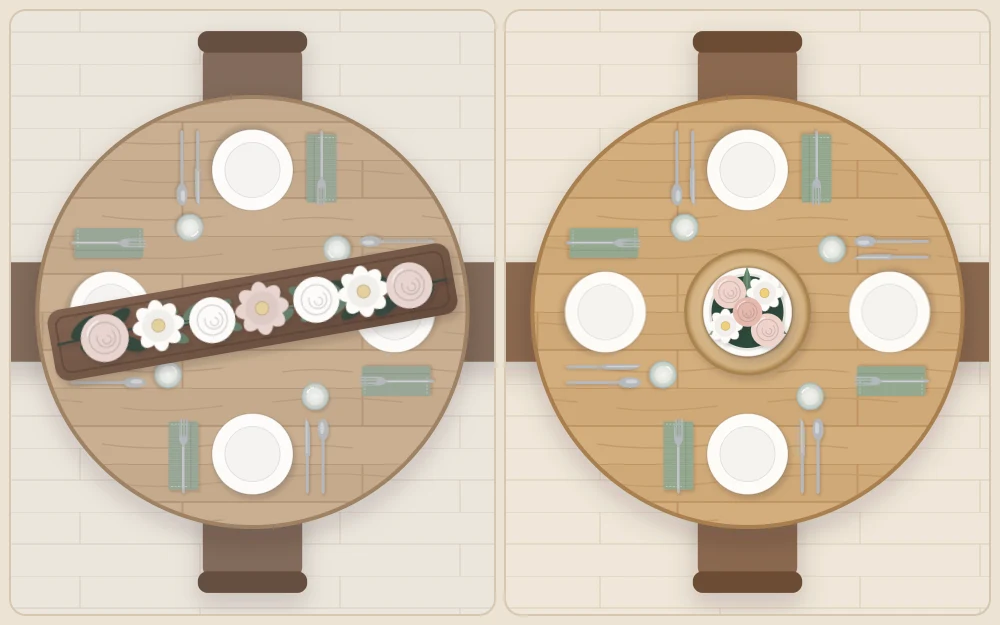
A long, narrow arrangement gives a round table a direction it does not have. Two people get a view of flowers, and two get the narrow end pointing at their plates.
The fix: use a centerpiece that is round itself, or one that reads as round from above. A low bowl, a single wide vase, a potted plant, or a tight cluster of three small vessels grouped on a round tray or mat all work. Then put it in the exact center. On a rectangle a slightly off-center piece can look relaxed; on a circle it simply looks misplaced, because every seat measures the gap.
To find the middle quickly, stand at the table and check the distance to the rim on four sides, as if reading 12, 3, 6 and 9 on a clock. The article on creating a table focal point explains how to make that one central piece strong enough to carry the whole table.
Problem: the middle is crowded and nobody can reach anything
On a round table everyone reaches toward the same point. Serving dishes, a water jug and the centerpiece are all competing for the middle, and it fills up fast.
The fix: keep the centerpiece compact. As a starting point, let it take up roughly a third of the table’s width. On a table about 48 in (120 cm) across, that suggests a centerpiece around 16 in (40 cm) wide, including its tray. Shrink it further if dishes need to share the middle.
Height matters as much as width. Keep the arrangement low enough to see over when seated, or slim enough to see around. A tall vase should be stable, level and tested with a gentle nudge before anyone sits down, and it belongs in the center, never near the rim.
Tip
Build the centerpiece on a round tray. When the dishes arrive, the whole arrangement lifts off in one move and goes back just as easily afterward.
Problem: rectangular placemats overlap or hang off the edge
Rectangular mats have square corners, and a round table has none. On a small circle the inner corners collide in the middle while the outer edge leaves gaps or overhangs the rim.
The fix: pick one of three options.
- Round mats. They echo the table and the plate, and they never collide at the corners. Choose a size that leaves a little rim of mat visible around the plate.
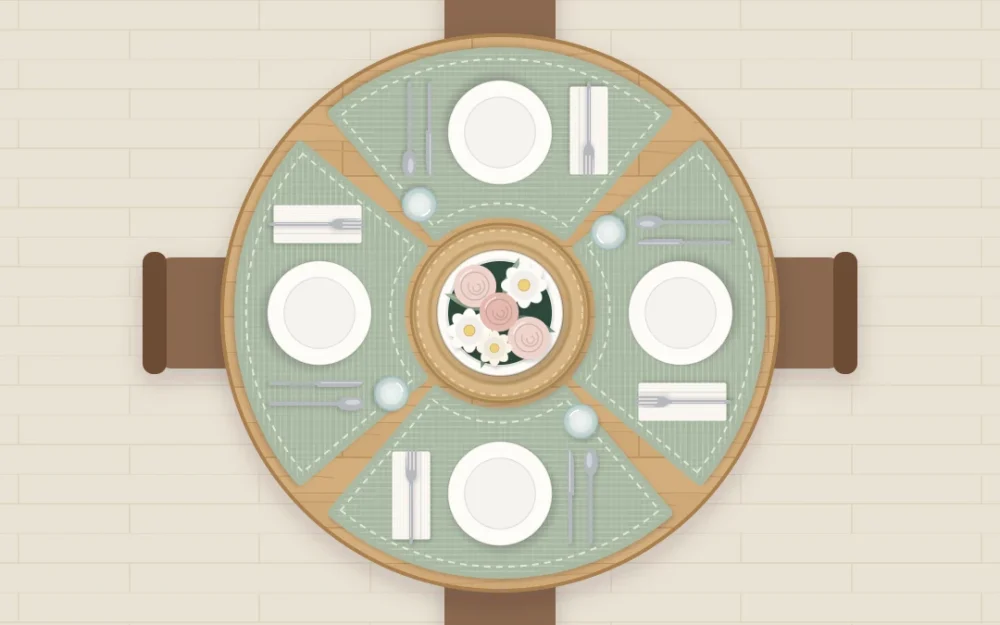
- Wedge-shaped mats. Curved along the outer edge and narrower toward the center, they follow the table like slices and give each person a clearly defined place.
- No mats at all. A bare wood top with a napkin under the fork, or a full cloth, often looks cleanest on a small round table.
For materials and sizes, see the placemat ideas guide.
Problem: the tablecloth hangs unevenly
A rectangular cloth on a round table drops long at four points and short between them, which can look accidental.
The fix: a round cloth gives an even drop all the way around and is the simplest choice. A square cloth also works well if you treat the corners as a feature: turn it so the four points fall between the chairs, like a diamond, rather than into people’s laps. A square cloth over a longer round one, in two close shades, gives a layered look with no extra objects on the table.
Problem: a runner looks like a stripe across a plate
A runner is made for length, so on a circle it needs a clear reason to be there.
The fix: if you like runners, use one in a way that suits the shape:
- One runner straight across the middle, long enough to hang over both edges by the same amount. It works best with two or four settings, where it passes between places instead of under someone’s plate.
- Two runners crossed at the center, forming a plus sign. Each of four diners gets a runner end as a placemat, and the crossing point marks where the centerpiece goes.
- A short runner folded into a square and used as a base under the centerpiece only.
With an odd number of seats, skip the runner. It will always sit awkwardly beside one place.
Problem: the settings look unevenly spaced
A rectangle has sides to line plates up against. A circle offers no such guide, so settings drift, and one gap ends up wider than the rest.
The fix: think of the table as a clock face. Four settings go at 12, 3, 6 and 9. Six settings go at every second hour. For five or seven, set the first plate, then place the others by eye and walk around the table once to even out the gaps. Line each plate up the same distance from the rim, about 1 in (2.5 cm) as a rule of thumb.
Push the chairs in afterward. If the chairs are evenly spaced, the plates in front of them usually are too.
Small round tables versus large ones
Size changes which problem you are solving.
On a small round table, such as a cafe table for two or a breakfast table for four, space is the limit. Use one small item in the center, such as a bud vase or a small plant, and keep mats minimal or skip them. The small table decor ideas go deeper on decorating when every inch counts.
On a large round table, the middle is the challenge, because it is too far away for anyone to reach. That empty zone can take a wider centerpiece: a generous low bowl, or a ring of small vases around a central one. Keep the same compact, circular outline, and leave a clear band between the centerpiece and the place settings for serving dishes.
Frequently asked questions
What is the best centerpiece shape for a round table?
A round or compact clustered centerpiece suits a circle best, because it looks the same from every seat. A low bowl, one wide vase or three small vessels grouped on a round tray all work. Place it in the exact center and keep it low enough to see across.
Can you put a table runner on a round table?
You can. Lay one runner straight across the center with equal overhang at both edges, or cross two runners to form a plus sign for four settings. Runners sit most comfortably with an even number of places; with an odd number, a round cloth or bare table usually looks tidier.
How big should a centerpiece be on a round table?
A common starting point is about a third of the table's width, including any tray underneath. Make it smaller when serving dishes need to share the middle, and a little wider on a very large table where the center is beyond everyone's reach anyway.