How to Use a Table Runner: Length, Width and Placement
Three ways to place a table runner, simple rules of thumb for length and width, what to do on a round table and how to keep the fabric flat and straight.
At a glance
- Difficulty
- Easy
- Time
- About 10 to 15 minutes, including pressing
- Best for
- Everyday tables, dinners and long tables with a row of decorations
- Table type
- Rectangular and oval tables, with options for round and square ones
What you need
- Table runner
- Tape measure
- Iron or steamer
- Thin non-slip liner (optional)
- Sturdy tube for rolled storage
A table runner is one of the simplest ways to make a table look finished, and one of the easiest to get slightly wrong. Too short and it looks like a placemat that lost its way. Too wide and it turns into a small tablecloth. Laid in the wrong direction, it works against the seating.
None of this is difficult once you know what the runner is there to do. Measure your table, choose one of three placements, and the questions of length and width mostly answer themselves.
What a runner actually does
A runner has two jobs. First, it gives the centerpiece a base. Objects placed directly on a large bare surface can look as if they are floating, while the same objects on a strip of fabric look grouped. Second, it breaks up a big expanse of wood or cloth, adding color and texture without hiding the table.
It also marks out territory. The strip down the middle belongs to decoration and serving dishes, and the space on either side belongs to the people eating.
Three ways to place it
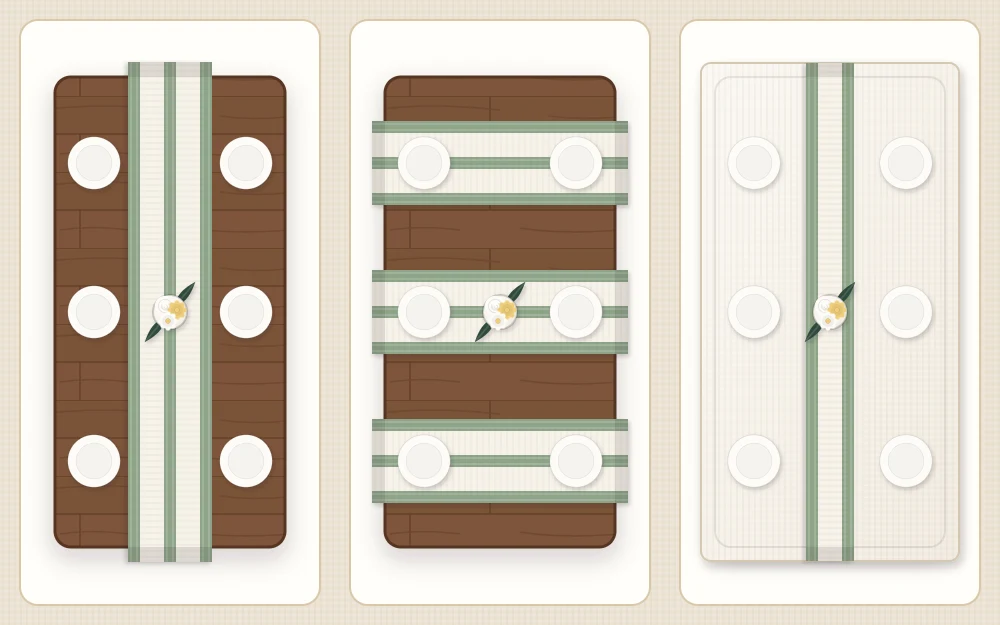
Lengthwise down the center
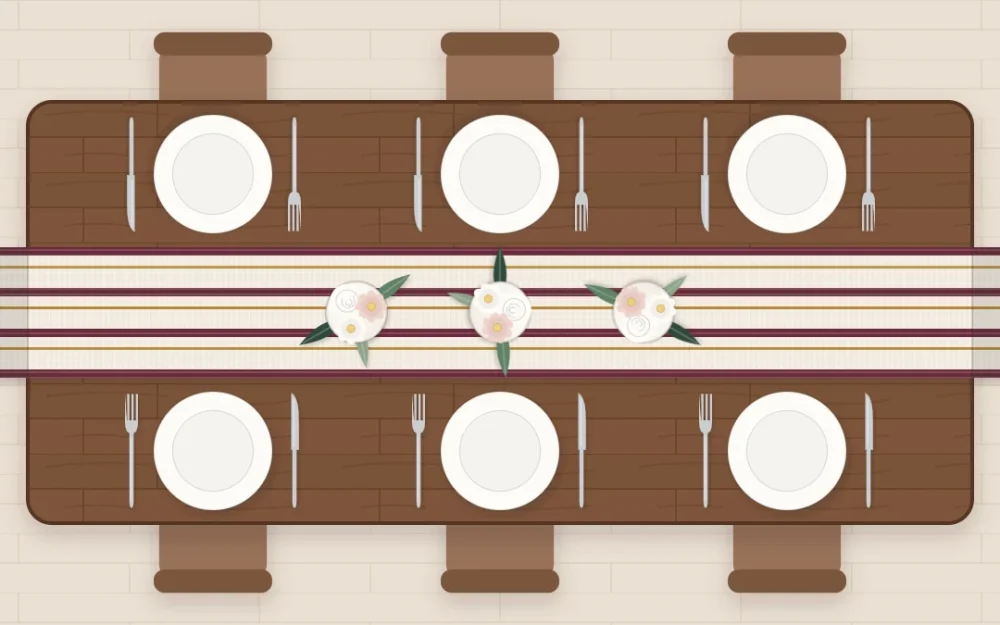
This is the familiar placement: one runner along the long axis of the table, centered between the two sides. It suits almost every rectangular and oval table, and it is the one to choose when you want a row of vases or a long, low arrangement. For ways to fill that strip on a big table, see these long table decor ideas.
Several short runners across the table
Here the runners go the other way, crossing the table from one long side to the other, so each pair of facing seats shares one. The runner takes over the role of a placemat for two people, and the wood shows in stripes between the pairs. It looks relaxed and modern, and it is useful when you have several shorter runners and no long one. If you are weighing this against individual mats, compare it with these placemat options.
Layered over a tablecloth
A runner on top of a cloth adds a second color or texture and gives a plain cloth a clear middle. Keep the contrast obvious: a patterned runner on a plain cloth, or a rough weave on a smooth one. Two fabrics that nearly match tend to look like a mistake. The guide to layering textures on a table goes further into pairing fabrics.
How long should it be?
There are two looks, and both are fine as long as the result is clearly one or the other.
- Hanging over the ends. A common starting point is an overhang of roughly 6 to 10 in (15 to 25 cm) at each end. Less than that can look as if the runner shrank; much more and it ends up in the lap of whoever sits at the head of the table.
- Stopping short on purpose. A runner that ends well inside the table edge, leaving about 6 in (15 cm) or more of bare table at each end, looks deliberate and suits tables where people sit at the ends.
What to avoid is the in-between: a runner that reaches the edge exactly, or misses it by a finger’s width. It reads as a wrong size.
To work out the length you need:
- Measure the length of the tabletop.
- For an overhang, add the drop you want twice, once for each end.
- For a short runner, subtract the bare margin twice.
- If a table has leaves that you sometimes add, measure it at the size you use most often.
When the runner sits on a tablecloth, let it hang a little shorter than the cloth, or match the drop exactly. A runner that hangs below the cloth looks untidy.
How wide should it be?
About a third of the table’s width is a useful starting point. On a table 36 in (90 cm) wide, that suggests a runner around 12 in (30 cm) across. The real test is practical: set a plate at a seat on each side and check that neither one sits on the runner. Each person should have clear table, or a placemat, in front of them.
Narrow tables may need a slimmer runner or none at all. If the plates on both sides overlap the fabric, the runner is too wide for that table and short crosswise runners will usually work better.
Runners on round and square tables
A round table has no long axis, so a runner has less to follow. It can still work in three ways:
- Straight across the middle, hanging over on both sides. It gives a round table a direction, which is handy when the table stands near a wall or a window.
- Two runners crossed at the center, which gives four people a strip each.
- A short runner or a square of fabric in the middle, with no overhang, simply as a base for the centerpiece.
Square tables take the same three options. On either shape, keep the centerpiece compact so it sits within the fabric.
Choosing fabric and pattern
Match the runner to how the table is used. Linen and cotton wash easily and suit everyday meals. Heavier woven or textured fabrics lie flat without help and add warmth. Thin, slippery fabrics look elegant but tend to slide when dishes are passed.
For pattern, look at what will sit on top. A busy print competes with a detailed centerpiece, so pair a patterned runner with simple objects and a plain runner with a fuller arrangement. Stripes that run along the length make a table look longer.
Good to know
Fabric burns easily, so use flameless LED candles on or near a runner. Battery and rechargeable candles give the same glow and can stand directly on the fabric.
Keeping it flat and straight
Creases show more on a runner than on almost anything else on the table, because it sits right in the middle.
- Press it before it goes on, and store it rolled around a sturdy tube instead of folded.
- Center it by eye from the end of the table, then check from the side that both overhangs match.
- Smooth it from the middle outward before adding anything.
- On a polished table, a thin non-slip liner underneath keeps it from drifting.
Tip
No runner the right size? A length of fabric with the long edges folded under and pressed, or a long scarf, can stand in for an evening. Fold the ends under as well so no raw edges show.
Frequently asked questions
How long should a table runner be?
A common starting point is the length of the table plus roughly 6 to 10 in (15 to 25 cm) of overhang at each end. Alternatively, choose one clearly shorter than the table so bare wood shows at both ends. Either look works; a runner that stops exactly at the edge tends to look like the wrong size.
Can you use a table runner with placemats?
Yes. A lengthwise runner and placemats sit well together as long as they do not overlap much. Check that the runner is narrow enough to leave room for a mat on each side, and vary the texture or color so the two layers look chosen instead of nearly matching.
Does a table runner go under or over a tablecloth?
Over. The cloth goes on first and the runner lies on top along the center, where it adds a second color or texture. Let the runner hang slightly shorter than the cloth or to the same length, and pick a clear contrast between the two fabrics.