How to Set a Basic Place Setting for Everyday Meals and Dinner Guests
One easy layout to remember for the fork, knife, glass and napkin, plus three levels built on it, from an everyday setting to a relaxed dinner with guests.

At a glance
- Difficulty
- Easy
- Time
- About 5 to 10 minutes for a table of four
- Best for
- Everyday meals and relaxed dinners with guests
- Table type
- Any table shape, from two seats upward
What you need
- Dinner plate
- Fork, knife and spoon
- Water glass
- Cloth or paper napkin
- Placemat (optional)
- Salad plate and bread plate (optional)
Fork on the left or the right? Glass above the plate or beside it? Most people set the table a little differently each time and hope it looks right. One layout is enough to settle it: a basic place setting that you can learn once and then add to when the meal calls for more.
What follows is the common Western convention. It is a habit that many households share, not a law, and it exists mostly because it is practical. Once you see the logic, you can adapt it to your own table without worry.
The layout in one sentence
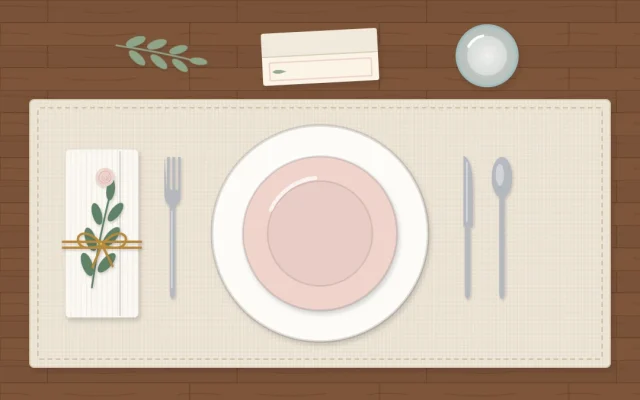
Plate in the center, fork to the left, knife and spoon to the right, glass above the knife, napkin on the left or on the plate.
The logic is simple. Most people hold the knife and the glass in the right hand, so both sit on the right. The fork goes in the left hand, so it sits on the left. Everything is placed where the hand will reach for it.
Set an everyday place in five steps
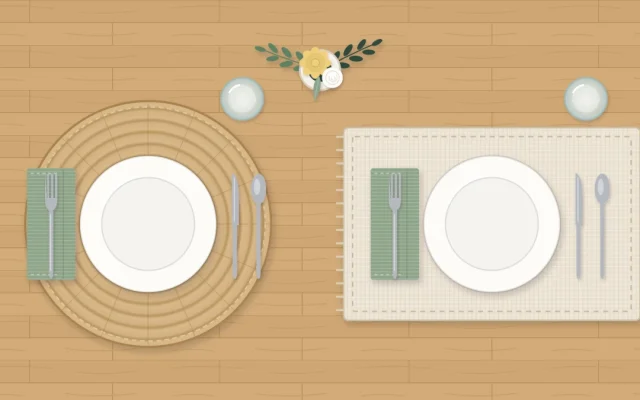
- Place the plate. Center it in front of the chair, about 1 in (2.5 cm) in from the table edge. If you use a placemat, the mat goes down first with the plate in its middle; these placemat ideas cover shapes and sizes.
- Add the fork. Lay it to the left of the plate, tines up, close to the plate without touching it.
- Add the knife. Lay it to the right of the plate with the blade facing the plate. If the meal needs a spoon, it goes to the right of the knife.
- Add the glass. Set it above the tip of the knife, at the upper right of the plate.
- Add the napkin. Fold it into a simple rectangle and lay it to the left of the fork, under the fork or on the plate. All three are common. For more decorative folds and ties, see these ways to present a napkin.
That is the whole everyday setting: five pieces, set in well under a minute once your hands know the order.
Three levels, built on the same base
You never have to learn a second layout. A fuller setting is the everyday one with a few pieces added around it.
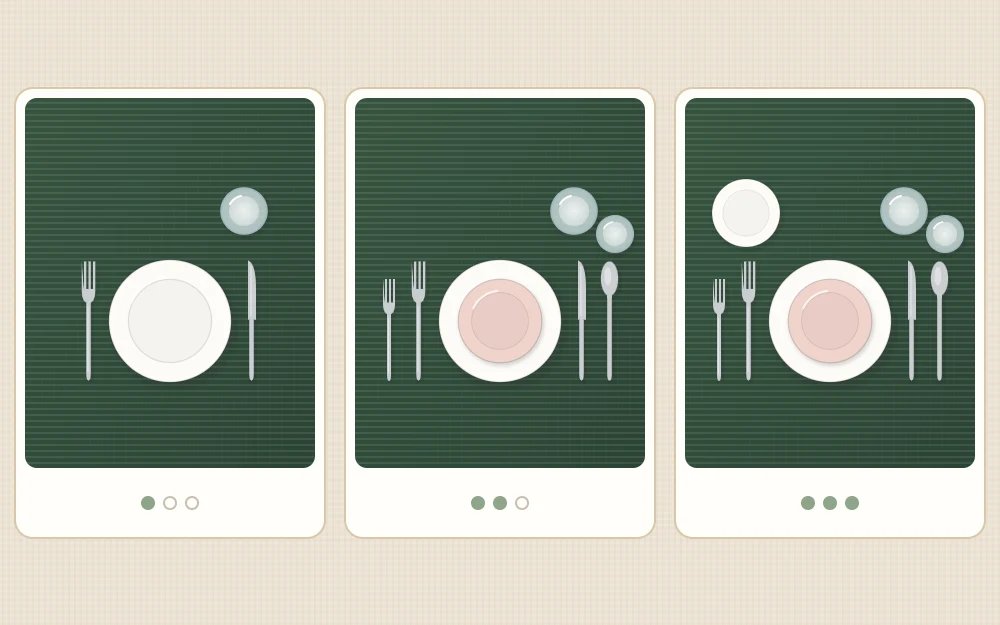
Level 1: everyday
Plate, fork, knife, glass and napkin. Add a spoon only if the meal will use one. This covers breakfast, weeknight dinners and most casual meals with friends.
Level 2: relaxed dinner
Start with level 1 and add whichever of these the meal will use:
- A salad fork, to the left of the dinner fork. By convention, flatware is used from the outside in, so the piece for the first course sits farthest from the plate.
- A salad plate or shallow bowl, stacked on the dinner plate.
- A second glass, to the right of the water glass and slightly lower on the table.
- A spoon, to the right of the knife.
Level 3: dinner with a bread plate
Take level 2 and add a small plate at the upper left, above the forks. That one extra plate is as formal as most home dinners ever need to be.
When you can stop
Set only what the meal will use. A soup spoon on a night with no soup is clutter, and it leaves guests wondering what they missed. The same applies to extra glasses and side plates.
A quick test: walk through the meal in your head, course by course, and touch each piece as it would be used. Anything you never touch goes back in the drawer. Fewer pieces also leave more of the table free for the decoration in the middle.
Spacing and lining things up
A setting can have every piece in the usual spot and still look untidy if the spacing wanders. Three small habits fix that.
- Line up the bottoms. The lower edge of the plate and the ends of the flatware handles should sit on one imaginary line, roughly 1 in (2.5 cm) from the table edge. This single habit does more for a neat table than anything else.
- Keep the gaps even. Leave about a finger’s width between each piece of flatware and between the flatware and the plate.
- Give each person room. As a rule of thumb, allow about 24 in (60 cm) from the center of one plate to the center of the next. On a small table you may have less; in that case use fewer pieces per place.
Tip
Set one place completely, step back and adjust it until you like it. Then copy that place around the table. Matching a finished example is far quicker than judging every setting from scratch.
Variations that still make sense
Left-handed diners
You can mirror the setting for a left-handed person, with the fork on the right and the knife and glass on the left, or simply leave it as it is and let them rearrange. At a crowded table, a seat at the left-hand corner gives a left-handed guest more elbow room.
Family-style meals
When dishes are passed around or served from the middle, keep each place at level 1 and tighten it slightly so there is room for the serving dishes. Roll the flatware inside the napkin and lay the bundle on the plate if space is very short.
Bowls instead of plates
For a meal eaten mostly from a bowl, set the bowl on a dinner plate so the place still has a clear center, and keep the rest of the layout the same.
Very small tables
Move the napkin onto the plate and the glass straight above the plate. The setting gets narrower without losing its order.
Fixing a setting that looks off
- It looks crowded. Remove pieces the meal will not use before you move anything.
- It looks crooked. Check the bottom line first, then the gaps.
- It looks bare. Add a placemat or a simple napkin fold; avoid adding more flatware.
- Places do not match. Choose one napkin position and use it at every seat.
For the history and regional differences behind these habits, there is general background on the table setting. When the places are done, the rest of the table can be built around them; these dinner table decor ideas pick up where this guide stops.
Frequently asked questions
Which side does the fork go on?
In the common Western convention the fork sits to the left of the plate and the knife and spoon to the right, with the knife blade turned toward the plate. It is a shared habit and not a requirement, so you can mirror it for a left-handed diner or adjust it to suit your table.
Where does the napkin go in a place setting?
The three usual spots are to the left of the fork, underneath the fork, or on the center of the plate. All are widely used. Pick the one that suits your space, since the plate position saves room on a small table, and then use the same spot at every seat.
Do I need to set a spoon if nobody will use it?
No. Setting only the pieces the meal will use is a sensible habit, because unused flatware crowds the place and leaves guests unsure what it is for. If dessert or coffee needs a spoon later, you can bring it to the table with that course.