How to Create a Focal Point on a Table
If your table looks scattered, it needs one clear focal point. Learn how to choose it, quiet everything around it, place it for your table shape and test the result.
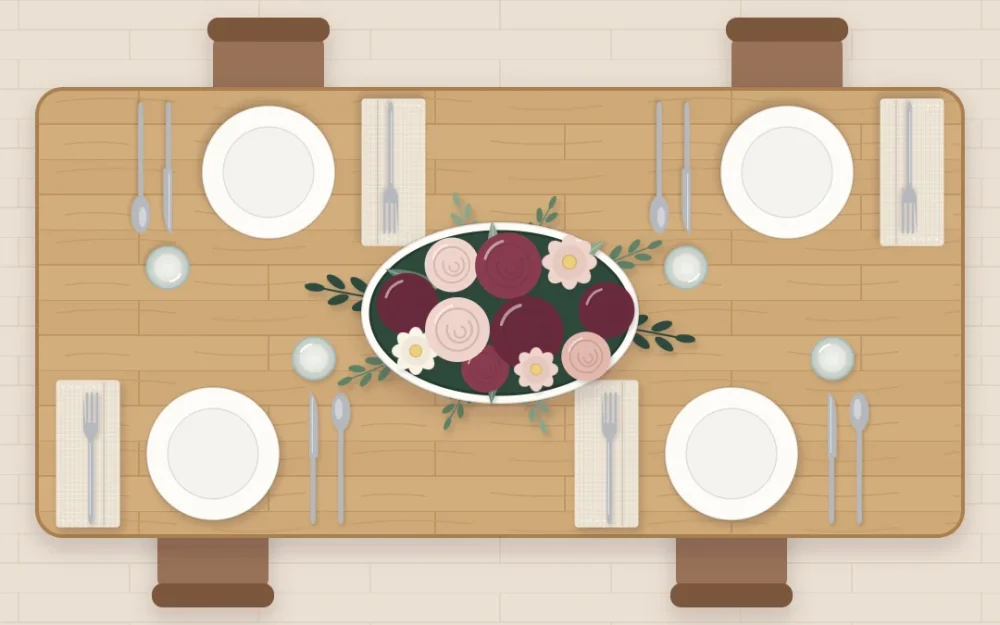
You set out the good plates, a vase, a few small objects and a patterned runner, and the table still looks scattered. Nothing is wrong with any single piece. The trouble is that they all ask for attention at the same volume, so the eye skips around and never settles.
What is missing is a focal point on a table: one thing that is clearly in charge, with everything else arranged to support it. The fixes below start with spotting the problem and end with a quick test you can run in a few seconds.
Signs your table has no focal point, or too many
- Your eye moves from object to object and does not stop anywhere.
- Small things are spread evenly across the whole surface.
- Two or three items are equally bold: a bright runner, strong plates and a large arrangement.
- The table looks busy from the doorway although there is not much on it.
- You keep adding things, and it keeps getting worse.
Each of these has the same cure. A table needs exactly one main focal point. With none, it looks unfinished. With two, they compete and the table feels restless.
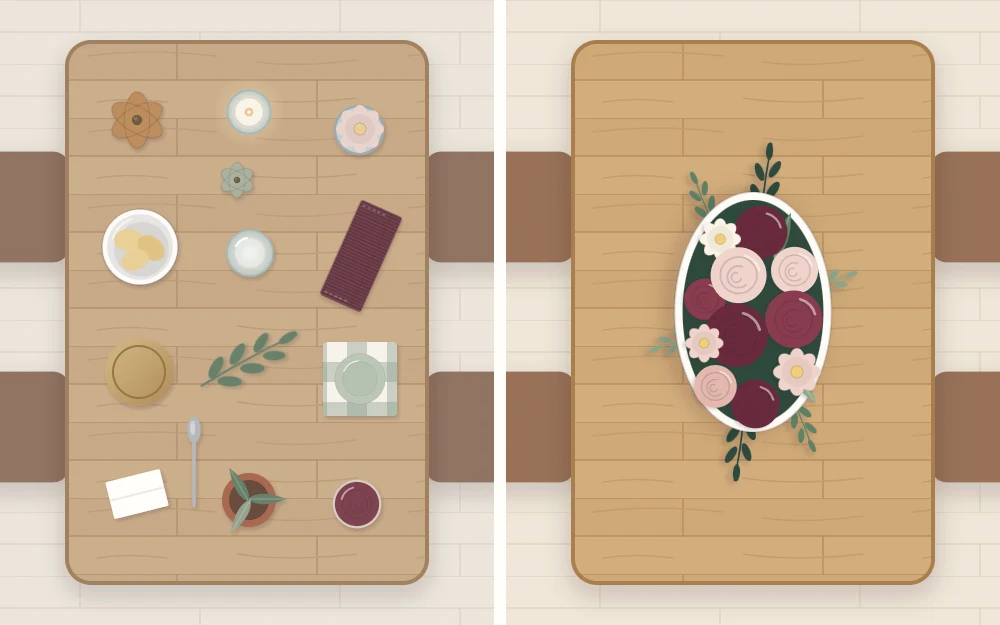
Fix 1: Choose the one thing that leads
Look at what is on the table and decide which single element deserves the attention. There are four usual candidates.
- A centerpiece. The most common choice, and the easiest to control. It does not need to be elaborate; these simple centerpieces built from household pieces are all strong enough to lead.
- A bold runner. A strong stripe or pattern down the middle can be the star, provided whatever sits on it is plain and low.
- A striking set of plates. When the dishes are the best-looking thing you own, let the places lead and keep the center very quiet: a single low bowl, or a few stems.
- A cluster of light. After dark, a group of flameless LED candles or a small battery lamp draws the eye more strongly than color does.
Pick one. The others are not banned from the table, but from here on they play a supporting part.
Fix 2: Turn everything else down
A focal point stands out only by comparison. Making it bigger or brighter is one way to get there; quieting the things around it is usually faster.
- Quieter colors. Keep the surroundings in neutrals or in paler shades of the focal color. If the centerpiece is deep red, blush or cream napkins support it while bright blue ones argue with it.
- Simpler shapes. Plain folds for the napkins, plain glasses, no extra ornaments at each place.
- More empty surface. Clear table around the focal point works like a frame. Fill that space and the frame disappears.
If a sparse table makes you uneasy, the guide to minimal table styling shows how little a table needs to look complete.
Fix 3: Use height or contrast once
The eye goes first to whatever is tallest, brightest, darkest or most different from its surroundings. That is useful, as long as you spend it once.
If the centerpiece is the only tall thing on the table, it leads without effort. Add tall glasses at every place and a stack of plates at each seat, and height stops meaning anything. The same goes for contrast: one dark object on a pale table is a focal point, while five dark objects are a pattern.
Good to know
If you use height, keep it stable. A tall vase, riser or stand should sit level, should not rock when the table is nudged, and should stay well away from the edge. Test it before guests arrive, and check that people can still see past it from their chairs.
Fix 4: Lead the eye toward it
Repetition works like a set of arrows. When the color of the focal point shows up again in small amounts, in a napkin, a ribbon or a small dish, the eye follows those echoes back to the source. Keep the echoes smaller and quieter than the main event, or they turn into rivals.
Lines do the same job. A runner points along the table toward whatever sits at its center.
Fix 5: Put it where the table shape wants it
- Rectangular and oval tables. The center of the long axis is the natural spot. A long, low arrangement can stretch along that line, but it should still have one fullest point in the middle so the eye knows where to stop.
- Round tables. The exact center, with one compact arrangement. Every seat is the same distance from it, which is why a single middle piece works so well; see these round table decor ideas for shapes that suit a circle.
- Square tables. The center again, with a shape that looks good from all four sides.
When the focal point belongs off-center
The middle is not always the best position. Two situations call for something else.
A table against a wall. Nobody sits on the wall side, so a centered arrangement is half wasted. Move the focal point to the back, toward the wall, where it can be taller because no one needs to see over it. A framed picture or a board leaned on the table against the wall can serve as a backdrop.
A buffet or serving table. The dishes need the front and the middle. Place the focal point at the back or at one end, and make it tall and slim so it stays visible above the food without taking up serving space.
An off-center focal point needs balancing. Something smaller and lower toward the other end, such as a stack of plates or a single small vase, keeps the table from looking as though it tips to one side.
The step-back test
- Walk to the doorway, or as far from the table as the room allows.
- Squint until the details blur into shapes and patches of color.
- Notice where your eye lands first. That is your real focal point, whatever you intended.
- Notice where it goes second.
If the first landing spot is the thing you chose, the table is working. If it is something else, such as a bright napkin or a shiny object near the edge, tone that item down or move it.
Tip
When the table still looks scattered, find the second most eye-catching thing and take it away. Removing the runner-up is nearly always more effective than strengthening the winner.
Frequently asked questions
Does a focal point have to be in the center of the table?
No. The center suits tables with seats all the way around, but a table pushed against a wall or used as a buffet often looks better with the main piece toward the back or at one end. Balance it with something smaller and lower on the opposite side so the table does not look lopsided.
Can a table have more than one focal point?
One main focal point is easiest to read. A very long table can carry smaller repeats of the main arrangement toward each end, as long as they are clearly lesser versions of the same idea. Two different bold features of equal strength tend to compete and make the table feel restless.
What if my plates are the boldest thing on the table?
Then let the plates be the focal point. Keep the middle of the table low and plain, with a single bowl or a few stems in a color taken from the plate pattern, and use plain napkins and a neutral base layer. The places lead and the center supports them.