Long Table Decor Ideas: Carrying Decoration Down the Whole Length
One centerpiece looks lost on a long table. Use repetition, a continuous line or an alternating pattern to decorate the full length, while keeping it low, narrow and open for serving dishes.
Put one centerpiece in the middle of a table that seats ten and the people at the ends are looking at bare wood. The arrangement that filled a table for four now looks like a small island a long way off.
Long table decor works on a different principle. Instead of one center, the table needs rhythm: something that repeats or continues from one end to the other, so every seat has a share of the decoration. There are three reliable ways to build that rhythm, and a few practical details that keep it usable once the dishes come out.
Three ways to carry decoration down the length
1. Repeat one small group
Make a small centerpiece group, then make it again. Three identical groups down the center line is a good starting number for a table seating eight to ten; a longer table can take five. Odd numbers put one group in the exact middle, which keeps the line anchored.
Each group can be very simple: a bud vase, a flameless candle in a glass holder and a small bowl on a round mat. What matters is that the groups match and the gaps between them are equal. Measure by eye from the middle group outward, and leave the last gap before each end of the table a little shorter than the gaps between groups.
2. Run one continuous line
A single unbroken element pulls a long table together faster than anything else. The options, from plainest to fullest:
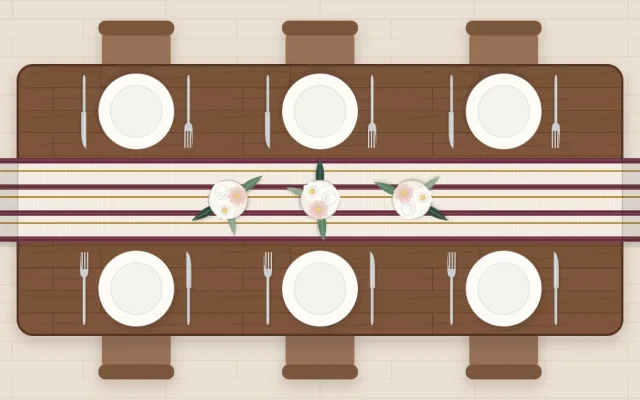
- A runner. One long runner, or two overlapped at the middle under a centerpiece, gives the eye a path to follow. The guide to using a table runner covers overhang and joining two lengths.
- A row of bud vases. One or two stems each, spaced a hand’s width or so apart. Mixed vase shapes in one color of glass look collected rather than mismatched.
- A garland. A loose line of foliage laid flat down the center. Keep it narrow and let it wander slightly instead of running ruler-straight. The greenery centerpiece guide explains which stems last out of water.
3. Alternate two elements
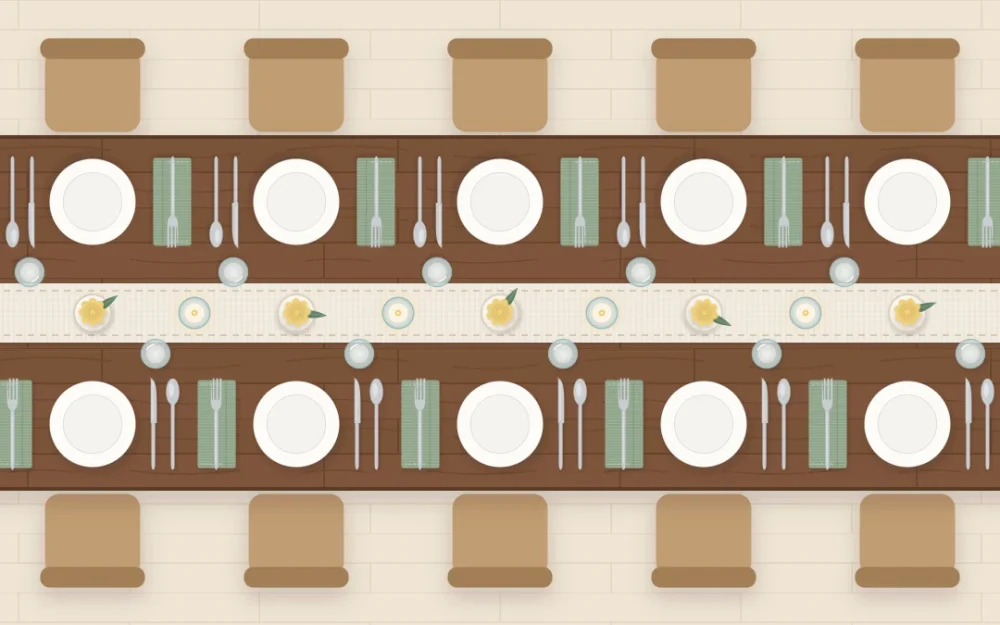
Choose two things and repeat them in turn: vase, light, vase, light. The pattern reads clearly even from the far end, and it is easy to extend when you add a leaf to the table. Keep to two elements. A third makes the sequence hard to follow and the line starts to look random.
Vary height a little between the two, such as a slim vase beside a low glass holder, so the line has a gentle up-and-down rather than a flat row.
Good to know
A long line of decoration almost always includes fabric, foliage or paper, and guests reach across it all evening. Use flameless LED candles, battery or rechargeable, for every light on a long table.
Keep it low and narrow
A long table is often not a wide one, and the center strip has to share space with serving dishes, bread baskets and bottles. As a rule of thumb, keep the decorated strip to about a third of the table’s width, and narrower still on a slim table. On a table roughly 36 in (90 cm) wide, that suggests a line around 12 in (30 cm) across.
Low matters just as much. People at a long table talk across it and diagonally along it, so anything in the center should sit below eye level for a seated guest. If you want one taller piece, use a slim one, check that it stands stable and level, and keep it on the center line well away from the table edge.
Leave gaps for dishes on purpose
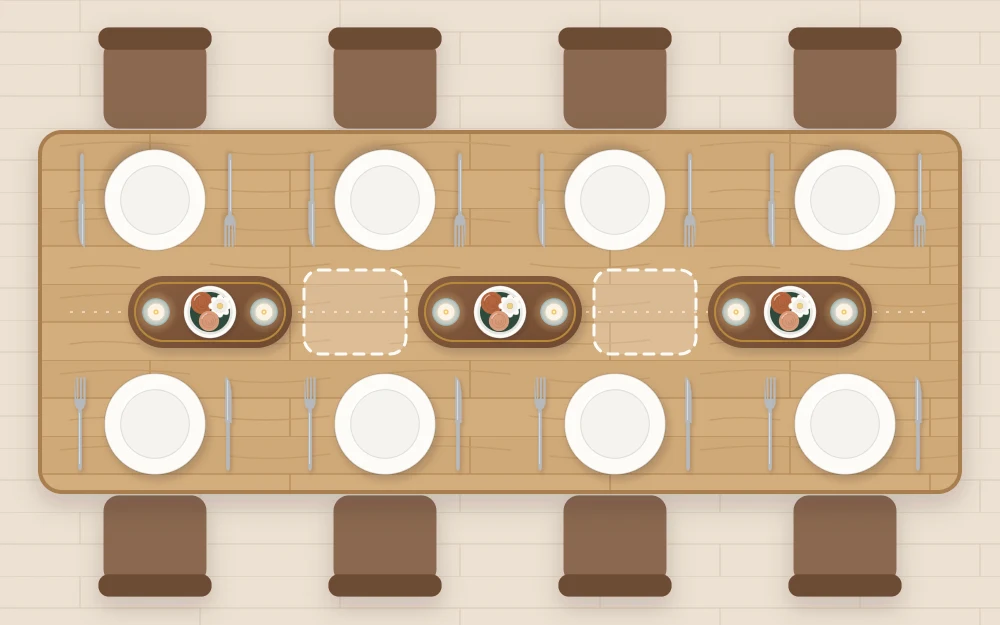
The most common mistake is a beautiful, unbroken line with nowhere to put a platter. Decide before you decorate where the serving dishes will land, then build around those spots.
- Set out the empty serving dishes, or plates standing in for them, along the center.
- Decorate the spaces between them.
- Lift the stand-ins away. The gaps left behind are your landing zones.
With repeated groups, the gaps are built in. With a garland or a row of vases, break the line in two or three places, or thin it to a single trailing stem that a dish can sit beside.
Match both sides
A long table is seen along its length, like a corridor, so small differences from seat to seat show up clearly. Use the same plate, napkin fold and glass at every place, and set each one directly opposite its partner across the table.
A quick way to line things up: set one long side first, then stand at the end of the table and place the opposite settings by sighting across. Keep every plate the same distance from the edge, about 1 in (2.5 cm) as a common starting point.
If you do not have enough matching pieces, alternate two sets in a regular pattern rather than using one set at each end. An alternating pattern looks planned; a change halfway down looks like you ran out.
Finish the ends of the table
The ends are where a line of decoration either stops neatly or just trails off. Three ways to finish it:
- End the line with the same element at both ends, so it has a clear start and stop.
- Let a runner hang over each end by an equal amount.
- If someone sits at the head, stop the decoration short of that setting so the place has elbow room.
When nobody sits at the ends, that space is useful for a water jug or a stack of extra napkins, which keeps the center clearer.
Joining two tables under one cloth
Two tables pushed together make a long one, provided the join disappears. Check first that both are the same height and sit steadily against each other, because a step in the surface will tip a vase.
Then hide the seam. One cloth long enough to cover both is the simplest answer. Two cloths also work if they overlap at the join and a runner lies over the overlap. Place a centerpiece group near the seam rather than directly on it, where the surface may be slightly uneven.
For a celebration where the long table also has to handle drinks, gifts and a crowd on its feet, the party table decor ideas cover planning the table around how guests will use it.
Frequently asked questions
How many centerpieces does a long table need?
Three matching groups is a good starting point for a table seating eight to ten, and five suits a longer one. Odd numbers place one group in the exact middle. Space them evenly and leave open gaps between them so serving dishes have somewhere to go.
How wide should decorations be on a long table?
As a rule of thumb, keep the decorated strip to about a third of the table's width, and narrower on a slim table. Lay out your place settings first, then check that a serving dish still fits between the decoration and the plates on each side.
Can I use candles down the middle of a long table?
Lights look lovely repeated down a long table, but choose flameless LED candles. A long line of decoration usually includes a fabric runner, foliage or paper, and guests reach across the center all evening, so battery or rechargeable lights are the practical choice here.