Party Table Decor Ideas: Plan a Table Guests Can Actually Use
Plan a party table around the job it has to do, then decorate it with one color story, one statement element and repeated small touches that still work once guests arrive.
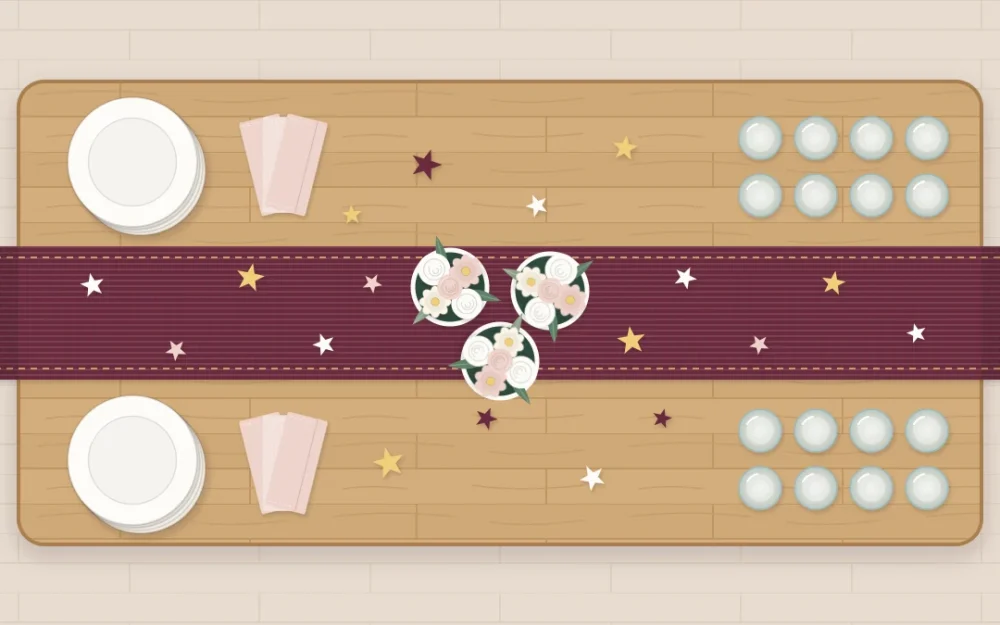
A party table usually looks its best about ten minutes before anyone arrives. Then people put down glasses, reach across the flowers, lean on the edge and move the napkins, and decoration that was planned for looking at starts getting in the way.
The party table decor that holds up is planned the other way around: first what the table has to do, then what goes on it. Decide that one thing early and most of the styling choices make themselves.
Decide the table’s job first
A party table generally does one of four jobs, and each one leaves a different amount of room for decoration in a different place.
| The table’s job | Where decoration goes | What to keep clear |
|---|---|---|
| Seated meal | Low, down the center | Sightlines and room for serving dishes |
| Grazing or self-serve table | At the back, or in the center if reached from both sides | The whole front edge |
| Drinks station | One back corner | A wide zone for glasses and pouring |
| Dessert table | Behind and beside the main stand | The center spot for the cake or main dish |
If one table has to do two jobs, split it down the middle and treat each half separately rather than mixing them. For a self-serve setup, the buffet table styling guide covers heights and the direction guests move in. A seated table for a crowd follows the rhythm described in the long table decor ideas.
Choose one color story
Parties tempt you to use every color in the drawer. A table looks more festive, not less, when it sticks to a small palette: one main color, one supporting color and a neutral. Wine, blush and ivory. Navy, mustard and white. Green, gold and natural linen.
Use the main color in the largest piece, usually the cloth or runner, then repeat it in at least two smaller places. The table color palette ideas show how to pick colors that sit well together and how much of each to use.
Pick one statement element
One strong feature is easier to arrange, easier to work around and easier to remember than five medium ones. Choose a single statement:
- A centerpiece. A cluster of three vases of different heights, or one generous low arrangement.
- A bold cloth. A deep color, a wide stripe or a strong pattern. With this, keep everything on top plain.
- A backdrop. For a table against a wall, lean or stand something behind it: a row of paper fans propped on the table’s back edge, a large framed print, tall branches in a heavy vase. Nothing needs fixing to the wall.
Whichever you choose, the other two stay quiet. A bold cloth with a large centerpiece and a backdrop is three statements shouting at once.
Add small touches that repeat
The statement draws people in. Small repeated details make the table feel finished. Pick one or two and use them several times:
- Ribbon in the main color tied around each napkin or each stack of napkins
- Small paper stars or circles scattered loosely near the center
- A sprig of greenery on each plate or tucked into each napkin tie
- Matching bud vases, one at each end of the table
Repetition is what separates a decorated table from a table with things on it. Three of the same detail look planned; three different details look like leftovers.
Put height where hands do not reach
Guests reach from the edge inward. So the edge stays low, and anything tall goes where arms are not passing: at the back of a table against a wall, or in the center of a table people walk around.
Tall vases, cake stands and risers should be stable, level and tested with a gentle push before guests arrive. Keep anything top-heavy well back from the table edge, and away from the corner where people turn.
Tip
Do a reach test. Stand where a guest will stand and reach for the farthest plate or glass. Anything your sleeve brushes on the way needs to move back or come off the table.
Mark clear zones for plates and glasses
People follow visual cues without thinking about them. Give plates one clear home, usually a stack at one end, and glasses another, in rows at the opposite end. Leave empty space beside each. An empty patch of table tells guests where to put something down, and it stops them from making room by pushing your decorations aside.
Napkins and flatware go where they will be picked up last, so nobody is juggling them while reaching for anything else.
Choose decor that survives being bumped
A party table gets knocked. Plan for it:
- Low and wide beats tall and narrow. A squat vase with a broad base stays put when the table is jostled.
- Short stems over long ones. Flowers cut low sit firmly in the vase and do not catch on sleeves.
- Weight at the bottom. A few clean pebbles in the base of a light vase help it stand firm.
- Fewer loose pieces. Scattered paper shapes are fine in the center; near the edge they stick to plates and end up on the floor. With young children at the party, skip beads, confetti and other tiny loose items.
Good to know
Use flameless LED candles on a party table. Guests reach across in a crowd, and paper fans, ribbon and napkins all burn easily, so battery or rechargeable lights are the right choice wherever paper decorations are used.
A quick plan for before, during and after
- The day before: lay the cloth, place the statement element and set out the empty serving pieces to check that everything fits.
- An hour before: add flowers, small touches and the plate and glass stacks. Switch on the flameless lights and do the reach test.
- During: walk past now and then. Straighten the napkin stack, remove empty glasses and move back anything that has drifted toward the edge.
- After: lift the centerpiece off first, gather the reusable pieces such as ribbon, paper fans and cloth napkins, and store them flat together for next time.
The same approach works for any celebration. For one built around a guest of honor, the birthday table decor ideas add the personal details.
Frequently asked questions
How do you decorate a party table without it getting in the way?
Decide what the table is for first, then keep decoration out of the reach path. Low pieces go near the edges, taller ones at the back or center, and plates and glasses each get a clear zone with empty space beside them for setting things down.
How many colors should a party table have?
Two colors plus a neutral is a comfortable starting point: a main color for the largest piece such as the cloth or runner, a supporting color for accents, and ivory, white or natural linen to calm it down. Repeat the main color in at least two smaller places.
What can I use as a party table backdrop without putting holes in the wall?
Lean or stand the backdrop instead of hanging it. Paper fans propped along the back edge of the table, a large framed print resting against the wall or tall branches in a heavy, stable vase all give height behind the table with nothing fixed in place.

