Greenery Table Centerpiece Ideas: Styling With Leaves and Branches
Four ways to make a centerpiece from leaves alone: a loose garland, stems in bottles, one big branch or potted plants on a tray, plus how to build, refresh and light it.
At a glance
- Difficulty
- Easy
- Time
- About 15 to 25 minutes
- Best for
- Dinners at a long table and relaxed gatherings in any season
- Table type
- Rectangular tables seating six or more; bottles or a tray for small tables
What you need
- Leafy stems in two or three shapes
- Sharp scissors or snips
- Bucket of cool water
- Runner or paper strip
- Flameless LED candles in glass holders
- Small bottles or bud vases (optional)
Flowers ask for decisions: which colors, how many, what goes with what. Leaves ask for almost none. A greenery table centerpiece works because it gives you shape and one calm color, and green sits comfortably beside any plate, napkin or tabletop you already have.
It also lasts. Most cut foliage holds up longer than blooms, potted plants keep going for months, and nothing wilts halfway through dinner. Below are four forms to choose from, how to build the most popular one, and how to light it.
Pick one of four forms
A loose garland down the center
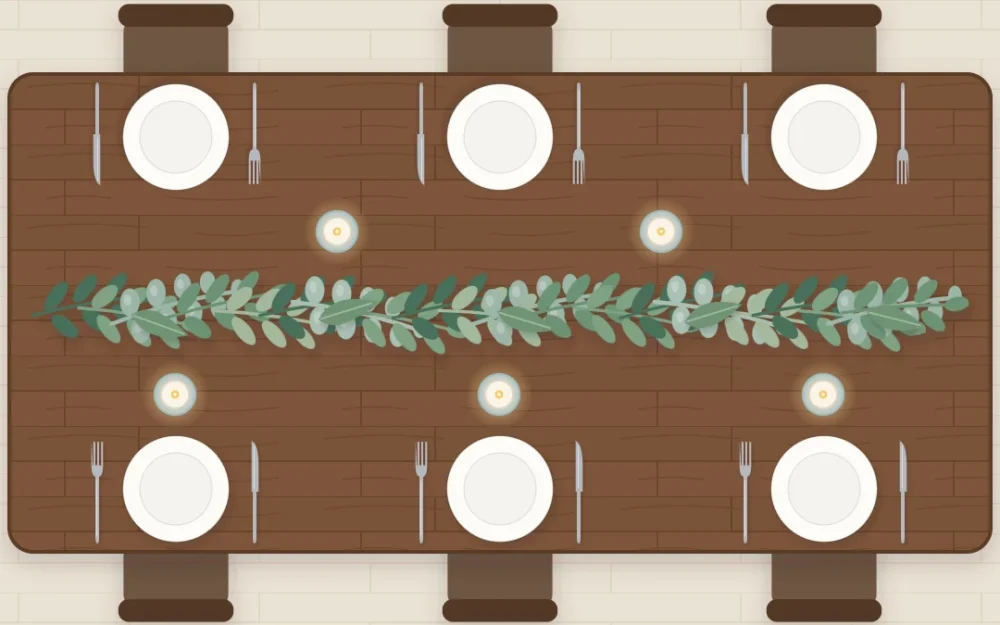
Leafy stems laid end to end along the middle of the table, flat and relaxed, with no vase at all. This is the natural choice for a rectangular table because it follows the table’s length and stays well below eye level. It pairs with most other ways to decorate a long table, since it leaves the place settings alone.
Single stems in a row of bottles
Three, five or seven small bottles or bud vases, each holding one leafy stem. Line them up along the center or stagger them slightly. The glass and the gaps between the bottles do half the work, so this is the form that needs the least foliage. Keep the stems short enough to talk over.
One large branch in a heavy pitcher
A single branch with good lines, standing in a stoneware pitcher or jug. It is tall, so it suits a sideboard, a buffet or the end of a table more than the middle of a dinner for six. Choose a container that is clearly heavier than the branch, set it on a level spot away from the table edge and nudge it before guests arrive. If it rocks, cut the branch shorter.
Potted plants grouped on a tray
Three small pots of herbs or leafy plants on a tray make a centerpiece that lifts off in one move. Mix heights and leaf shapes: one upright, one bushy, one trailing. Slip plain pots inside matching covers, or wrap them in linen, and put a saucer under each so water never reaches the tabletop. Here the herbs are decoration only.
How to build a loose garland
- Lay a runner or a strip of paper down the table first if you want to protect the surface from damp stems.
- Sort the foliage into long stems and short pieces. You need roughly enough long stems to cover the table’s length twice.
- Start at one end. Lay the first stem with its tip pointing toward the end of the table.
- Lay the next stem over it so its leaves cover the cut end of the first. Keep every stem pointing the same way, like shingles.
- At the middle of the table, stop. Go to the other end and repeat, working back toward the center, so both tips point outward.
- Cover the join in the middle with a cluster of short pieces, then fill any thin spots.
Nothing is wired or tied, which is why it looks relaxed. Aim for a band about 8 to 10 in (20 to 25 cm) wide on a standard dining table, as a starting point, and let a few tips wander past it. Mixing two or three leaf shapes, such as one round, one long and narrow, one feathery, gives more depth than a single kind.
Cut, potted or artificial?
| Type | Best for | Keep in mind |
|---|---|---|
| Cut foliage | Garlands, bottles, branches for one occasion | Looks its best for a day or two out of water, longer in it |
| Potted plants | An everyday table | Needs light and watering; move it to a window between meals |
| Artificial stems | A centerpiece you reuse all year | Choose good-quality stems with matte leaves and varied greens; dust them now and then |
Mixing is fine. A few fresh stems laid over an artificial garland is a quick way to make the whole thing look alive.
Keep cut greenery fresh for the day
Foliage laid flat on a table has no water, so timing matters more than technique. Re-cut the stems when you bring them home and stand them in a bucket of cool water for a few hours or overnight. Build the garland as close to the meal as you reasonably can, in a room that is not too warm, and keep it out of direct sun until guests arrive.
Sturdy, leathery leaves hold their shape far longer than soft, thin ones. If a soft variety is what you have, use it in bottles of water instead of in a garland.
Tip
If pets or young children may reach the table, check each specific plant before you use it, whether it is cut or potted.
Add one accent, and only one
Greenery is calm, and a single addition keeps it that way:
- White flowers. A few small white blooms laid into a garland or added to every other bottle. If you want more than a few, you are really making a low flower arrangement in a vase.
- Whole fruit. Lemons, pears or green apples, kept in their peel and spaced along the leaves for color and shape.
- Flameless lights. Small LED candles in glass holders, or a battery string light threaded loosely along the garland.
Choose the accent to match the season. Citrus and white flowers read as spring and summer. Evergreen sprigs and pine cones turn the same garland into the base of a winter table.
Light it with flameless candles only
Cut greenery dries out as the evening goes on, and dry leaves burn easily. For that reason every greenery centerpiece on this site is lit with flameless LED candles or battery lights, and nothing with a flame goes on the same table.
Candle safety
Fresh, dried and artificial greenery are all flammable. Use flameless LED candles with a garland, branches or potted plants, and leave anything with a flame off the table altogether.
Flameless candles look most convincing in warm white, inside clear glass holders, spaced evenly along the leaves. Switch them on before guests sit down and the table glows without anyone having to watch it.
Common problems and quick fixes
- The garland looks thin. Add short pieces at an angle across the main line instead of more long stems.
- It looks like a hedge. Pull out a third of it. Gaps where the table shows through are part of the look.
- Leaves are in the plates. Narrow the band and trim the side shoots that reach toward the settings.
- Bottles look scattered. Move them closer together or stand them on a runner so they read as one group.
Frequently asked questions
How much greenery do I need for a table garland?
A rough starting point is enough long stems to cover the length of the table twice, because the stems overlap like shingles, plus a handful of short pieces for the middle and any thin spots. It is easier to buy a little extra and put leftovers in a bottle of water.
Can I use real candles with a greenery centerpiece?
This site recommends flameless LED candles only whenever greenery is on the table. Fresh leaves dry out over an evening, and dried and artificial foliage are flammable too. Warm white flameless candles inside glass holders give a similar glow, and nobody has to watch them during the meal.
How far ahead can I make a greenery centerpiece?
Stems standing in water, such as bottles or a branch in a pitcher, can be set up a day ahead. A garland laid flat has no water, so condition the stems in a bucket beforehand and build it on the day, as close to the meal as is practical.