How to Arrange Flowers in a Vase for a Low Table Centerpiece
Turn one bunch of store flowers into a low, rounded arrangement that looks finished from every seat, using a wide vase, a tape grid and three simple layers.
At a glance
- Difficulty
- Easy
- Time
- About 20 to 30 minutes
- Best for
- Sit-down dinners, weekend lunches and everyday dining tables
- Table type
- Round or rectangular dining tables seating four to eight
What you need
- One mixed bunch of flowers with greenery
- Low, wide vase or bowl
- Narrow clear tape
- Sharp scissors or floral snips
- Cool, clean water
- Towel to work on
A bunch of store flowers dropped straight into a tall vase tends to do two things on a dining table: it splays into a ring with a hole in the middle, and it hides the person sitting opposite. A good flower centerpiece for a table you eat at is low, rounded and finished on every side, because nobody at the table is looking at a “front”.
The method below works with one mixed bunch, or two small ones, and a vase you probably already own. It rests on three things: choosing the vase first, a grid of tape that holds stems where you put them, and building in layers instead of adding stems at random.
Choose the vase before you touch the flowers
The vase sets the height of the whole arrangement. As a loose guide, flowers end up about one and a half times as tall as the container holding them, so a tall vase forces a tall arrangement. For a table people talk across, start with a low, wide vase or a bowl roughly 4 to 6 in (10 to 15 cm) tall, with a mouth about as wide as the vase is high.
A wide mouth lets stems lean outward, and that lean is what makes the rounded shape. An opaque ceramic or stoneware vase hides the stems and the tape. Clear glass shows everything, so use it only if you are happy to keep the water spotless. Whatever you pick, it should have a broad, flat base that sits level and stays put when the stems on one side are heavier than the other.
What to gather
- One mixed bunch that includes some greenery, or a bunch of flowers plus a few leafy stems
- A low, wide vase, washed and rinsed
- Narrow clear tape
- Sharp scissors or floral snips
- Cool, clean water and a towel to work on
Tip
For a table where people eat, lightly scented flowers are usually the easier choice. A strong perfume competes with the meal. This is a matter of taste, so follow your own nose.
Sort and condition the stems
- Unwrap the bunch and sort it into three piles on the towel: greenery, the largest flowers, and the small flowers and airy stems.
- Strip every leaf that would sit below the water line. Leaves left under water break down and cloud it quickly.
- Fill the vase about two-thirds full with cool, clean water.
- Cut each stem at an angle just before it goes in. A fresh cut takes up water more easily, and the angle keeps the end from sitting flat against the bottom of the vase.
Do not cut everything to one length in advance. You will trim each stem to fit its spot as you go, and it is easier to shorten a stem than to wish it longer.
Tape a grid across the mouth
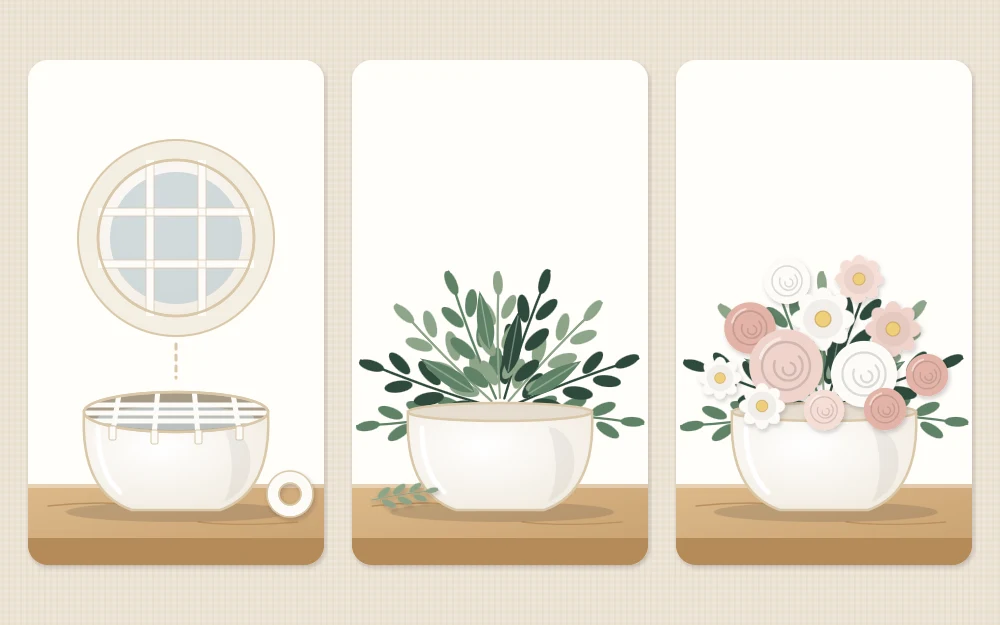
In a wide vase, stems slide to the rim and leave the middle empty. A tape grid fixes that. Dry the rim well, then stretch three or four strips of narrow clear tape across the mouth in one direction and three or four across them, leaving openings about a finger wide. Run one last strip around the outside of the rim, over the ends, to hold them down.
Each opening now holds one or two stems at the angle you choose. Upright stems go in the middle openings, leaning stems in the outer ones.
Build the arrangement in three layers
Greenery sets the shape
Start with the leafy stems. Place them in the outer openings, angled outward so the leaves rest just over the rim and cover the tape. Add a few shorter pieces to the middle. You are drawing the outline: a low dome that is wider than the vase and not much taller above the rim than the vase is high. If you find you like this stage enough to stop here, a centerpiece made from leaves and branches alone is a style in its own right.
The largest flowers go low and off-center
Cut the biggest blooms short so their heads sit just above the greenery. Set three or five of them in a loose triangle around the vase, with one a little off-center instead of dead in the middle. Large flowers placed low give the arrangement weight. Placed high, they wobble and look as if they are about to fall out.
Small flowers and airy stems fill the gaps
Tuck the smaller flowers into the spaces, cut slightly longer than the large ones so they sit a little proud of them. Finish with a few fine, airy stems that reach just past the outline. They loosen the edge and stop the arrangement from looking like a tight ball.
Turn the vase as you work
After every three or four stems, give the vase a quarter turn. It is the single habit that separates an arrangement with a bald back from one that reads well from every chair. If the same color keeps landing on one side, move a stem across.
When you think you are finished, carry the vase to the table, sit down in a dining chair and look at it from seat height. Then move to another chair. Gaps and flat spots that were invisible from above show up at once, and one or two extra stems usually solve them.
Check the finished height and size
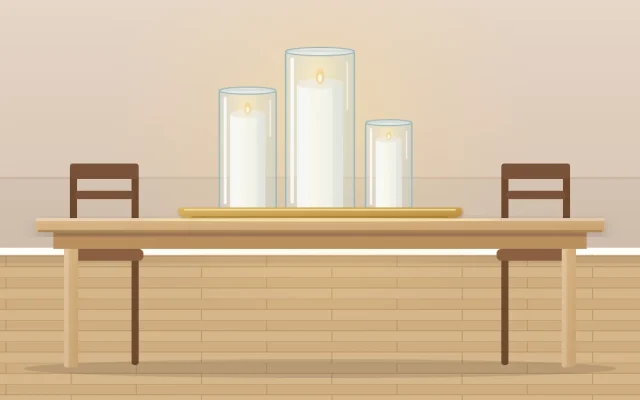
A common rule of thumb is to keep the vase and flowers together at about 12 in (30 cm) or under. The simpler test is to sit down: you should see the face opposite without leaning. If one stem pokes into the sight line, pull it out, cut it shorter and put it back.
Width matters as well. An arrangement about a third as wide as the table is a reasonable starting point, and it should leave room for serving dishes on both sides. On a long table, one vase can look lost. Repeat the arrangement in two or three smaller vases, or borrow from these simple centerpiece ideas to fill the length.
Keep it looking fresh
Top up the water daily and replace it every couple of days by tilting the vase gently over the sink and refilling through the grid. Pull out any bloom that fades, and keep the vase out of direct sun and away from heaters. Greenery often outlasts the flowers, so when the blooms are done, re-cut the leafy stems and move them to a smaller vase.
Which flowers you start with changes through the year, and a spring table is the easiest season to practice on because bunches are plentiful and soft in color. One caution: if pets or young children might chew leaves or petals, check each specific plant before you bring it to the table.
Frequently asked questions
How tall should a flower centerpiece be on a dining table?
A common starting point is to keep the vase and flowers together at roughly 12 inches or under, but the practical test is better: sit in a dining chair and check that you can see the person opposite without leaning. If a stem rises into the sight line, shorten it.
Can I use something other than tape to hold the stems?
Yes. The stems themselves can do the job: cross the first leafy stems in the vase so they form a loose lattice, then slide flowers into the gaps. A ball of crumpled wire mesh sold for arranging also works. Tape is simply the quickest option for a wide mouth.
How many flowers do I need for a low vase arrangement?
For a vase about as wide as a small bowl, one generous mixed bunch is usually enough: a handful of leafy stems, three or five large blooms and a few smaller flowers. A wider vase may need a second small bunch. More greenery is the easiest way to fill space.