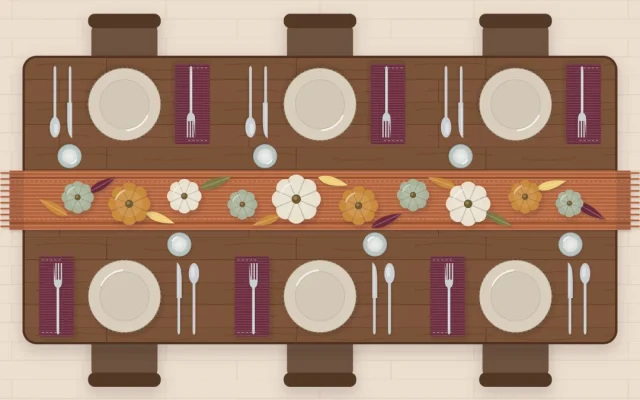
Spring Table Decor Ideas: Fresh, Light and Simple
Three easy swaps from your winter table, a pale palette with one fresh accent, small vases, potted bulbs and a simple spring table you can set step by step.

After months of heavy cloths and early dark, the table is one of the easiest places to mark the change of season. Good spring table decor does not ask for a new set of anything. It asks for more light, less weight and one clear sign of new growth.
The ideas below start with the smallest possible change, three swaps from the table you used all winter, and build up to a complete table you can set in order. Take as many or as few as suit the meal.
Start by swapping only three things
If your winter table is still out, you do not have to clear it and begin again. Three changes carry most of the season:
- The napkins. Put away the dark, heavy ones and bring out a lighter cotton or linen in a pale color. Napkins sit at every place, so this one swap repeats the new color all the way around the table.
- The centerpiece. Replace evergreens, pine cones and anything metallic with something that looks alive: a few flowers, a pot of bulbs or a pot of herbs.
- The runner. Trade a thick, dark runner for a thin pale one, or take the runner off and let the tabletop show.
Keep your usual plates, glasses and flatware. Against lighter fabric they will already look different.
Choose a pale palette with one fresh accent
Spring colors work best when most of the table is quiet. Use white, ivory or pale linen for the cloth and plates, then add a single accent and repeat it in two or three places.
- Soft green reads as new leaves and goes with nearly any plate.
- Blush is gentle and warm, and flatters wood tones.
- Butter yellow is the brightest of the three and suits a table that gets little daylight.
Pick one, not all three. A table with pale green napkins, green stems and nothing else colored looks calmer than one that tries to show the whole season at once. If you would like help deciding how much of each color to use, the guide to building a table color palette walks through it.
Use several small vases instead of one large one
A big mixed bouquet feels like a special occasion. A few small bunches feel like spring. Set three or five small vases, jars or bottles down the middle of the table and give each one only a handful of stems of the same flower.
Keep everything low, roughly 8 to 10 in (20 to 25 cm) from the tabletop to the top of the flowers, so people can see each other across the table. Vary the vase heights a little and leave gaps between them rather than pushing them into a tight cluster. Small vases are also easy to lift away when you need the space.
Tulips, daffodil-style flowers, ranunculus and simple white blossoms all suit this approach, and so do good faux stems. For conditioning stems and getting a bunch to sit well, see the method for arranging a flower centerpiece in a vase.
Tip
Choose lightly scented flowers for a table where people will be eating. A strong perfume competes with the meal, which is a matter of taste more than anything else.
Keep flowering branches slim
A branch in blossom is the most dramatic spring decoration, and the easiest to overdo. Two or three slender branches in a narrow-necked vase are enough. The vase should be heavy at the base, stand level and stay put when you nudge the table; test it before anyone sits down.
Tall branches belong at the middle of the table or on a sideboard, never close to the edge where an elbow can catch them. If the branches block the view when you sit, shorten them or move the vase to the end of the table and use small vases in the center.
Try a living centerpiece
Potted bulbs and herbs make a centerpiece that lasts well beyond one meal. Small pots of grape hyacinth-style bulbs, miniature daffodils, or herbs with soft green leaves all work. Slip each plastic nursery pot into a plain container: a terracotta pot, a white ceramic one or a small basket with a saucer inside to catch water.
Line up three matching pots, or group pots of different heights on a tray so you can move them in one go. Keep the containers simple and alike, and let the plants supply the variety. If young children or pets share your home, check each specific plant before you bring it to the table.
Add eggs and nests sparingly
Egg and nest shapes say spring at a glance, which is exactly why a little goes a long way. Choose one use and stop there:
- A shallow bowl of wooden or ceramic decorative eggs in one pale color.
- A single small twig nest at the center of the table, with two or three decorative eggs in it.
- One decorative egg resting on each folded napkin.
Natural, matte finishes look better than glossy bright ones. With young children at the table, skip very small loose pieces.
Set a simple spring table step by step
- Clear and lighten the base. Lay a pale cloth or a thin runner, or leave a wooden table bare and clean.
- Place the centerpiece first. Space three small vases or pots along the middle, leaving room between them for serving dishes.
- Set the plates. Use your everyday white or ivory plates, one at each seat.
- Add the accent napkins. Fold them simply and lay them on the plates or to the left, so the accent color shows at every place.
- Put out glasses and flatware. Clear glass keeps the table light; colored glass counts as a second accent, so use it only if it matches the first.
- Finish with one small detail. A few green leaves along the center, or a single stem laid across each napkin, is enough.
- Sit down and look. Check that you can see across the table and that nothing is in the way of reaching a glass.
Carry the table toward warmer days
A spring table changes easily as the weeks pass. Swap the blush or soft green for a stronger color, replace bulbs with leafy stems, and move the whole arrangement outside when the weather allows. When that time comes, these summer table ideas for indoor and outdoor meals pick up where this table leaves off.
Frequently asked questions
What colors work best for a spring table?
A quiet base of white, ivory or pale linen with one fresh accent works well. Soft green, blush and butter yellow are all good choices. Repeat the accent in two or three places, such as the napkins and the flowers, and leave the rest of the table neutral so it stays light.
Can I decorate a spring table without fresh flowers?
Yes. Small pots of herbs or bulbs, a few slim branches, good faux stems or a bowl of decorative wooden eggs all bring the season to the table. Lighter napkins and a thin pale runner do a lot of the work on their own, even with no centerpiece at all.
How tall should a spring centerpiece be?
As a rule of thumb, keep anything in the middle of the table low enough to see over when seated, roughly 8 to 10 inches from the tabletop. Taller pieces such as flowering branches are better at the end of the table or on a sideboard, in a heavy vase that stands level.