
The Ultimate Guide to Travel Friendly Camera Supports
Why Travel Friendly Camera Supports Are Essential for Better Shots
Travel friendly camera supports are the fastest way to go from blurry, frustrating shots to sharp, stunning images — especially for night skies, long exposures, and low-light scenes.
Here are the most popular types to know about:
- Ultra-compact tripods – Fold down small (some to just 12.6 inches), lightweight, great for landscapes and star photography
- Flexible/gorilla-style tripods – Wrap around poles or rocks, ideal for uneven terrain
- Tabletop tripods – Tiny and pocketable, perfect for street photography and tight spaces
- Monopods – One leg only, fast to deploy, great for hiking and wildlife
- Portable gimbals – Electronic stabilizers for smooth video while moving
- Multi-clamp kits – Attach to rails, fences, or car windows when tripods aren’t allowed
The right support depends on your travel style, camera weight, and the type of shots you want to capture.
Travel moves fast. A blurry long exposure or a shaky handheld shot at dusk can mean losing a moment you’ll never get back.
For beginner photographers chasing starry skies or silky waterfalls, camera shake is the enemy — and even the best in-body image stabilization (IBIS) has its limits. The OM System OM-3, for example, is impressive enough to shoot handheld at shutter speeds as slow as 1–4 seconds. But for true long exposures — think 30 seconds of stars streaking across the sky — you still need something solid to rest your camera on.
That’s where travel friendly supports come in. They don’t have to be heavy or bulky. Modern carbon fiber tripods can weigh under a kilogram. Some fold smaller than a water bottle. The challenge is knowing which one fits your kit, your bag, and your adventures.
This guide breaks it all down so you can stop guessing and start shooting sharper.
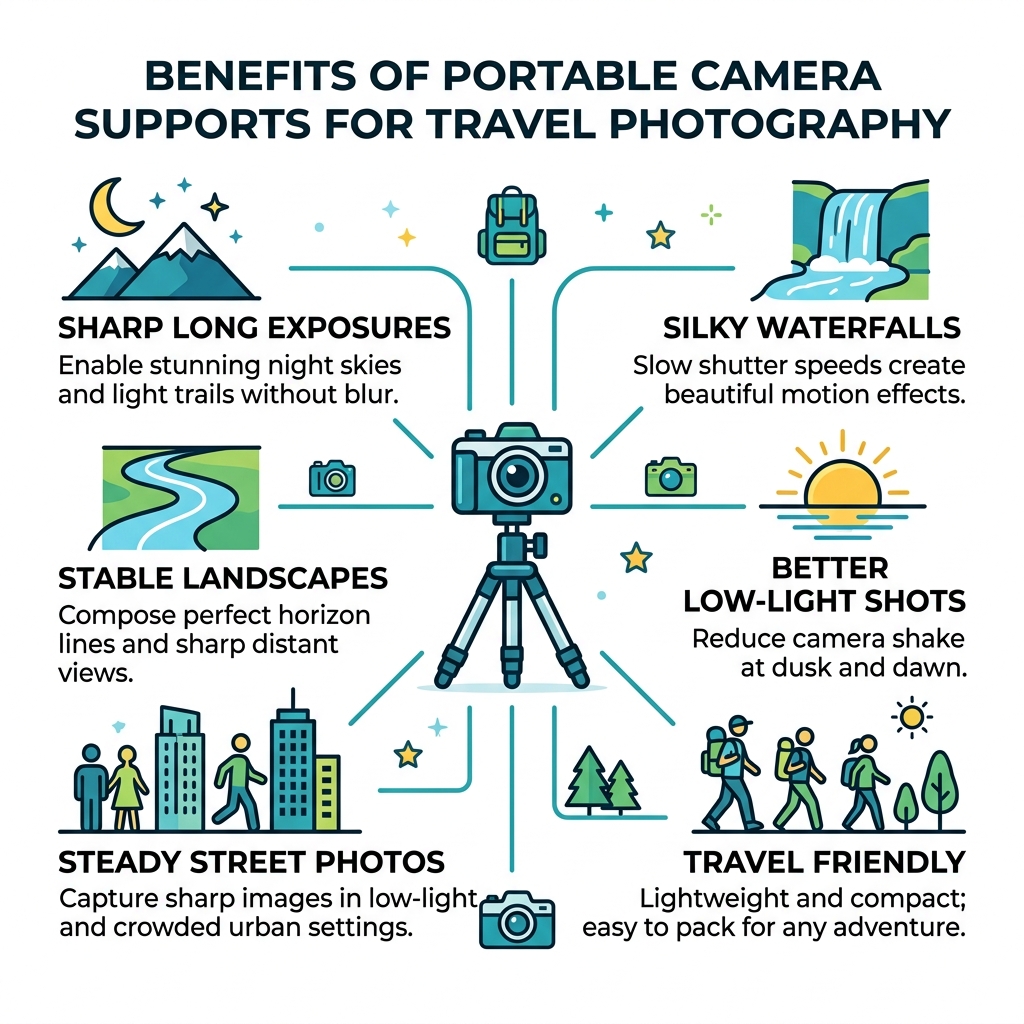
Essential Types of Travel Friendly Camera Supports
When we talk about travel friendly camera supports, we aren’t talking about the massive, heavy studio tripods of the past. Today’s gear is designed for the one-bag traveler, the hiker, and the street photographer who needs to stay mobile.

Ultra-Compact Tripods for Every Journey
The gold standard for stability remains the tripod, but for travel, the “folding length” is the most critical spec. A great example is the MeFoto BackPacker Tripod, which can fold down to a remarkably small 12.6 inches. When a tripod fits inside your backpack rather than strapped to the outside, you’re more likely to actually carry it with you.
Material choice is the next big decision. Carbon fiber is the darling of the travel world because it is incredibly lightweight and dampens vibrations better than metal. However, high-quality aluminum tripods are often more affordable and rugged for those who don’t mind a few extra ounces. Weight management is key; many pros aim for tripods under 3 pounds to stay within airline carry-on limits and avoid fatigue on long treks.
Portable Gimbals and Electronic Stabilizers
If you are more of a videographer or a vlogger, a static tripod might feel too restrictive. This is where electronic stabilizers come in. These handheld devices use brushless motors to counteract your hand movements, resulting in “cinematic” footage that looks like it was shot on a Hollywood rail system.
For mobile shooters, checking out the Best Smartphone Gimbals for Night Photography is a great starting point. These 3-axis stabilizers allow you to walk, pan, and tilt without the jittery “micro-shakes” that ruin digital video. Even for stills, a gimbal can act as a motorized head for panoramic shots or time-lapses.
Specialized and Flexible Mounts
Sometimes, a traditional three-legged stand isn’t allowed or practical. In busy city squares or historic cathedrals, security may ban tripods. In these cases, we look toward more discreet travel friendly camera supports:
- Flexible Mounts: These are the “octopuses” of the gear world. You can Bend It Like a Pro with These Flexible Camera Mounts by wrapping the legs around tree branches, railings, or even car side mirrors.
- Tabletop Supports: These tiny devices, like the RRS tabletop tripod, can support up to 15 lbs despite being pocket-sized. They are perfect for low-angle macro shots or resting on a cafe table.
- Multi-Clamp Kits: These are essentially industrial-strength clamps with a camera stud. They allow you to “mount” your camera to almost anything—a fence, a window ledge, or a signpost.
Key Factors: Balancing Portability and Stability
Choosing the right support is always a game of trade-offs. If a tripod is too light, the wind will knock it over. If it’s too heavy, it stays in the hotel room.
Balancing Portability and Stability in Travel Friendly Camera Supports
Stability isn’t just about weight; it’s about engineering. When looking at travel friendly camera supports, pay attention to the number of leg sections. A tripod with 5 sections folds smaller than one with 3, but those thinner bottom segments can be less stable in a breeze.
Height is another factor. If you are shooting the night sky, you need to know the Determining the Best Tripod Height for Astrophotography to ensure you aren’t constantly bending over, which leads to back pain and accidental bumps to the gear.
| Feature | Carbon Fiber | Aluminum |
|---|---|---|
| Weight | Ultralight (typically < 2.5 lbs) | Heavier (typically 3-5 lbs) |
| Vibration | Excellent damping | Moderate vibration |
| Durability | High (won’t corrode) | High (but can dent/scratch) |
| Price | Premium/Expensive | Budget-friendly |
| Temperature | Neutral to touch in cold | Gets very cold to the touch |
Practical Tips for Packing and Carrying Gear
We’ve all been there: standing at the airport gate wondering if security will classify our tripod as a “blunt instrument.” Generally, most compact tripods are allowed in carry-on luggage, but always check your specific airline’s length restrictions.
To make life easier on the road:
- Use Quick-Release Systems: Arca-Swiss compatible plates allow you to pop the camera on and off the support in seconds.
- Weight Distribution: If you must strap a tripod to your bag, place it centrally or on the side balanced by a heavy water bottle.
- Protective Pouches: Salt spray and sand are the enemies of tripod joints. Always use a protective bag or rinse your gear with fresh water after a beach shoot.
- Shoulder Straps: For short walks where you don’t want a backpack, a dedicated tripod strap can make a 3-lb support feel weightless.
Maximizing Image Quality in Low Light
The primary reason we carry travel friendly camera supports is to unlock creative possibilities that handheld shooting simply can’t touch.
Leveraging IBIS and Travel Friendly Camera Supports for Long Exposures
Modern cameras have incredible In-Body Image Stabilization (IBIS). The FUJIFILM X-H2 offers up to 7 stops of stabilization, which is mind-blowing. Similarly, the OM-5 Mark II features 7.5 stops of sync IS, allowing for handheld high-res shots (up to 80MP!) and “Live ND” modes that simulate long exposures without physical filters.
However, “simulated” isn’t always “perfect.” For crisp, professional-grade shots of the Milky Way or light trails, a physical support is non-negotiable. Even with the best IBIS, a 30-second exposure will always be sharper when the camera is physically locked down.
If you’re using a smartphone, you can Stop Shaking and Start Stargazing with These Phone Adapters. These adapters bridge the gap between your mobile device and a sturdy tripod head, ensuring your night mode shots aren’t ruined by a slight hand tremor.
Specialized Supports for Different Travel Styles
Your “travel style” should dictate your gear. We don’t recommend a heavy landscape tripod for someone doing street photography in Tokyo.
- Hiking/Backpacking: Prioritize weight above all else. A carbon fiber monopod can even double as a walking stick.
- Street Photography: Look for “discreet” supports. A small tabletop tripod or a wrist strap that helps you brace against a wall can be more effective than a full-sized stand.
- Landscape/Seascape: You need something that can handle wind and uneven ground. Look for tripods with spiked feet and a hook on the center column to hang your bag for extra weight/stability.
- Astro-Travelers: If your goal is the stars, you need specialized mounts. Check out The Best Portable Mounts for Phone Astrophotography for gear that can track the stars’ movement, preventing “star trails” and keeping your images pinpoint sharp.
Frequently Asked Questions about Travel Camera Gear
Can I take a tripod in my carry-on luggage?
Yes, in most cases. Most international and domestic airlines allow tripods in carry-on bags as long as they fit within the standard dimensions (usually under 22 inches). However, some specific countries or budget airlines have stricter “prohibited items” lists that occasionally flag large tripods as potential weapons. We recommend choosing a model like the MeFoto BackPacker that folds to 12.6 inches to avoid any scrutiny.
Is a monopod better than a tripod for hiking?
It depends on your goals. A monopod is lighter, faster to set up, and takes up less space on narrow trails. It’s great for stabilizing long telephoto lenses for wildlife. However, a monopod cannot stand on its own, meaning it is useless for long exposures (like waterfalls or stars) or self-portraits. For true versatility, many travel tripods now feature a “detachable leg” that converts into a monopod, giving you the best of both worlds.
Do I need a support if my camera has IBIS?
IBIS is a miracle of modern tech, but it isn’t magic. While an OM-5 Mark II can let you shoot a 1-second exposure handheld, it cannot help you with a 2-minute exposure of a star-filled sky. Furthermore, using a support allows you to keep your ISO low, resulting in much cleaner images with less digital noise. If you want the highest possible image quality, a support is always better than relying on stabilization alone.
Conclusion
At Pratos Delícia, we believe that the best gear is the gear that actually makes it into your bag. Investing in travel friendly camera supports isn’t just about buying a piece of hardware; it’s about buying the freedom to shoot in any lighting condition, from the dimmest cathedral to the darkest mountain peak.
Gear maintenance is vital—especially when traveling. A little bit of sand in a tripod leg can grind the gears and ruin an expensive support. Keep it clean, keep it light, and prioritize your own comfort so you can stay out longer and wait for that perfect light.
For more tips on building the perfect mobile kit, check out our more equipment guides and reviews. Happy shooting, and may your horizons always be level!
