
Why Flexible Arm Camera Mounts Belong in Every Creator’s Kit
Flexible arm camera mounts are adjustable arms that hold your camera, phone, or light at almost any angle — without the bulk of a traditional tripod.
Quick answer — best flexible arm camera mounts by use case:
| Use Case | Mount Type | Key Feature |
|---|---|---|
| Desk / streaming | Gooseneck clamp | 360° swivel, clamps to table |
| Pro video rigs | Articulating magic arm | Up to 11 lbs payload |
| Action cameras | Flex arm (short) | Lightweight, handlebar-ready |
| Overhead shots | Modular extension arm | Add/remove pole sections |
| On-the-go vlogging | Mini gooseneck tripod | Pocket-sized, universal thread |
Unlike a rigid tripod, a flexible arm bends, twists, and locks into position in three dimensions. That means you can shoot straight down, over your shoulder, or at a tight side angle — without repositioning your whole setup.
For night photographers especially, this matters. Long exposures demand a rock-solid, perfectly positioned camera. A flexible arm lets you dial in that exact angle over a desk, tripod plate, or car window — then lock it down tight.
Prices range from around $7 for basic action camera flex arms all the way to $100+ for professional articulating arms that hold heavy DSLRs without drift.
This guide walks you through the top picks, key features to look for, and how to choose the right one for your shooting style.

Understanding Different Flexible Arm Camera Mounts
When we talk about flexible arm camera mounts, we aren’t just talking about one specific tool. The world of flexible mounting is divided into three main “families,” each with its own strengths. Choosing the wrong one is the fastest way to end up with a sagging camera and a frustrated face.
Articulating Magic Arms
These are the heavy hitters of the mounting world. An articulating magic arm usually consists of two metal arm sections connected by a central elbow joint. The magic happens at that joint: when you loosen the central friction knob, every joint in the arm (including the ball heads at the ends) becomes loose. Once you find your angle, you tighten that one knob, and the whole thing locks into a rigid, unmoving shape.
A prime example is the Tilta Pro Articulating Arm – Black | Tilta , which is designed for professional rigs. These are prized for their high load capacity and “set it and forget it” stability.
Gooseneck Tubes
If you’ve ever used a desk lamp that you can twist into a spiral, you know what a gooseneck is. These are flexible metal tubes—often covered in plastic or silicone—that can be bent in any direction. They don’t have “joints” in the traditional sense; the entire length of the arm is the joint.
Products like the Gooseneck Mount For Camera | Flexible Arm are fantastic for webcams and lightweight lights because they allow for micro-adjustments without turning a single knob. For even more specialized reach, the Camera SnakeClamp Flexible Gooseneck Tube Arm Stand Mount … offers a variety of lengths to snake your camera into tight spots.
Modular Extension Poles
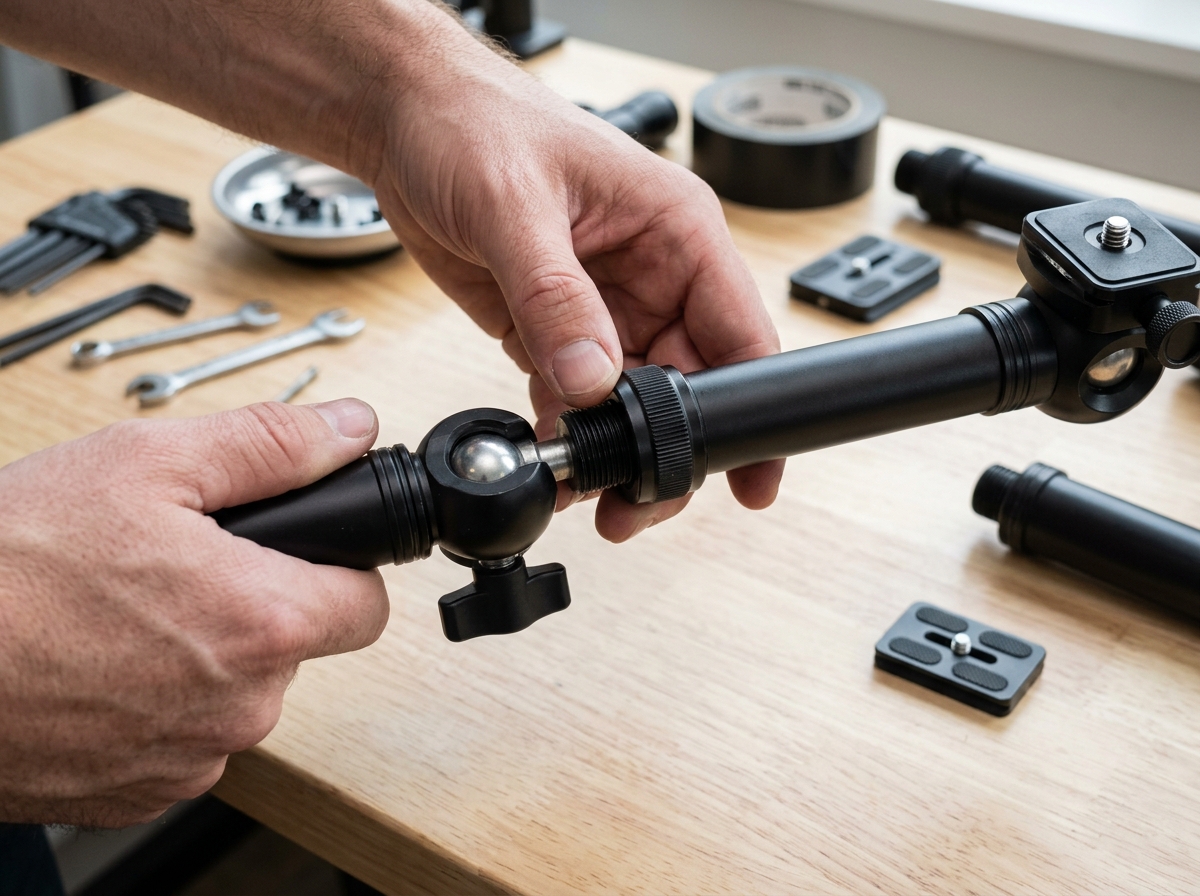
Modular systems are the “LEGOs” of camera gear. Instead of one solid arm, you have individual sections that snap or screw together. The Flex Arm L | Modular Mount Extension Arm | Elgato is a leader here. You can use two poles for a tight space or four sections for maximum reach. Each section usually features a ball joint, giving you sweeping three-dimensional maneuverability. This modularity means you only use as much “arm” as the shot requires, which helps maintain stability.
Essential Features of Flexible Arm Camera Mounts
Before you hit “buy,” you need to know if the arm can actually hold your gear. A mount that works for a GoPro will likely fail miserably under the weight of a full-frame DSLR.
Capacity and Materials
The build material dictates the price and the performance. Most professional arms use aluminum alloy or stainless steel for the core components. Cheaper, hobbyist versions might use ABS plastic and silicone, which is fine for action cams but can “creep” (slowly sag) over time under heavy loads.
| Feature | Entry-Level (Gooseneck) | Mid-Range (Modular) | Pro (Articulating) |
|---|---|---|---|
| Typical Material | Plastic / Thin Steel | ABS / Aluminum | High-Grade Aluminum / Steel |
| Load Capacity | 0.5 lbs – 1.1 lbs | 2 lbs – 5 lbs | 5 lbs – 11+ lbs |
| Adjustment Style | Bending / Twisting | Ball Joints per section | Single Locking Friction Knob |
| Common Use | Webcams, Phones | Streaming, Lights | Monitors, Heavy DSLRs |
Mounting Threads and Pins
Most flexible arm camera mounts use the standard 1/4-20 thread, which is the universal screw size for cameras. Some heavier arms also include 3/8-16 threads for tripod heads or larger accessories.
One feature we always look for is anti-twist pins. There is nothing more annoying than your camera unscrewing itself because the arm moved. High-end models, like the FlexiCapture Magic Arm | Modular Camera Mount | 60cm , often feature these pins or non-slip pads to keep everything oriented exactly where you want it.
Locking Mechanisms
Look for arms that offer 360-degree rotation at the base and the head. For articulating arms, a single tie-down screw that locks all axes simultaneously is a lifesaver in shooting environments. For goosenecks, check the “stiffness” rating; you want a tube that is hard to bend, as that indicates it will hold its shape under weight.
Top Use Cases for a Flexible Arm Camera Mount
Why do you need one? Because tripods have legs, and legs get in the way.
- Overhead Shots (The “Tasty” Shot): If you are filming a cooking tutorial or a drawing demo, you need the camera looking straight down at the table. A modular arm like the Elgato Flex Arm system allows you to clamp the base to the back of your desk and extend the camera out over your workspace without any tripod legs appearing in the frame.
- Live Streaming and Vlogging: For streamers, space is at a premium. A flexible arm camera mount can hold your webcam and a ring light on a single desk clamp, keeping your workspace clear for your keyboard and mouse.
- Medical and Technical Filming: In highly specialized fields, such as Video Camera Mount Flexible Stationary – OMS Supply , flexible arms are used in dental and surgical environments to capture close-up, hands-on sessions without obstructing the professional’s movement.
- Action and Automotive: If you’re a fan of “Behind the Scenes” (BTS) content or action sports, you can find Flex Arms With Action Cameras Mount options designed for motorcycle handlebars or car dashboards. These are usually shorter and stiffer to handle the vibrations of a moving vehicle.
- Macro Photography: When you’re inches away from a flower or an insect, moving a tripod an inch can feel like moving a mountain. A flexible arm allows for those tiny, precise adjustments required for perfect macro focus.
Best Practices for Stability and Safety
We’ve all seen it: the slow, tragic “droop” of a camera mid-recording. To avoid this, you need to follow a few golden rules of “arm-craft.”
- The Tightening Direction Rule: When using a magic arm, try to position the arm so that the weight of the camera is pulling in the tightening direction of the root screw. If the weight pulls in the loosening direction, physics will eventually win, and your camera will take a dive.
- Anti-Slip Surfaces: Always use mounts with anti-slip spiral textures or rubber rings on the ball joints. These increase friction and locking strength. If your mount doesn’t have them, you can sometimes add a small rubber washer for extra grip.
- Clamp Compatibility: Most “Super Clamps” feature a V-groove. This is a notch that allows the clamp to grip both flat surfaces (like a desk) and cylindrical objects (like a tripod leg or a handlebar). Ensure your clamp is rated for the thickness of your surface—most handle up to 2 inches.
- Weight Distribution: Don’t extend the arm to its maximum length if you don’t have to. The further the camera is from the base, the more leverage it has to cause vibration or sagging. Keep it as “compact” as possible.
- Maintenance: For gooseneck arms, avoid “kinking” the metal by making extremely sharp bends in the same spot repeatedly. This can fatigue the metal. Smooth, sweeping curves are better for the longevity of the mount.
Frequently Asked Questions about Flexible Camera Mounts
What is the maximum weight a flexible arm camera mount can hold?
Payload capacity varies wildly. Lightweight goosenecks usually top out at around 500g (17.6oz), which is perfect for a smartphone or a small webcam. On the other end of the spectrum, heavy-duty articulating arms can support up to 11 lbs (5kg). Always check the specs! If you are using a DSLR with a heavy lens, you must use a professional-grade magic arm.
How do I prevent my flexible arm camera mounts from shaking?
Shaking is usually caused by two things: a weak base or an overextended arm. Ensure your clamp is tightened until it doesn’t budge. If you are on a shaky desk, no mount can save you. Look for arms with single tie-down screws that lock all joints at once, as these tend to be more rigid than modular systems with multiple points of failure.
Can I use flexible arm camera mounts for smartphones and webcams?
Absolutely. Most flexible arm camera mounts come with a standard 1/4-20 screw. To use a phone, you just need a simple phone holder adapter (which many brands, like NEEWER or Hemmotop, include in the box). You can also use adapters to convert ball mounts to cold shoe brackets for mounting lights or microphones.
Conclusion
At Pratos Delícia, we know that the right gear doesn’t just make your life easier—it unlocks your creativity. Whether you’re capturing the perfect long exposure of the night sky or just trying to look better on your morning Zoom call, flexible arm camera mounts provide the 3D maneuverability that traditional tripods simply can’t match.
By choosing a mount with the right load capacity, utilizing anti-twist features, and following best practices for stability, you can “bend it like a pro” and never worry about camera droop again. Ready to level up the rest of your kit? Check out our More equipment guides for more expert tips and hardware recommendations.
