
Stop Fiddling and Start Seeing with These Portable Star Focusing Solutions
Why Portable Astronomy Star Focusing Makes or Breaks Your Night Sky Shots
Portable astronomy star focusing is the single biggest factor separating blurry, disappointing night sky photos from sharp, stunning ones — and the good news is that the right gear makes it surprisingly simple.
Here are the best portable auto-focusing telescope options to consider right now:
| Telescope | Aperture | Weight | Best For |
|---|---|---|---|
| Gskyer 70mm AZ Mount | 70mm | ~3 lbs | Budget beginners |
| Celestron Travel Scope 70 | 70mm | ~3 lbs | On-the-go stargazing |
| ToyerBee 70mm | 70mm | ~3 lbs | Value + accessories |
| Travel Telescope 114 | 114mm | 5.7 lbs | DIY + astrophotography |
| Seestar S50 (smart) | 50mm | 2.5 lbs | Auto app-controlled focus |
Most beginners assume blurry stars come from shaky hands or a cheap camera. Usually, the real culprit is focus.
Unlike daytime photography, your camera’s autofocus is essentially useless at night. Infinity marks on lenses shift with temperature changes. And even a tiny focus error turns a crisp star into a soft blob that ruins the whole shot.
The frustrating part? You often don’t notice the problem until you get home and zoom in on your images.
That’s exactly why the right portable telescope or focusing tool matters so much. Whether you’re shooting from a dark field or your backyard, having gear that helps you nail focus quickly and consistently is what separates one frustrating night from dozens of great ones.
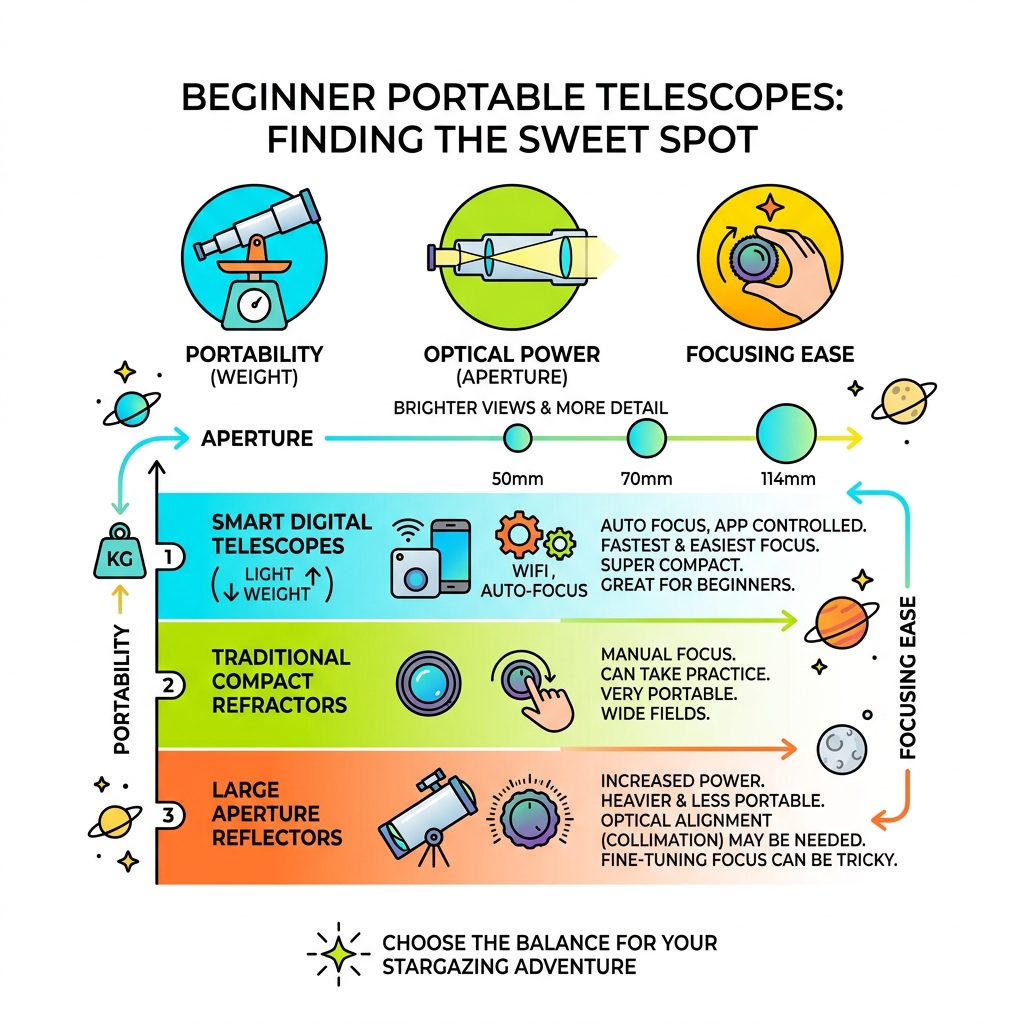
Essential Features for Portable Astronomy Star Focusing
When we talk about portable astronomy star focusing, we aren’t just talking about how small the telescope is. Portability in the astronomy world means “grab-and-go”—the ability to take your gear from the closet to the backyard (or the trunk of your car to a mountain top) and be viewing in minutes.
To achieve that perfect, pin-sharp view of a distant galaxy, several technical factors come into play. First and foremost is the focuser itself. Many entry-level telescopes use a basic rack-and-pinion system, but for high-precision work, we often look for dual-speed focusers. These allow for a “coarse” adjustment to get close and a “fine” adjustment (often a 10:1 ratio) to dial in that perfect pinpoint star.
Understanding the mechanics of your optics is the first step toward better images. We recommend checking out our detailed resource on focusing on stars: a guide to sharp night skies to understand why atmospheric turbulence and thermal equilibrium matter just as much as the knobs you turn.
How Aperture Impacts Portable Astronomy Star Focusing
In telescopes, aperture is king. Aperture refers to the diameter of the primary lens or mirror. It dictates two things: how much light the telescope gathers and how much detail it can resolve.
For portable astronomy star focusing, a larger aperture (like the 114mm found in the Travel Telescope 114 – North Star Scientific) allows you to see fainter stars, which actually makes focusing easier. Why? Because you have more “signal” to work with. When a star is bright and clear, it’s much easier to see when it reaches its smallest, sharpest point.
However, larger apertures usually mean more weight. A 70mm refractor is incredibly light (often under 3 lbs), making it a breeze to carry, but it won’t show the same level of detail as a 114mm or 127mm reflector. If you are using a smartphone to capture your views, you’ll want as much light as possible. Learn more about adding sharpness to star details in your mobile images to see how aperture and software work together.
Smart App-Enabled Options for Automatic Portable Astronomy Star Focusing
If the idea of squinting through an eyepiece and turning tiny knobs in the dark sounds like a headache, welcome to the future: smart telescopes. Devices like the Seestar S50 and the DWARF 3 have revolutionized the hobby.
These units are entirely autonomous. They use a process called “plate solving,” where the internal camera takes a picture of the stars, compares it to an internal database, and figures out exactly where it’s pointing. Once aligned, they use motorized focusers to achieve perfect portable astronomy star focusing automatically.
Modern smart telescopes utilize “live-stacking” technology. This means the telescope takes dozens of short exposures and layers them on top of each other in real-time. The result? You see colorful nebulas and distant galaxies on your phone screen that would be invisible to the naked eye.

Top-Rated Portable Telescopes for Every Budget
Choosing the right rig depends on your goals. Are you looking for a quick peek at the Moon, or do you want to hunt for deep-space nebulas? Here is how the most popular models stack up:
| Model | Type | Aperture | Price Range | Customer Rating |
|---|---|---|---|---|
| Gskyer 70mm | Refractor | 70mm | $70 – $100 | 4.2/5 (21k+ reviews) |
| Celestron Travel Scope 70 | Refractor | 70mm | $80 – $110 | 4.2/5 (15k+ reviews) |
| Dianfan 90mm | Refractor | 90mm | $130 – $160 | 4.5/5 (600+ reviews) |
| Travel Telescope 114 | Reflector | 114mm | $200 – $300 | High (Build Kit) |
| Celestron PowerSeeker 127EQ | Reflector | 127mm | $150 – $200 | 4.1/5 (10k+ reviews) |
The Gskyer 70mm is a powerhouse in the beginner market, with over 3,000 units bought in the past month alone. It’s light, comes with a carry bag, and includes a smartphone adapter. However, if you want something with a bit more “oomph” for deep-sky objects, the Dianfan 90mm offers a larger objective lens for better light gathering while maintaining a high 4.5-star rating.
Comparing Refractor and Reflector Designs for Travel
When shopping for portable astronomy star focusing solutions, you’ll encounter two main designs:
- Refractors (Lenses): These are the classic “spyglass” telescopes. They are rugged because the lenses are permanently mounted. They require almost zero maintenance, making them perfect for travel. The downside is “chromatic aberration”—a purple or blue fringe around bright stars or the Moon. High-end models like the ASTRO-PHYSICS 105 mm f6 TRAVELER use special ED glass to eliminate this, but they come with a premium price tag.
- Reflectors (Mirrors): These use mirrors to bounce light. They offer the most aperture for your dollar. The Travel Telescope 114 is a fantastic example of a collapsible Newtonian reflector that fits in a backpack. The trade-off? Mirrors can get knocked out of alignment (collimation) during travel and need occasional adjusting.
Must-Have Accessories for Precision Focus
Even the best telescope needs a little help. If you’ve ever tried to focus a telescope, you know that the moment you touch the knob, the image starts shaking like an earthquake. This makes seeing fine detail nearly impossible.
To combat this, we recommend a few key upgrades:
- Smartphone Adapters: These hold your phone steady over the eyepiece. Check out our guide on how to stop shaking and start stargazing with these phone adapters for the best options.
- Star Trackers: If you want to take long-exposure photos, you need a mount that moves with the stars. Compact star trackers use specialized motors to turn a standard tripod into a professional imaging rig, allowing for the long exposures needed to capture faint details.
- Precision Finders: A red-dot finder or a specialized pointer like the Starbeam advanced telescope pointer makes finding your target much faster, so you can spend your time focusing rather than searching.
Using Artificial Stars and Masks for Sharpness
If you want to achieve “pro-level” focus, you need to use diffraction. A Bahtinov mask is a plastic grid you place over the front of your telescope. It creates a specific “X” pattern with a central line through the middle of a star. When that center line is perfectly centered in the X, you are in perfect focus. It takes the guesswork out of the process!
For those who want to practice their portable astronomy star focusing during the day or in a long hallway, tools like the AstroZap Artificial Star are invaluable. It provides a tiny, high-intensity point of light that mimics a star at infinity, allowing you to collimate and focus your optics without waiting for a clear night.
For landscape photographers using standard camera lenses, specialized filters like those from Focus On Stars use a similar diffraction principle to ensure stars are pinpoints rather than blurry dots. You can also explore focus peaking and other tricks for perfect star focus for more software-based solutions.
Expert Tips for Setting Up Your Portable Rig
We’ve spent many nights under the stars, and we’ve learned that the best gear in the world won’t help if your setup is flawed. Here is our checklist for a successful night:
- Thermal Stabilization: Glass and metal expand and contract with temperature. If you take a telescope from a 70°F house to a 30°F field, the air inside the tube will swirl, making the stars look like they are underwater. Give your scope at least 20–30 minutes to “cool down” before you start your final portable astronomy star focusing.
- Stability is Key: A shaky tripod is the enemy of focus. If your tripod is flimsy, try hanging a small weight (like a water bottle) from the center column to lower the center of gravity. For phone-specific setups, look into the best portable mounts for phone astrophotography.
- Use a Red Light: Your eyes take 20 minutes to fully adjust to the dark. A bright white flashlight will ruin that instantly. Use a dim red LED to see your focus knobs and star charts.
- Flexible Mounting: Sometimes you need to attach your gear to a fence post or a tree branch. In those cases, we love to bend it like a pro with these flexible camera mounts.
Frequently Asked Questions about Portable Astronomy
What is the ideal budget for a beginner portable telescope?
For a reliable starter kit that includes a tripod and basic eyepieces, we recommend a budget of $100 to $250. In this range, you can get a solid 70mm–90mm refractor or a 114mm reflector. If you want a “smart” telescope that does the work for you, expect to spend between $400 and $800 for entry-level models like the Seestar or DWARF series.
Can I use my smartphone for star focusing?
Absolutely! Modern smartphones are incredible tools for astronomy. By using a smartphone adapter and a specialized app (like NightCap or ProCam), you can use “Focus Peaking”—a feature that highlights sharp edges in green or red—to help you see when the stars are perfectly dialed in. There are many specialized smartphone astrophotography gadgets available that can help you level up your mobile imaging game and capture stunning celestial views.
How do I maintain focus during temperature changes?
As the night gets colder, your telescope tube will actually shrink slightly. This moves the focal point. Expert astronomers check their focus every 30–60 minutes, or whenever they notice the stars looking a bit “soft.” If you are using a smart telescope, many models have built-in temperature compensation to adjust the focus automatically throughout the night.
Conclusion
At Pratos Delícia, we believe that the wonders of the universe shouldn’t be hidden behind a wall of technical frustration. Portable astronomy star focusing is a skill that anyone can master with the right tools and a little bit of patience. Whether you choose a classic “grab-and-go” refractor for quick lunar views or a high-tech smart telescope to capture distant nebulas, the goal is the same: to stop fiddling with gear and start seeing the stars.
By investing in a stable tripod, a precision focusing mask, and a quality portable telescope, you’re not just buying equipment—you’re opening a window to the cosmos. Ready to dive deeper into the technical side of the hobby? You can Master your stargazing skills with Pratos Delícia and join our community of night-sky enthusiasts. Clear skies!
