
Low Angle Camera Supports for Unique Perspectives
Why Low Angle Camera Supports Change Everything You Shoot
Low angle camera supports are tools that hold your camera close to — or flat on — the ground, opening up perspectives that a standard tripod simply can’t reach.
Here are the most popular options at a glance:
| Support | Best For | Payload | Approx. Price |
|---|---|---|---|
| Platypod Max | Travel, versatility | 300 lb | ~$99 |
| Naturescapes Skimmer II | Wildlife, wet terrain | N/A | ~$100 |
| Kirk Low-Angle Pod | Heavy rigs, durability | 300 lb | ~$100+ |
| DIY Frying Pan Pod | Budget shooting | Light rigs | Under $10 |
| Joby GorillaPod 3K | Casual, portable use | ~6 lb | $56–$80 |
Most photographers start out shooting at eye level. It’s natural — it’s how we see the world every day. But that familiarity is exactly the problem.
Eye level is forgettable.
Drop your camera to the ground, and something changes. Grass becomes a forest. Puddles turn into mirrors. A frog looks like a giant. Viewers stop scrolling.
This is especially powerful for night photographers. Imagine capturing a starry sky with a wildflower field sweeping across the entire foreground — that shot requires your camera to be inches from the dirt.
That’s where low angle camera supports come in. Whether you’re shooting long exposures on dewy grass, photographing wildlife at their level, or hunting for dramatic landscape compositions, the right ground-level support makes the difference between a snapshot and a standout image.
And the good news? You don’t need expensive gear to get started.

Top Commercial Low Angle Camera Supports
When we look at the professional market for low angle camera supports, three names consistently rise to the top: Platypod, Naturescapes, and Kirk. While they all aim to get your lens as close to the dirt as possible, they go about it in very different ways.
Choosing between them usually comes down to your specific environment. Are you sliding through the mud of a tidal flat to photograph shorebirds, or are you setting up a macro shot of a rare orchid on a rocky cliffside?
| Feature | Platypod Max | Naturescapes Skimmer II | Kirk Low-Angle Pod |
|---|---|---|---|
| Payload Capacity | 300 lb | High (Heavy Lens Compatible) | 300 lb |
| Weight | ~1 lb (Plate only) | ~15 oz | 30 oz |
| Best Surface | Rocks, Concrete, Uneven Ground | Sand, Mud, Snow, Grass | General Ground Use |
| Portability | Ultra-slim (fits in laptop sleeve) | Round, fits in backpack | Solid aluminum disc |
For a deeper dive into how these specialized tools compare to other unique positioning gear, check out this guide on camera supports for unique-angle camera positioning.
Specialized Low Angle Camera Supports for Wildlife
If you are a wildlife photographer, the Naturescapes Skimmer Ground Pod II is often considered the “gold standard.” Unlike a flat plate, the Skimmer is shaped like a shallow bowl with a 10-inch diameter and a 1.5-inch lip.
This design is intentional. It allows you to “skate” your camera across soft surfaces like sand, mud, or packed snow. If you’re photographing nesting birds at the beach, you don’t want to be constantly picking up and resetting a tripod. With the Skimmer, you can simply push your entire rig forward as the subject moves. It’s also incredibly effective in wet conditions, capable of maneuvering through up to 1.5 inches of puddles or wet grass without getting your expensive ball head submerged. Many users in the photography community swear by its ability to slide easily while attached to the outside of a backpack via a carabiner. You can read more about user experiences in this discussion on the best low angle pods.
Compact Low Angle Camera Supports for Travel
For the traveling photographer who needs to save every ounce of weight, the Platypod Max (and its smaller sibling, the Ultra) is a marvel of engineering. It isn’t a tripod in the traditional sense; it’s a flat, aircraft-grade steel plate about 0.2 inches thick.
Don’t let the slim profile fool you. The Platypod Max can support a staggering 300 lb payload—enough for the heaviest cinema rigs or telephoto lenses. It features adjustable leveling bolts that allow you to stabilize the camera on jagged rocks or uneven forest floors. Because it’s flat, it fits into the laptop compartment of almost any bag. We’ve even seen photographers use it in European cathedrals where full-sized tripods are banned, simply by placing it on a railing or the floor. If you’re interested in other ways to manipulate your camera’s position, you might want to bend it like a pro with these flexible camera mounts.
DIY Alternatives and Budget Solutions
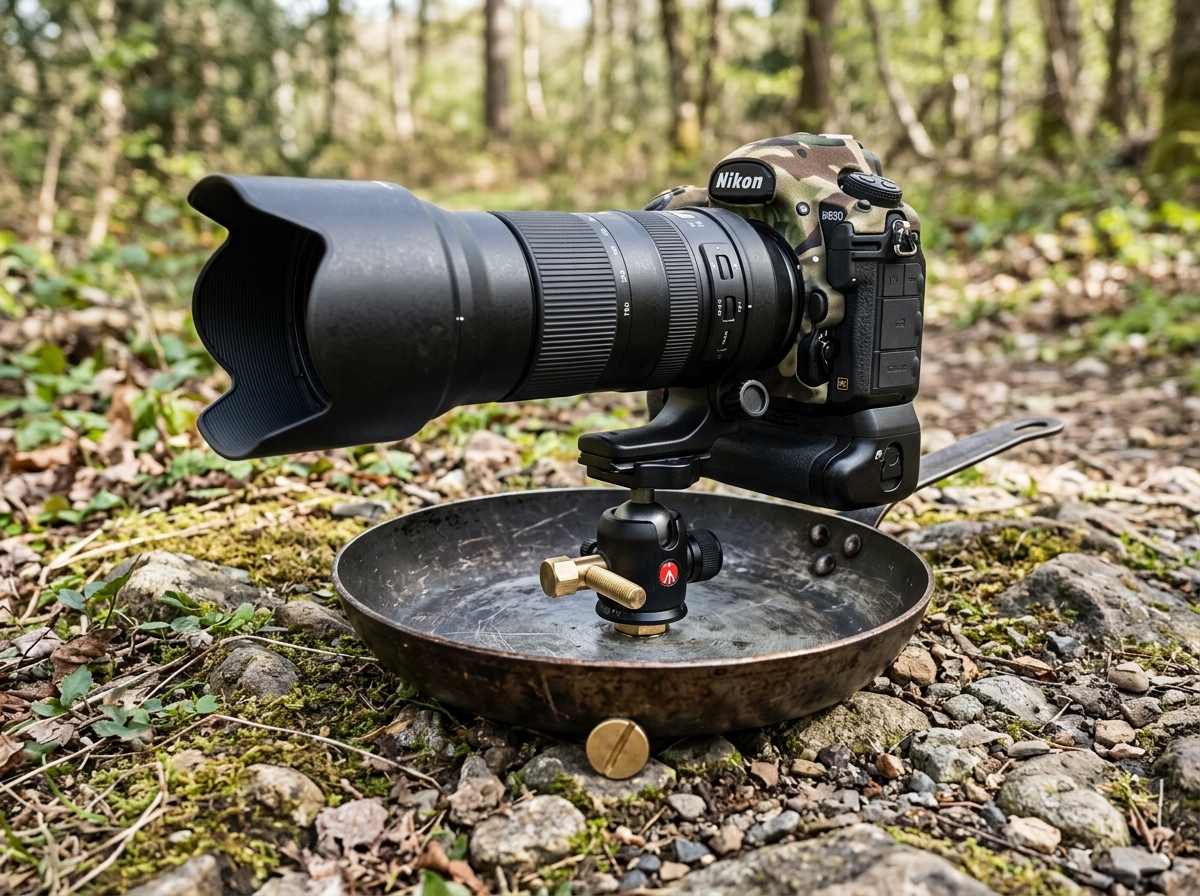
We know that spending $100 on a metal plate or a plastic bowl can feel a bit steep. If you’re a fan of “MacGyver-ing” your gear, DIY low angle camera supports is surprisingly effective.
The most famous DIY solution is the “Frying Pan Pod.” By taking a retired aluminum frying pan (you can find these at thrift stores for $2), drilling a 3/8″ hole in the center, and mounting a ball head using a sex bolt, you create a support that mimics the Naturescapes Skimmer for a fraction of the cost.
Other popular DIY materials include:
- Plastic Plates: A heavy-duty plastic plate from a camping store can serve as a lightweight ground pod.
- Cutting Boards: Small nylon or wood cutting boards are incredibly sturdy and easy to drill through.
- 3/8″ Sex Bolts: These are essential for DIY builds as they allow a flush mount on the bottom of your support so it can still slide smoothly.
If you’re moving from ground-level shots to looking up at the stars, you might also be interested in how to stop shaking and start stargazing with these phone adapters.
Pros and Cons of Homemade Pods
While DIY pods are great for the wallet, they do have trade-offs.
- Pros: They are nearly free, customizable, and you won’t feel bad if they get scratched up by rocks or salt water.
- Cons: They often lack the precision leveling features of a Platypod. A metal frying pan can be noisy on rocky surfaces and may not be as durable as a powder-coated commercial product. Furthermore, DIY plastic plates might flex under the weight of a heavy full-frame DSLR and a 600mm lens, leading to blurry shots.
Advanced Mounting: Wedges and Right-Angle Brackets
Sometimes, just being “low” isn’t enough. You might need to tilt your camera at an extreme angle—perhaps looking straight up at a redwood canopy or performing a “Dutch tilt” for a stylized video shot.
The Proaim Mitchell Wedge Tilt Camera Mount is a heavy-duty beast. It supports a massive 100kg (220lb) payload and offers a tilt range of 0° to 105°. This is a tool for professional filmmakers who need to level their rigs on sloped terrain or achieve over-slung tracking shots.
For photographers who need to switch to portrait mode while staying low, the Hague Heavy Duty 90° Right Angle Tripod Camera Mount is a solid choice. It supports up to 20kg, making it perfect for vertical filming with cinema cameras like the Sony FS7. Even high-end cinema brands offer solutions like the ARRI Low Mode Support LMS-3, which is designed specifically for ARRI ALEXA models to provide the lowest possible profile for handheld or underhand footage.
Vertical and Multi-Angle Solutions
If you need something more portable than a Mitchell wedge, the Proaim Multi-Angle Camera Wedge Plate is a lightweight aluminum alternative. It weighs only 350g but can support 15kg, providing a tilt range of 0° to 90°.
For those using gimbals or Arca-Swiss systems, the Tilta Adjustable Vertical Camera Support Bracket allows for instant switching between horizontal and vertical shooting. This is particularly useful for social media creators who need to capture high-quality vertical content from a low perspective. Speaking of gimbals, if you’re shooting at night, don’t miss our roundup of the best smartphone gimbals for night photography.
Choosing the Right Support for Your Environment
The “best” support depends entirely on where you’re standing (or crawling).
- Sand and Snow: You need a “skimmer” style pod with a curved bottom. This prevents the support from digging in and allows you to slide the camera smoothly.
- Mud and Puddles: Look for something with a lip or height-adjustable feet to keep your camera gear out of the muck.
- Rocks and Concrete: A flat plate like the Platypod with rubber-tipped feet or leveling bolts is best here, as a curved pod will wobble on hard, uneven surfaces.
- Studio and Indoor: A camera riser or Lowpod can give you that slight elevation needed for product photography or low-angle interviews without taking up the floor space of a full tripod.
When planning your shoot, it’s also worth determining the best tripod height for astrophotography to ensure you’re balanced for those long exposures.
Comparing Pods to Traditional Mini Tripods
You might be wondering: “Why not just use a Joby GorillaPod?”
While the Joby GorillaPod 3K is a fantastic, versatile tool that can wrap around branches or fences, it has limitations as one of your primary low angle camera supports. First, it only supports about 6 pounds, which is fine for a mirrorless setup but risky for a pro DSLR with a battery grip. Second, even with the legs splayed out, a GorillaPod still sits several inches off the ground. A ground pod or plate allows you to get the camera body literally touching the earth, which is essential for that true “worm’s-eye view.”
If you are on a budget and looking for something more traditional, there are many affordable tripods for night sky photography that feature legs that splay nearly flat, though they still won’t match the portability of a dedicated low-angle plate.
Practical Tips for Ground-Level Photography
Shooting from the ground is physically demanding. We’ve learned a few tricks over the years to make the process easier and more effective.
- Invest in Kneepads: This is the #1 tip from experienced pros. Whether you’re in the mud or on gravel, your knees will thank you.
- Use a Leveling Base: Adding a small leveling base between your pod and your camera head can save you minutes of frustration. It allows you to straighten the horizon without fiddling with the pod’s feet.
- Ball Heads vs. Gimbals: For macro and landscapes, a low-profile ball head is best to keep the center of gravity low. For wildlife with long lenses, a gimbal head on a ground pod allows for smooth tracking, though it does add height.
- Counterbalancing: If you are using a tripod with a laterally adjustable center column to get low, always hang a weight (like your camera bag) on the opposite side to prevent a tip-over.
- Remove the Strap: When your camera is an inch from the ground, a dangling strap is a trip hazard and a magnet for dirt. Use quick-release straps to pop it off instantly.
For more wisdom on building a versatile kit, read this excellent piece on four tripods and why professional photographers use them.
Frequently Asked Questions about Low Angle Gear
How do I keep my camera clean when shooting at ground level?
Shooting low is inherently messy. We recommend using a “ground sheet” (even a cheap trash bag works) to lie on. For the gear itself, use a pod with a lip (like the Skimmer) to provide a barrier against mud. After a shoot, always wipe down the bottom of your support with a damp cloth to remove salt, sand, or grit before packing it away.
Can I use a gimbal head on a low angle plate?
Yes! Many wildlife photographers mount a full-sized gimbal head to a Naturescapes Skimmer or a Platypod Max. This setup is perfect for tracking birds at eye level. Just be aware that a gimbal significantly raises the height of your lens, so if you want the absolute lowest shot possible, a low-profile ball head or even mounting the camera directly to the plate is better.
Are DIY frying pan mounts safe for heavy DSLR rigs?
If built correctly, yes. The key is using a high-quality “sex bolt” (also known as a Chicago bolt) that provides a wide, flat surface area to distribute the weight. Aluminum pans are surprisingly rigid. However, always test your DIY rig at home over a soft surface before taking it into the field with $5,000 worth of glass.
Conclusion
At Pratos Delícia, we believe that the best images come from seeing the world differently. Low angle camera supports are the keys to that kingdom. Whether you choose the ultra-portable Platypod Max, the rugged Naturescapes Skimmer, or a trusty $2 frying pan from the local thrift shop, getting low will fundamentally change your compositions.
The world looks different from six inches up. Shadows are longer, reflections are clearer, and the mundane becomes magical. So, grab a support, put on some kneepads, and get down in the dirt. Your portfolio will thank you.
Ready to upgrade the rest of your kit? Explore more professional camera equipment to find the perfect tools for your next photographic adventure.
