
Why Wind is the Enemy of Sharp Star Photos
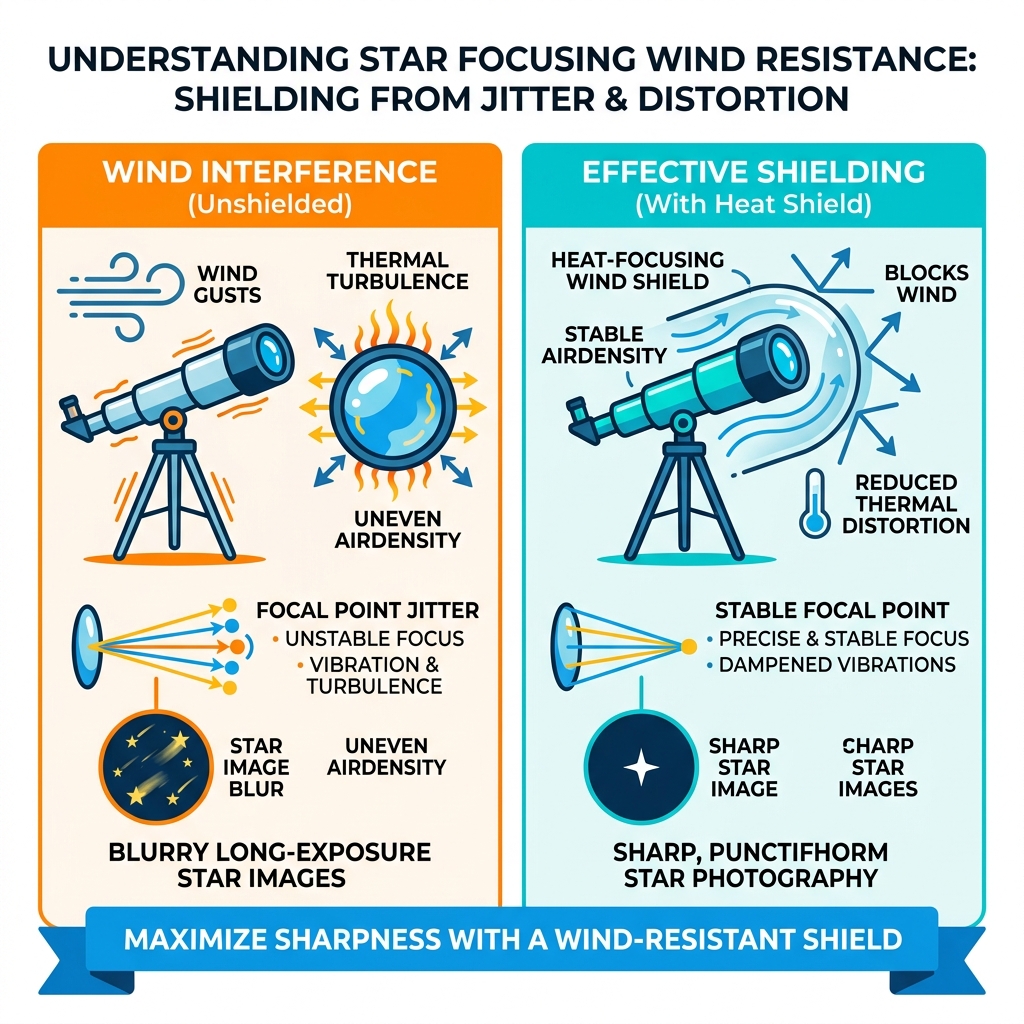
Star focusing wind resistance is the key challenge every night sky photographer faces when trying to capture crisp, pinpoint stars in long-exposure shots.
Here are the best ways to fight wind interference when focusing on stars:
- Use a wind-resistant heat shield around your lens or telescope to block gusts and reduce thermal turbulence
- Weigh down your tripod with a bag or sandbag to dampen vibrations
- Shoot during calmer conditions — even light wind causes blur in exposures longer than a few seconds
- Use electronic or remote shutter release to avoid camera shake when pressing the shutter
- Enable autofocus error-weighting (in software like N.I.N.A.) so wind-caused jitter doesn’t throw off your focus curve
You’ve set up your camera. The sky is clear. But every star looks like a tiny smear instead of a sharp point. Sound familiar?
Wind is almost always the culprit. Even a gentle breeze can shake your tripod, distort warm air around your lens, and ruin a 30-second exposure. This problem is so serious that even professional observatories — using massive telescopes worth millions of dollars — treat wind turbulence as one of their biggest engineering challenges. Research on large telescope design confirms that unsteady wind loads from turbulence are among the most significant disturbances affecting image sharpness.
For beginner astrophotographers, the good news is that you don’t need a dome or an adaptive optics system to fight back. The right heat-focusing wind shield can make a dramatic difference for a fraction of the cost.
The Science of Star Focusing Wind Resistance
To understand how to fight the wind, we first have to look at the stars themselves—specifically the giants that create their own “wind” problems. In astrophysics, the most extreme examples of star focusing wind resistance come from Wolf-Rayet (WR) stars. These are massive stars at the end of their lives, blowing off their outer layers at incredible speeds.
According to scientific research on optically thick WR winds, these stars develop winds so dense that they are “optically thick.” This means a single photon doesn’t just fly away; it gets absorbed and re-emitted many times, bouncing around like a pinball before it finally escapes. This process creates a massive amount of radiation pressure that drives the star’s mass loss.
For us on Earth, the lesson is clear: energy and movement are linked. Just as a WR star’s internal “diffusion limit” and “iron-opacity peak” determine how its wind behaves, the way we manage the air (and heat) around our equipment determines how sharp our focus will be. If you want to dive deeper into the basics of getting those crisp points of light, check out our guide to focusing on stars for sharp night skies.
Understanding Optically Thick vs. Thin Winds
Most stars have “optically thin” winds, where light passes through relatively easily. However, WR stars have a high “wind efficiency” (the η factor), often greater than 1. This happens because of multiple photon scattering. In these environments, the standard CAK (Castor, Abbott, and Klein) parameters used to describe wind flow show that the efficiency of Doppler shifts is actually reduced.
In our own photography, we deal with a similar “thick” versus “thin” problem. On a clear, still night, the air is “thin” and easy to see through. On a windy night with high thermal gradients, the air becomes a turbulent “thick” soup that scatters light, making it nearly impossible to maintain a steady focus.
Mass Limits and Metallicity Effects
Interestingly, theoretical models show that there are stellar mass limits below which these continuous, thick winds cannot exist. For stars in our Galaxy, this limit is about 14 times the mass of the Sun. In the Large Magellanic Cloud (LMC), where there is lower “metallicity” (fewer heavy elements), the limit is higher—around 25 times the mass of the Sun. This is because these stars need enough iron-group elements to provide the opacity required to “push” the wind.
When the wind isn’t steady, it creates a “wind-driven halo.” You can read more about this in this scientific analysis of wind-driven halos, which explains how atmospheric turbulence and instrument delays can create a fuzzy glow around stars in high-contrast images.
Mechanical Challenges: Wind Buffeting and Image Jitter
When we talk about star focusing wind resistance, we aren’t just talking about the stars themselves. We’re talking about your gear. For ground-based telescopes, “wind buffeting” is a major headache.
Unsteady wind loads caused by turbulence inside a telescope enclosure are the primary cause of dynamic disturbances. This leads to “image jitter,” where the star moves slightly during the exposure, resulting in a blurry mess. Professional studies on the wind buffeting of large telescopes show that even the most advanced control systems struggle with “servo-lag error”—the tiny delay between a wind gust hitting the telescope and the motors correcting for it.
For those of us shooting in the backyard, we face the same jitter. If your setup isn’t shielded, every gust is a potential ruined shot. You can find some great tips on how to stabilize your night sky photography without a tripod if you’re caught in a pinch, but a dedicated shield is always better.
Achieving Star Focusing Wind Resistance in High-Contrast Imaging
In high-end systems like the SPHERE-SAXO at the Very Large Telescope (VLT), researchers have identified a specific phenomenon called the “Wind-Driven Halo” (WDH). This occurs when the atmospheric turbulence changes faster than the adaptive optics can keep up with.
The jet stream (located 8-14 km up) contributes about 40% of the effective wind velocity, which is the main culprit for this halo. If the “coherence time” of the air is less than 3 milliseconds, the WDH becomes a major problem, reducing image contrast by a factor of 10. While we might not have a VLT in our backyard, this reminds us that the wind high above us matters just as much as the wind hitting our tripod.
Hardware for Star Focusing Wind Resistance
To combat these forces, we recommend a multi-pronged approach:
- Wind Shields: A physical barrier that wraps around your optical tube.
- Heat Focusing Reflectors: These help manage the “micro-climate” inside your lens hood, preventing thermal plumes from distorting the air.
- Vibration Suppression: This includes using affordable tripods for stability and high-quality portable mounts for phones that have lower profiles to catch less wind.
Advanced Solutions for Atmospheric Turbulence
If you want to get really fancy, we can look at how the pros use “artificial stars.”
The European Space Agency (ESA) uses artificial star technology to fight turbulence. By firing a laser to excite sodium atoms 90km up in the atmosphere, they create a “guide star.” Since they know exactly what that star should look like, they can measure the wavefront distortion caused by the wind and correct for it in real-time.
Early measurements of atmospheric wavefront using laser stars proved that this could resolve binary stars that were previously just a blur. While we can’t fire lasers into the sky (seriously, don’t do that), we can use software to achieve a similar result.
Optimizing Star Focusing Wind Resistance with N.I.N.A.
One of the best tools for modern astrophotographers is N.I.N.A. (Nighttime Imaging ‘N’ Astronomy). Its autofocus routine uses a “Star HFR” (Half Flux Radius) method.
What makes it great for star focusing wind resistance is its ability to use “error-weighted fitting.” When the wind blows and causes a star to jitter, the software detects the increased error in that specific measurement. It then uses a hyperbolic curve-fitting algorithm that gives less weight to those “windy” data points, ensuring your final focus is based on the clearest moments of the night.
To get the most out of these digital tools, you might also want to explore focus peaking tricks for perfect star focus, which can help you visually confirm when you’ve hit the sweet spot.
The Role of Radiation Pressure and Dust
We also have to consider the environment around the star. Take the red giant R Doradus. Scientists once thought that starlight pushing on dust grains was the main driver of its massive winds. However, recent research on starlight and giant star wind power found that the dust grains are actually too small (only 0.0001 mm!) for radiation pressure to do the job alone.
Instead, giant convective bubbles and stellar pulsations provide the extra “kick.” This is a great metaphor for our own equipment: sometimes the “light” (your settings) isn’t enough; you need the right “structure” (your wind shield and tripod) to handle the physical movement of the environment.
Frequently Asked Questions about Star Focusing
How does wind clumping affect mass-loss diagnostics?
In massive stars, “clumping” refers to density inhomogeneities in the wind caused by line-driven instability. If astronomers ignore these clumps, they can overestimate a star’s mass-loss rate by a factor of 2 to 10! For us, “clumping” is like the uneven gusts of wind. If you only focus during a lull, your settings might not work when the wind picks back up.
Why do theoretical models predict mass limits for WR stars?
As we mentioned, WR stars need a specific amount of iron-opacity at their “sonic point” to keep their winds blowing. If the star is too small (low mass) or doesn’t have enough metals (low metallicity), it can’t sustain a continuous optically thick wind. This explains why we don’t see many low-mass WR stars in galaxies like the LMC.
What is the “weak wind problem” in massive stars?
This is a puzzle where some late O-type stars have mass-loss rates 10 to 100 times lower than what standard theory predicts. It might be due to “ion decoupling,” where the ions being pushed by light stop “talking” to the rest of the gas. In photography, this is like having a great camera but a cheap tripod—the connection between your gear is broken, and the results fall short.
Conclusion
At Pratos Delícia, we want you to spend your nights looking at the stars, not fighting your equipment. Achieving star focusing wind resistance is a mix of high-tech software and low-tech physical shielding. By understanding how wind affects everything from the massive Wolf-Rayet stars to your own backyard telescope, you can take steps to ensure your images are always tack-sharp.
| Wind Shield Material | Stability Rating | Portability | Best Use Case |
|---|---|---|---|
| Carbon Fiber Wrap | High | Excellent | Mobile setups / Hiking |
| Rigid Plastic Shield | Very High | Moderate | Fixed backyard observatories |
| Thermal Fabric | Moderate | High | Dew prevention + Light wind |
Don’t forget that height matters! Check out our guide on determining the best tripod height for astrophotography to find the balance between a good view and wind stability. If you’re using a smartphone, you can stop shaking with these phone adapters designed for a secure fit.
Ready to take your skills to the next level? Explore more professional techniques on our blog and turn those blurry smears into breathtaking masterpieces. Clear skies!
