
What Are Long Exposure Water Effects (And How Do You Get Them)?
Long exposure water effects are the silky, smooth, almost dreamlike streaks of water you see in photos of waterfalls, ocean waves, and rivers — created by leaving your camera’s shutter open for a second or more while the water moves through the frame. This technique, often referred to as long-exposure photography, allows you to capture the passage of time in a single image.
Here’s a quick summary of how to capture them:
- Mount your camera on a tripod — any movement will ruin the shot
- Set a low ISO (100–200) and a mid-range aperture (f/8–f/11)
- Use a slow shutter speed — start at 1 second and adjust from there
- Use an ND filter in bright light to allow longer exposures without overexposing
- Trigger the shutter remotely to avoid shake when pressing the button
There’s something almost magical about what a slow shutter does to water. Rough, chaotic waves become smooth silk. A crashing waterfall turns into soft, flowing ribbons of light. You’re not just taking a photo — you’re capturing a slice of time that your eyes can never actually see.
The good news? You don’t need expensive gear to get started. Many of these effects are achievable with an entry-level camera, a basic tripod, and a little patience.
This guide walks you through everything — from gear and settings to composition and post-processing — so you can start creating stunning silky water images right away.

Essential Gear for Long Exposure Water Effects
To master long exposure water effects, we need to move beyond the “point and shoot” mentality. Because we are keeping the shutter open for extended periods—anywhere from half a second to several minutes—the gear we choose must prioritize stability and light control.
The Foundation: A Sturdy Tripod
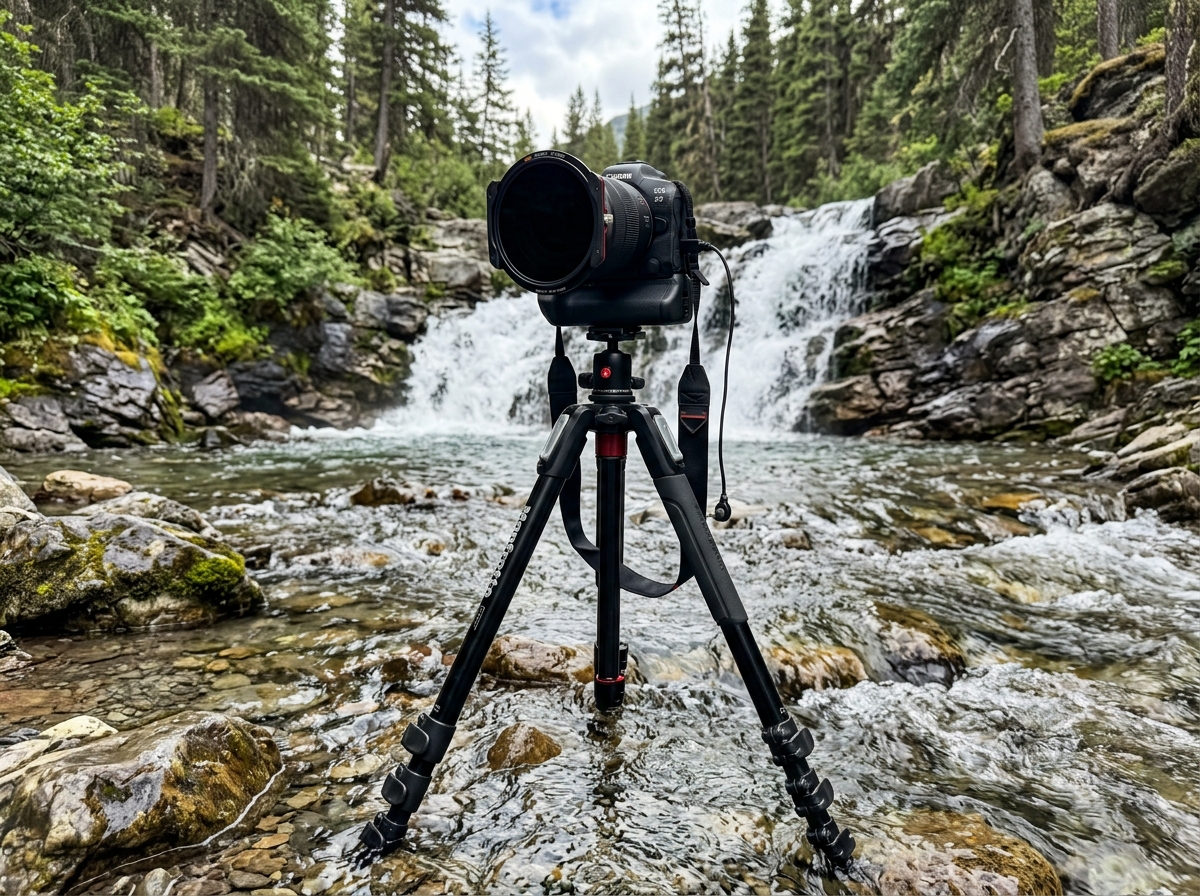
In long exposure photography, the tripod is more important than the camera. Even the tiniest vibration from your heartbeat or a light breeze can turn a sharp landscape into a blurry mess. We recommend a tripod that is heavy enough to withstand wind but portable enough for hiking. A pro tip: avoid extending the center column if possible, as this creates a “lollipop” effect that is highly susceptible to shaking.
Neutral Density (ND) Filters: Sunglasses for Your Lens
In broad daylight, your camera sensor is flooded with light. If you try to set a 5-second shutter speed at noon, your photo will be a solid block of white. Neutral-density (ND) filters are darkened pieces of glass that sit in front of your lens, reducing the amount of light that enters without changing the color of the scene.
- 3-stop or 6-stop filters: Great for waterfalls in the shade or shooting during the “golden hour.”
- 10-stop or 15-stop filters: These are essential for “melting” ocean waves into mist during the bright middle of the day.
Remote Shutter Release
Even the act of pressing the shutter button creates a micro-vibration. A remote shutter release (wired or wireless) allows us to trigger the camera without touching it. If you don’t have one, you can use your camera’s built-in 2-second or 10-second self-timer.
Lenses and Maintenance
A wide-angle lens (typically 14mm to 35mm) is the standard choice for landscape photography, allowing us to capture the scale of a waterfall or a sweeping coastline. However, don’t overlook telephoto lenses for “intimate landscapes”—zooming in on a specific swirl of water around a rock can be incredibly powerful.
Always carry high-quality lens cloths. Waterfalls create “mist,” and ocean waves create “spray.” You will spend half your time wiping droplets off your glass! For more advanced techniques on handling different environments, check out how to Master your photography skills with our full guides.
Mastering Camera Settings for Moving Water
Getting the settings right is a balancing act. We want to maximize image quality while forcing the camera to take a long time to record the image.
- Manual Mode: This is non-negotiable. We need full control over the “Exposure Triangle.”
- ISO 100: Always use the lowest native ISO (usually 100 or 64). This ensures the cleanest image with the least amount of digital noise.
- Aperture (f/8 to f/11): This is the “sweet spot” for most lenses. It provides a deep depth of field (keeping the foreground and background sharp) while avoiding “diffraction,” which happens at very small apertures like f/22 and can actually make your photo look softer.
- RAW Format: Always shoot in RAW. Long exposures can sometimes result in “clipped” highlights in the white foam of the water; RAW files give us the data needed to recover those details in post-processing.
- Focus Manually: Once you have composed your shot, focus on a static element (like a rock in the foreground). Switch your lens to Manual Focus (MF) so the camera doesn’t try to “hunt” for focus when the water starts moving or when you put a dark filter on.
Shutter Speed Comparison Table
| Water Type | Desired Effect | Suggested Shutter Speed |
|---|---|---|
| Fast Waterfall | “Ribbons” / Retained Texture | 1/4 sec to 1 second |
| Slow River | Silky / Smooth Flow | 2 seconds to 8 seconds |
| Ocean Waves | Misty / Ethereal Fog | 20 seconds to 30+ seconds |
| Calm Lake | Mirror-like Reflection | 30 seconds to 2 minutes |
Choosing the Right Shutter Speed for Long Exposure Water Effects
There is no “perfect” shutter speed; it depends entirely on the velocity of the water. For a powerful, crashing waterfall, a shorter long exposure (around 1/2 second) is often better because it retains some of the “power” and texture of the water. If you go too long (e.g., 30 seconds) on a fast waterfall, it can end up looking like a flat white blob.
Conversely, for ocean waves, we often want that misty, “creamy” look. This usually requires 20 to 30 seconds. Experimenting with different speeds is the only way to find your personal style. For those shooting in colder climates, you might want to read about how-to-capture-frozen-beauty-with-winter-long-exposures to see how ice interacts with these settings.
Calculating Exposure Times for Long Exposure Water Effects
When you put a 10-stop ND filter on your lens, the viewfinder goes pitch black. The camera’s internal meter often gets confused. The best way to handle this is to calculate the “Base Exposure” first.
Take a photo without the filter until the histogram looks perfect. Let’s say your shutter speed is 1/60th of a second. If you add a 10-stop filter, you have to double that time ten times.
- 1/60 -> 1/30 -> 1/15 -> 1/8 -> 1/4 -> 1/2 -> 1s -> 2s -> 4s -> 8s -> 15s.
Your new exposure is 15 seconds! If your calculation goes beyond 30 seconds, you will need to switch your camera to Bulb Mode. Many photographers use exposure calculator apps to do this math instantly. If you are dealing with snow or ice, the brightness can change these calculations significantly, as discussed in our guide on how-to-capture-frozen-beauty-with-winter-long-exposures.
Advanced Techniques: The High ISO Test Shot
Waiting 4 minutes for a long exposure only to find out it’s too dark is frustrating. Professional landscape photographers use the High ISO Test Shot method to save time.
- Compose and Focus: Get everything ready with your ND filter attached.
- Crank the ISO: Set your ISO to 6400 (or higher).
- Take a Test Shot: Because the ISO is so high, you can get a “bright” photo in just a few seconds (e.g., a 2-second exposure).
- Check the Histogram: If the 2-second shot looks good, you now have your math.
- The Conversion: There is a convenient “Seconds to Minutes” rule. If your test shot at ISO 6400 took 4 seconds, then your final shot at ISO 100 will take exactly 4 minutes.
This method is incredibly efficient for nailing long exposure water effects without the trial and error. This same principle of calculating light accumulation is used when making-the-night-sky-spin-with-long-exposures.
Composition and Post-Processing for Professional Results
A photo of “blurry water” isn’t necessarily a good photo. To make it professional, we need a strong composition.
Composition Tips
- Leading Lines: Use the flow of the water to lead the viewer’s eye into the frame. Look for “S-curves” in rivers.
- Foreground Interest: A sharp, static rock or a piece of driftwood provides a vital contrast to the moving water. This “anchor” makes the silkiness of the water stand out.
- The Polarizer Trick: A circular polarizer is just as important as an ND filter. It removes the glare from wet rocks and the surface of the water, revealing the colors and textures beneath the surface.
Post-Processing
Once you’re back at your computer, you can enhance the long exposure water effects using software like Lightroom or Photoshop.
- Selective Sharpening: Sharpen the rocks and trees, but never sharpen the silky water. Keeping the water “soft” enhances the effect.
- Dodging and Burning: Brighten the “highlights” of the water flow (dodging) to make the motion “pop” against the darker surroundings.
- Luminosity Masking: For advanced users, this helps balance the bright white water with the dark shadows of the forest or cliffs.
If you are just starting out with your phone, you can still apply these compositional rules. Learn more about it in our guide to capture-the-night-long-exposure-smartphone-photography.
Frequently Asked Questions about Silky Water Photography
Can I achieve these effects with a smartphone?
Yes! While a DSLR or mirrorless camera offers the best quality, modern smartphones have “Long Exposure” modes or Live Photo features that can mimic the look. You will still need a mobile tripod to keep the phone steady. For the best results, we recommend using specialized top-mobile-camera-apps-for-long-exposure-shots that allow you to manually control the shutter speed.
What are the best weather conditions for long exposures?
Contrary to popular belief, a bright sunny day is the worst time for long exposures. The light is too harsh, and the contrast is too high.
- Overcast Skies: This is the “gold standard.” The clouds act as a giant softbox, providing even, diffused light that makes colors (like the greens in a forest) look saturated and rich.
- Golden Hour: The hour after sunrise or before sunset provides soft, directional light.
- Blue Hour: The period just before sunrise or after sunset is perfect for getting very long exposures without needing heavy ND filters.
For more tips on timing your shots, see our long-exposure-tips-for-smartphone-night-photos.
How do I avoid common mistakes like camera shake?
Even with a tripod, your camera can shake.
- Turn off Image Stabilization (IS/VR): When your camera is on a tripod, the stabilization system can actually create shake by trying to find movement that isn’t there.
- Hang your bag: Many tripods have a hook at the bottom. Hanging your camera bag there adds weight and lowers the center of gravity, making it more stable in the wind.
- Use Exposure Delay Mode: This tells the camera to wait a second after the mirror flips up before taking the photo, eliminating “mirror slap” vibration.
If you’re finding that your mobile shots are still blurry, check out these top-mobile-camera-apps-for-long-exposure-shots-2 for apps that have better stabilization algorithms.
Conclusion
Mastering long exposure water effects is a rite of passage for every landscape photographer. It forces us to slow down, observe the rhythm of the environment, and think creatively about how time is represented in a single frame. Whether you are standing in front of a thundering waterfall or watching the tide roll in at the beach, the ability to transform motion into art is a powerful tool.
At Pratos Delícia, we believe that photography is one of the best ways to appreciate the natural beauty of our world. Don’t be afraid to get your boots wet, experiment with “crazy” shutter speeds, and fail a few times before you get that perfect shot. Ready to dive deeper into other styles? Master your photography skills with our full guides and keep exploring the magic of the long exposure.
