
What Are Long Exposure Star Trails (And How to Capture Them)
Long exposure star trails are streaks of light created when a camera records the apparent movement of stars across the night sky over an extended period of time.
Here’s the quick answer for getting started:
- Point your camera at the night sky from a dark location
- Use manual mode with ISO 400–1600, aperture f/2.8–f/5.6, and 30-second exposures
- Shoot continuously for at least 2 hours using an intervalometer
- Stack the images in free software like StarStaX to create smooth, bright trails
- Aim toward Polaris (the North Star) for dramatic circular trails
There’s something almost magical about watching a finished star trail image for the first time. What looks like an empty dark sky transforms into a spinning web of light — proof that the Earth itself is constantly moving beneath your feet.
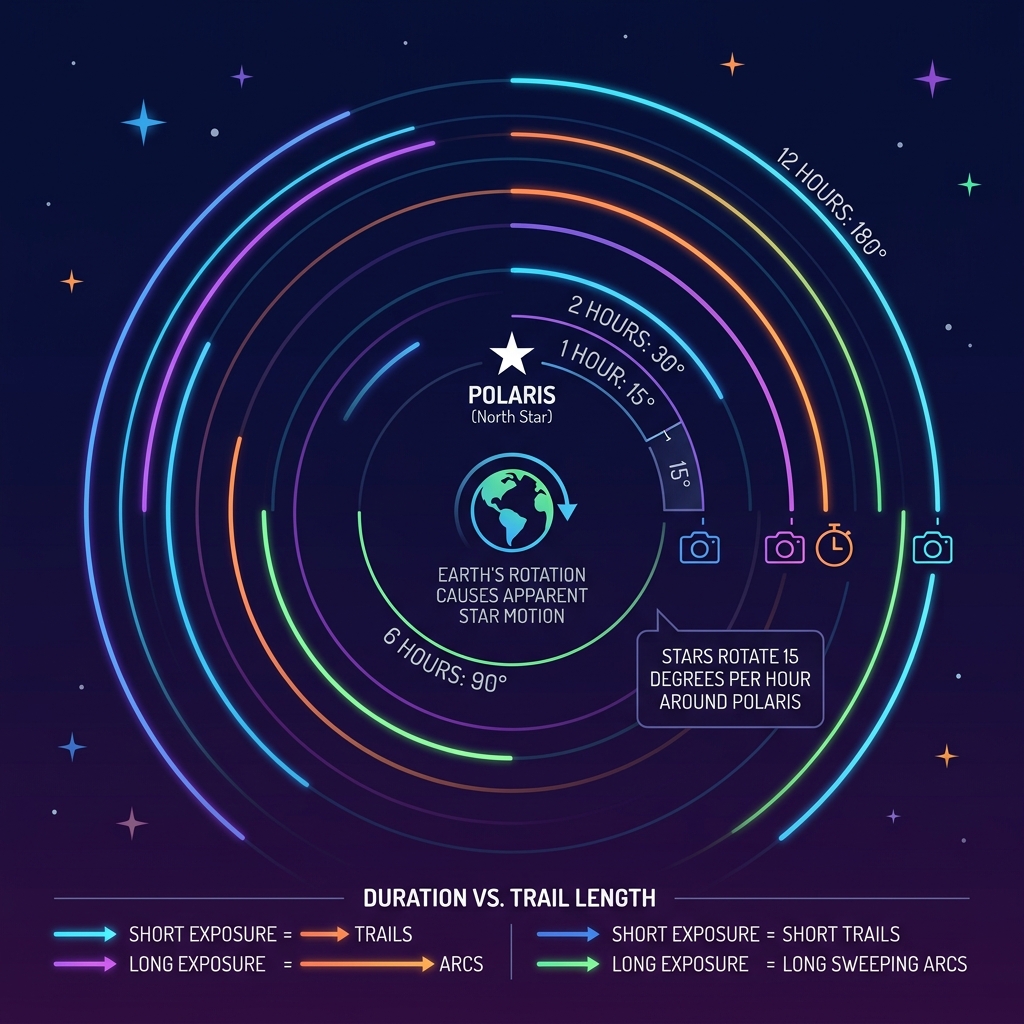
The effect is surprisingly simple to understand. Earth rotates roughly 15 degrees every hour. A camera on a tripod stays still while the stars appear to sweep across the sky. Leave the shutter open long enough, and those tiny points of light become long, sweeping arcs.
The good news? You don’t need expensive gear or years of experience to pull it off. A camera with manual controls, a sturdy tripod, and a dark sky are the core requirements. The rest is patience and preparation.
This guide walks you through everything — from the science behind the trails to the exact settings, timing, and post-processing steps that turn a dark field into a stunning nightscape.
The Science and Planning of Long Exposure Star Trails
Before we start clicking the shutter, we need to understand what we are actually photographing. When we talk about long exposure star trails, we aren’t seeing the stars move; we are seeing the Earth rotate. This is known as diurnal motion. As our planet spins on its axis, the stars appear to travel in “diurnal circles” across the sky.
According to Star trail – Wikipedia, these trails are a record of this motion, and they are one of the most accessible forms of astrophotography for beginners. However, success depends heavily on your environment. You can’t just set up in your backyard if you live in the middle of a bright city.
We recommend using light pollution maps to find “Dark Sky Reserves” or remote areas where the stars aren’t washed out by streetlights. Planning is half the battle, and our Planning Your Night Sky Photography Shoot: A Guide can help you coordinate your trip.
Weather forecasting is your best friend. A single cloud passing through a three-hour shoot can create a giant gap in your trails. We always check for zero percent cloud cover and keep an eye on moon phases. While a full moon might seem helpful for lighting the ground, it actually washes out the fainter stars, making your trails look thin and sparse. Aim for a new moon or a thin crescent moon for the best results.
Finding the North Star for Circular Long Exposure Star Trails
If you want those iconic, perfect circles, you need to find the “hub” of the wheel. In the Northern Hemisphere, this hub is Polaris, also known as the North Star. Polaris sits almost exactly above the North Celestial Pole, meaning it barely moves while everything else spins around it.
To find it, look for the Big Dipper and follow the two stars at the end of the “bowl” straight up. If you are in the Southern Hemisphere, you’ll look for the South Celestial Pole near the constellation Sigma Octantis. Since there isn’t a single bright star exactly at the pole in the south, you can use the Southern Cross method: extend the long axis of the cross about 4.5 times its length to find the center of the rotation.
Using a compass is helpful, but remember to adjust for magnetic declination (the difference between magnetic north and true north). Many photographers use Best Apps to Track Stars and Planets on Your Mobile to pinpoint exactly where the poles are before they even set up their tripod.
Choosing the Right Timing and Duration
How long should you shoot? The short answer is: as long as you can stand the cold!
Statistically, stars rotate approximately 15° in one hour. If you use an ultra-wide lens (15-20mm), a one-hour shoot will only give you a small arc. For impressive, long trails that truly show the circular motion, we recommend a two-hour minimum. If you can stretch it to 3.5 hours, you’ll capture over 50° of rotation, which looks spectacular.
- 1 Hour: ~15° rotation (Short trails)
- 2 Hours: ~30° rotation (Solid circular arcs)
- 3.5 Hours: ~53° rotation (The “wow” factor)
We often suggest a “twilight start.” By starting your sequence during the end of civil twilight (the blue hour), you can capture a beautiful blue gradient in the sky and naturally illuminated foreground details. As it gets darker, the stars will start to show up in your subsequent frames. For more on this, check out our Timing Tips for Capturing Stars.
Essential Gear and Technical Setup
You don’t need a telescope, but you do need stability. A long exposure star trails session involves the camera sitting in one spot for hours. If the tripod nudges even a millimeter, you’ll have a “jump” in your trails that is a nightmare to fix.
Check out our list of Affordable Tripods for Night Sky Photography to find a sturdy base. We often hang our camera bag from the center column of the tripod to add weight and prevent wind shake.
An intervalometer is the most important tool in your kit. This is a remote that tells your camera to take a photo every X seconds. Some modern cameras have this built-in (often called “Time-lapse” or “Interval timer”), but an external one is often more reliable.
Don’t forget power! Long exposures eat batteries for breakfast. We recommend using Reliable Battery Packs for Long Astrophotography Sessions or a battery grip. If you’re shooting in a humid or cold environment, your lens will eventually “fog up” due to dew. Small electric lens heaters or even a chemical hand warmer rubber-banded to the lens barrel can save your shoot. For mobile users, look at Gear Essentials for Mobile Night Photography for specialized clamps and mounts.
Optimal Settings for Long Exposure Star Trails
When shooting at night, your camera’s “Auto” mode will be completely lost. You must take control. Here are the baseline settings we use:
- Mode: Manual (M)
- File Format: RAW (Essential for recovering detail and white balance)
- Aperture: f/2.8 to f/5.6. You want to let in enough light to see the stars, but stopping down slightly (to f/4 or f/5.6) can make the stars appear sharper and more colorful.
- ISO: 400 to 1600. Unlike Milky Way photography where we use ISO 3200 or 6400, star trails benefit from lower ISOs to keep noise down and preserve star color.
- Shutter Speed: 30 seconds. This is the standard “sweet spot.” It’s long enough to capture light but short enough to keep the sensor from overheating.
- White Balance: 4000K to 5000K. This keeps the sky looking naturally cool and blue rather than orange/brown.
- Drive Mode: Continuous (if using a locked remote) or Interval Timer.
For those attempting this on a phone, refer to Photographing the Heavens: Best Smartphone Settings for Astrophotography for app-specific advice.
Focusing and Framing at Night
Focusing is the hardest part of night photography. Your autofocus will not work in the dark.
We use the “Live View Zoom” method. Find the brightest star in the sky, turn on your camera’s screen (Live View), and zoom in digitally as far as the screen allows. Manually turn the focus ring until that star becomes a tiny, sharp pinprick of light. Once you have it, tape the focus ring down with gaffer tape so it doesn’t move.
When framing, don’t just point at the sky. A photo of only stars lacks scale. Find a “foreground anchor”—a lone tree, an old barn, or a mountain range. Use the Adding Sharpness to Star Details in Your Mobile Images guide to ensure your foreground and stars are both crisp.
Single Exposure vs. Stacking Methods
In the old days of film, you would just leave the shutter open for two hours. That’s usually a bad idea.
| Feature | Single Long Exposure | Stacking Multiple Exposures |
|---|---|---|
| Noise Level | High (Sensor heats up) | Low (Sensor cools between shots) |
| Risk Factor | High (One car headlight ruins the whole 2 hours) | Low (Just delete the one bad frame) |
| Star Color | Often washed out | Vibrant and preserved |
| Processing | Easy (One file) | Requires software (StarStaX/Photoshop) |
| Flexibility | None | Can create a time-lapse video too |
We almost always recommend the stacking method. It involves taking hundreds of 30-second photos and merging them later. This prevents “hot pixels” (bright red or blue dots caused by a hot sensor) and gives you much more control. If you’re on a phone, you can use Stacking Smartphone Astrophotography Images for Clear Views to achieve similar results.
Preventing Gaps and Noise in Your Trails
The biggest enemy of a smooth star trail is the “gap.” This happens if there is too much time between your photos. If your camera takes 30 seconds to expose and then waits 5 seconds to process, the star will have moved, leaving a tiny black dot in your trail.
To prevent this:
- Turn OFF Long Exposure Noise Reduction (LENR). This setting takes a second “dark” photo after every shot, effectively doubling your wait time and creating massive gaps.
- Set your intervalometer gap to 1 second.
- Use a fast memory card so the camera doesn’t “buffer” and stop shooting.
Noise is still a factor at night. You can use apps to help clean up your images; see Eradicating Noise from Night Photos Using Apps for more info. Another pro tip: take 10-20 “dark frames” at the end of your shoot. Put the lens cap on and take a few more 30-second shots with the same settings. Stacking software uses these to identify and remove sensor noise.
Advanced Stacking for Long Exposure Star Trails
Once you have your 200+ photos, it’s time to merge them. The most popular free tool is StarStaX. It’s incredibly simple: you drag your photos in, click “Start Processing,” and watch the trails grow in real-time.
For more advanced users, Photoshop scripts can automate the process using the “Lighten” blend mode. This mode looks at every pixel across all your photos and only keeps the brightest one. Since the stars move and the sky stays dark, only the stars are added to the final image.
You can also experiment with the “Comet Effect,” which makes the trails look like they are tapering off at the ends. If you’re doing this on a mobile device, check out Combining Multiple Exposures on Phone for the Perfect Shot and Star Trail Image Editing: A New Dimension to the Night Sky.
Step-by-Step Shooting and Post-Processing
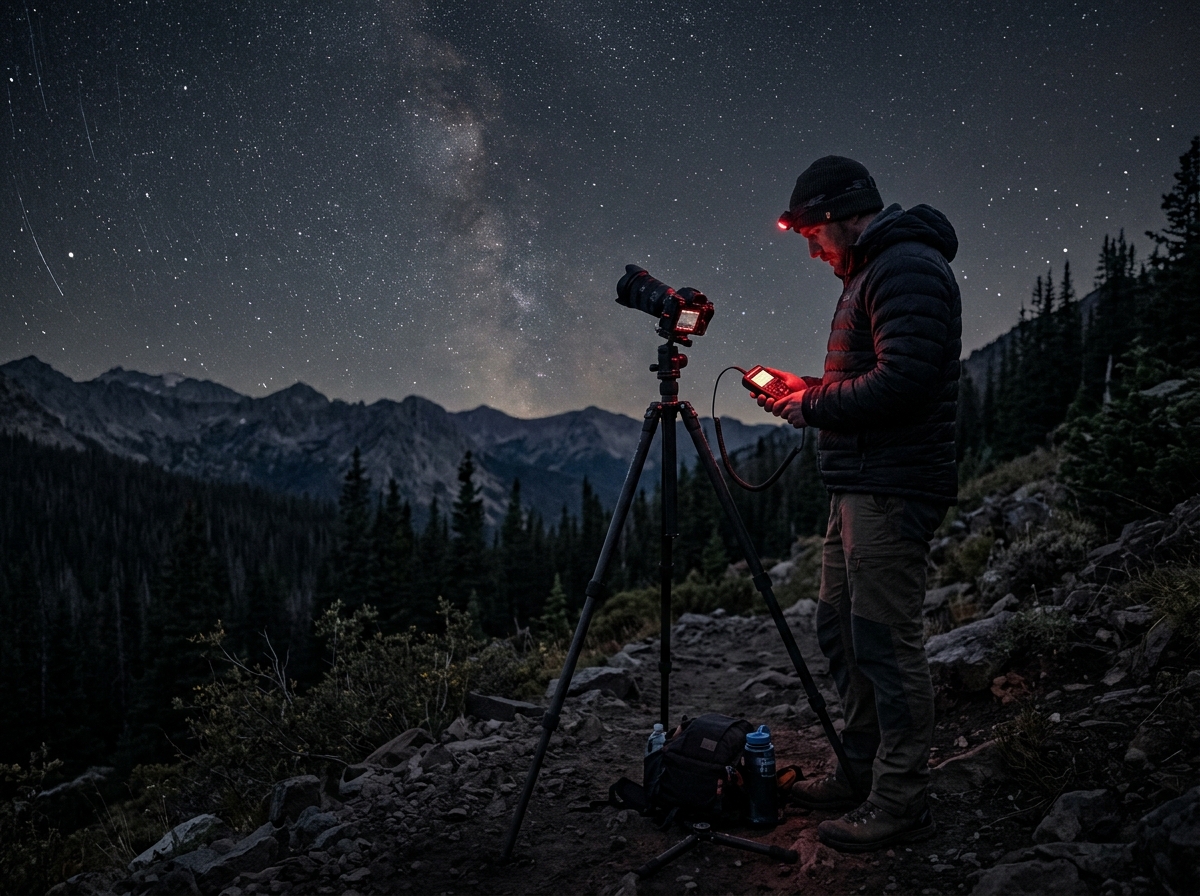
Ready to go? Here is our step-by-step workflow:
- Arrive Early: Scout your location during the day. Find your foreground and identify where North is.
- Setup: Level your tripod. Double-check your battery and memory card space.
- Test Shots: Crank your ISO up to 6400 and take a 5-second shot. This will look grainy, but it lets you see your composition and focus immediately without waiting 30 seconds.
- Final Settings: Drop your ISO back down to 800 or 1600, set your aperture, and set your shutter to 30s.
- Light Painting: If your foreground is too dark, use a flashlight to quickly “paint” light onto the trees or rocks during one of your exposures. Don’t do it for all of them, or it might look overexposed.
- The Sequence: Start your intervalometer and settle in. This is a great time for a thermos of coffee.
- Post-Shoot: Take your dark frames (lens cap on) before you pack up.
For a deeper dive into the basics, our Night Sky Photography: A Beginner’s Guide is a great companion.
Blending and Enhancing Your Final Image
After stacking, you might find the image looks a bit flat. We use “Linear RAW” conversion to keep the colors as accurate as possible. You’ll want to balance the exposure so the sky isn’t too bright (which hides the stars) but the foreground is still visible.
Key adjustments in post-processing:
- Contrast: Boosting contrast helps the stars “pop” against the dark sky.
- Clarity/Dehaze: These tools are great for cutting through any slight atmospheric haze.
- Color Correction: Refer to Color Correction Techniques for Night Sky Photos on Your Smartphone to fix any orange glow from distant city lights.
If you’re new to the digital darkroom, check out Astrophotography Post-Processing for Beginners.
Integrating the Foreground
A common problem is that if you expose for the stars for three hours, your foreground might look like a silhouette. To fix this, we often take a “foreground plate.”
This is one long exposure (maybe 2-5 minutes) taken during “Blue Hour” (twilight) when there is still a little light in the sky. Since the camera hasn’t moved, you can later mask this beautifully lit foreground over your star trail stack in Photoshop. This gives you the best of both worlds: sharp, bright trails and a detailed, clear landscape.
This technique is even possible on modern phones; see Unlocking the Galaxy: Photographing Stars with a Smartphone for blending tips.
Frequently Asked Questions about Star Trails
How long do I need to shoot for a full circular trail?
To get a “full” circle, you would technically need 24 hours (which is impossible due to the sun!). However, for a visually “complete” feel where the arcs are long and sweeping, aim for 3 to 4 hours. With an ultra-wide lens, this captures enough of the rotation to create that beautiful vortex effect.
Can I shoot star trails with a smartphone?
Yes! While it used to be impossible, modern smartphones have “Night Mode” or specialized apps that allow for long exposures. You will still need a tripod and an app that supports interval shooting or “Light Trail” mode. Check out Long Exposure Tips for Smartphone Night Photos and Starry Night: How to Photograph Stars with Your Phone for the best apps to use.
How do I prevent my lens from fogging up?
This is a shoot-killer. As the temperature drops, moisture in the air condenses on your glass.
- Lens Heaters: These are USB-powered strips that wrap around your lens.
- The Sock Hack: Cut the toe off a thick wool sock and slide it over your lens barrel. It provides just enough insulation to keep the glass slightly warmer than the air.
- Hand Warmers: Use a rubber band to strap a chemical hand warmer to the side of the lens.
Conclusion
At Pratos Delícia, we believe that mastering the night sky is one of the most rewarding challenges a photographer can face. Capturing long exposure star trails isn’t just about technical settings; it’s about the experience of sitting in the stillness of the night and watching the universe move.
With a bit of patience, a sturdy tripod, and the right planning, you can turn a simple night out into a masterpiece. Remember to stay safe, dress warmly, and always tell someone where you’re going if you’re heading into the wilderness for a shoot.
Ready to take your night photography to the next level? Explore more in our comprehensive guides and start making the night sky spin!
