
Essential Gear and Planning for Night Sky Success
To master how to composite night sky photos, we first need to talk about the tools of the trade. While you can certainly dabble with entry-level gear, achieving those high-resolution, gallery-quality results often requires a specific kit. In our experience, using a full-frame mirrorless system like the Sony Alpha 7 IV provides the dynamic range and low-light performance necessary to pull detail out of the shadows.
When it comes to glass, we recommend a fast prime lens. The 14mm f/1.8 GM is a favorite among professionals because its wide aperture allows a massive amount of light to hit the sensor, which is critical when you are limited by short exposure times. However, even the best camera can’t save a blurry photo. A sturdy tripod is non-negotiable; even a slight breeze can ruin a 30-second exposure or a multi-frame panorama.
For those looking to take their sky detail to the next level, a star tracker is a game-changer. These devices counter the Earth’s rotation, allowing you to take exposures of 60 to 120 seconds without the stars turning into streaks. This results in a much higher signal-to-noise ratio.
The Importance of Planning
Planning is just as important as the gear. We always check three main factors before heading out:
- Moon Phases: A new moon is best for seeing the Milky Way, but a 25% illuminated moon can actually be helpful for lighting your foreground naturally.
- Light Pollution: Use light pollution maps to find locations away from city glows.
- Weather and Dew Point: High humidity can lead to “foggy” stars. We look for low dew points and clear skies. If you’re shooting near the coast, checking the dew point is essential for maximum clarity.
For more on the basics of night photography, check out our internal link to a relevant Pratos Delícia guide.
How to Composite Night Sky Photos: The Shooting Phase
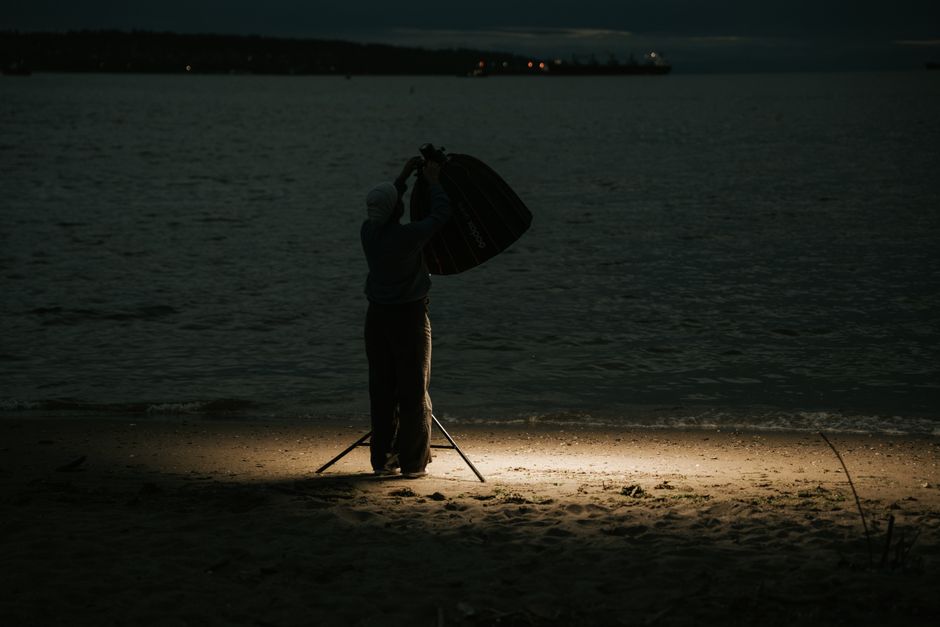
When we get into the field, the “shooting phase” is actually two separate missions: one for the sky and one for the ground.
Shooting the Sky
To keep stars sharp without a tracker, we follow the 500 Rule (500 divided by your focal length equals your max shutter speed). For a 20mm lens, that’s 25 seconds. We typically set our ISO between 400 and 1600, though some modern Sony sensors can handle ISO 3200 or 6400 with minimal “hot pixel” noise. Always use manual infinity focus; autofocus will almost certainly fail in the dark.
Capturing the Foreground
This is where the “composite” magic happens. We have a few favorite methods for getting a clean foreground:
- Blue Hour Blending: We arrive early and shoot the foreground just after sunset (the blue hour). The tripod stays in the exact same spot until the stars come out. This gives us a perfectly lit, low-noise foreground.
- The Starlight Method: We leave the shutter open for 4–8 times longer than the sky exposure (sometimes 5–10 minutes) to soak up every bit of ambient starlight.
- Light Painting: We use low-level LED panels or a flashlight to “paint” light onto specific subjects like trees or old buildings. Pro tip: keep your body between the light and the camera to avoid light streaks in your shot!
If you’re starting out with simpler gear, you might find our guide on combining-multiple-exposures-on-phone-for-the-perfect-shot helpful for understanding the logic of blending.
Mastering Exposure for Your Night Sky Composite
To truly understand how to composite night sky photos, you must embrace image stacking. Stacking involves taking 20 to 50 identical exposures of the sky and “averaging” them in software. This drastically reduces digital noise and makes the Milky Way pop.
Always shoot in RAW format. RAW files contain significantly more data in the highlights and shadows, which is vital when you start pushing sliders in Photoshop. For mobile enthusiasts, we’ve covered stacking-smartphone-astrophotography-images-for-clear-views to show that these principles apply to almost any device.
Step-by-Step: Blending Sky and Foreground in Photoshop
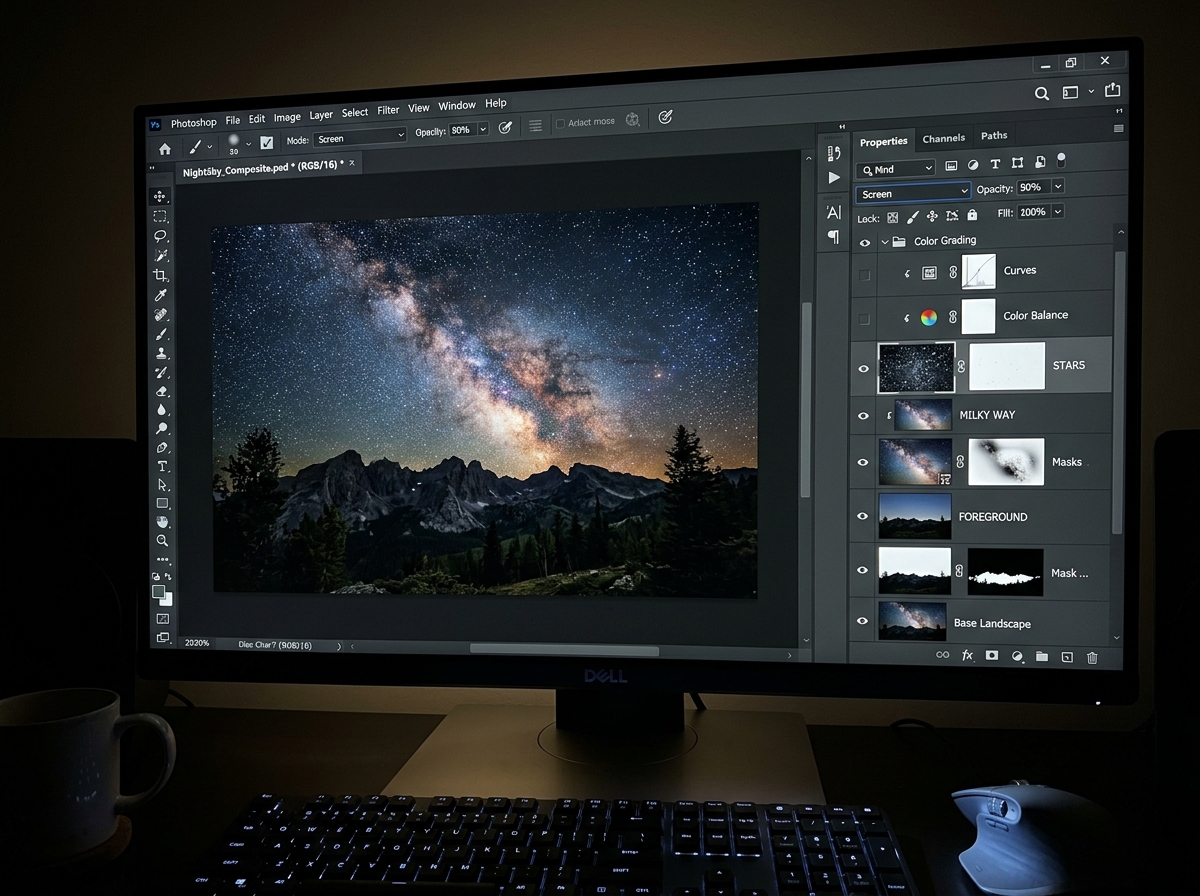
Once we’re back at the computer, it’s time to assemble the pieces.
- Load Files into Stack: Go to File > Scripts > Load Files into Stack. Put your sky on one layer and your foreground on the layer below.
- Initial Alignment: If you didn’t move your tripod, they should align perfectly. If they don’t, use the Move tool and Free Transform (Ctrl/Cmd + T).
- The “Select Sky” Trick: In newer versions of Photoshop, you can go to Select > Sky on your foreground layer. Then, Alt-click the Layer Mask icon to hide the original, messy sky.
- The Lighten Blend Mode: If you’re adding stars to a city scene, try changing the sky layer’s blend mode to “Lighten.” This tells Photoshop to only show pixels that are brighter than the layer below—perfect for making stars appear through a dark sky without complex masking.
- Puppet Warp: If you shot a panorama and the horizons don’t quite match, Edit > Puppet Warp allows you to “pin” the landscape and gently stretch the sky to meet the horizon line perfectly.
- Match Color: Go to Image > Adjustments > Match Color. Select your sky as the source to make the foreground’s color temperature and luminance match the cool, dark tones of the night.
For more detailed editing tips, see our internal link to a relevant Pratos Delícia guide.
Advanced Techniques to Composite Night Sky Photos Seamlessly
To make your composite look “real” rather than “photoshopped,” we use a few pro secrets. First, we often use a plugin like StarXTerminator. This allows us to temporarily remove the stars so we can edit the nebulosity and dust clouds of the Milky Way using an S-curve in the Curves tool without bloating the star sizes.
Another trick is the Blend If slider. By double-clicking a layer, you can use the “Underlying Layer” slider (hold Alt/Option to split the triangle) to feather the horizon. This prevents that “cut-out” look where the sky meets the mountains.
If you are interested in more creative edits, our article on star-trail-image-editing-a-new-dimension-to-the-night-sky dives deep into artistic night processing.
Creating Motion: Star Trails and Celestial Movement
Sometimes, we don’t want static stars; we want to show the passage of time.
If you use Olympus cameras, the Live Composite mode is legendary. It builds the image in real-time, only adding new light (like moving stars) to the base exposure. For Sony and other users, we achieve this by stacking hundreds of 30-second exposures.
To get that classic spiral look, aim your camera toward Polaris (the North Star). If you aim East or West, the stars will appear as straight lines or slight arcs.
| Feature | Single Long Exposure | Stacked Composite |
|---|---|---|
| Noise Level | High (Sensor Overheating) | Very Low (Averaged) |
| Star Detail | Often Bloated | Sharp and Defined |
| Foreground | Usually Silhouetted | Detailed (if shot separately) |
| Flexibility | Fixed | Can adjust trail length in post |
Software like Starry Landscape Stacker (Mac) or DeepSkyStacker (Windows) are the industry standards for aligning these frames. These tools are much more powerful than Photoshop’s basic auto-align feature for stars.
Check out our internal link to a relevant Pratos Delícia guide for a deeper look at star trail gear.
Frequently Asked Questions about Night Sky Compositing
How do I avoid unnatural halos when I composite night sky photos?
Halos usually happen because of “hard” masks. We use a very soft brush (0% hardness) when painting our layer masks near the horizon. Another trick is to slightly brighten the sky right at the horizon line using a Curves adjustment; this mimics the natural atmospheric glow and helps the transition look more organic.
What is the best software for stacking Milky Way shots?
For Mac users, Starry Landscape Stacker is incredibly user-friendly. For those who want professional, scientific-grade results, Astro Pixel Processor or PixInsight are the heavy hitters. If you are on a budget, DeepSkyStacker is a fantastic free option.
Can I use moonlight to light my foreground?
Absolutely! We actually prefer a little moonlight. A moon that is roughly 25% illuminated provides enough directional light to create soft shadows and textures in the landscape without washing out the Milky Way. It’s much more natural-looking than a blue hour blend.
Conclusion
At Pratos Delícia, we believe that learning how to composite night sky photos is the bridge between taking a snapshot and creating a piece of art. It requires patience—both in the cold night air and behind the computer screen—but the results are worth every second. By mastering realistic blending, color matching, and stacking, you can turn a dark, noisy evening into a magical celestial masterpiece.
Ready to take your skills further? Explore our full category of guides to continue your journey into creative photography.
