
Star Tracking is Overrated: A Guide to Static Astrophotography
You Don’t Need a Star Tracker to Shoot Deep-Sky Objects
Astrophotography without star tracker is absolutely possible — and it can produce stunning, noise-free images of nebulae, star clusters, and the Milky Way using gear you likely already own.
Here’s the quick answer:
- Camera: Any modern DSLR with ISO 6400 or higher
- Lens: Any lens from 14mm to 200mm
- Tripod: Any sturdy tripod
- Technique: Shoot 50-100 short exposures, then stack them in free software like DeepSkyStacker
- Key rule: Use the 500 Rule — divide 500 by your focal length to get your max shutter speed before star trails appear (e.g., 10 seconds at 50mm)
That’s the core of it. No mount. No polar alignment. No expensive gear.
Most beginners assume a star tracker is required for deep-sky photography. It’s not.
The old way required long single exposures — minutes at a time — to collect enough light from faint objects. That’s where a tracker became essential. Without one, stars would streak across the frame.
But modern DSLRs changed everything. Sensors capable of clean ISO 6400 images mean you can capture usable data in just 1-3 seconds per frame. Stack 100 of those frames together, and the software does the “tracking” for you — aligning each frame digitally to cancel noise and reveal faint details.
The result? A limiting magnitude of around 14mag with a 135mm lens and 100 stacked exposures. That’s enough to photograph planetary nebulae, open clusters, and rich Milky Way star clouds — all from a plain tripod.
This guide walks you through every step, from gear and settings to stacking and post-processing.

Quick look at astrophotography without star tracker:
Essential Gear for Astrophotography Without Star Tracker
When we strip away the expensive equatorial mounts and autoguiding systems, what are we left with? Surprisingly, a very capable kit that fits in a standard backpack. To master astrophotography without star tracker, your focus shifts from mechanical precision to optical speed and sensor sensitivity.
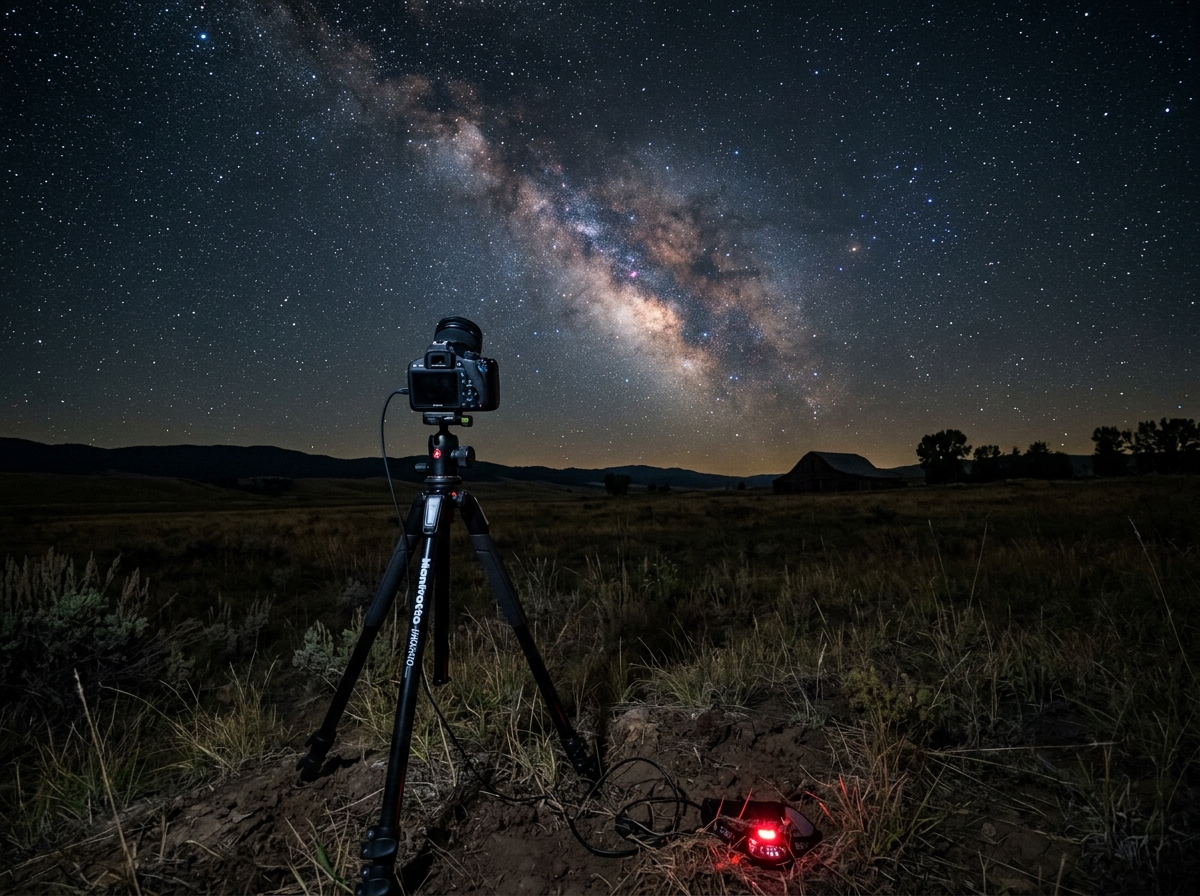
The Camera Body
You don’t need a $5,000 flagship. Any modern DSLR or mirrorless camera released in the last decade will likely suffice. The key requirement is high ISO performance. Since our exposures are limited to a few seconds, we need to “crank up” the sensitivity to capture faint photons. Look for cameras that can handle ISO 3200 to 6400 with manageable noise. If you are shopping on a budget, check out these 6 Inexpensive Astrophotography Cameras That Actually Work to find a used gem for under $300.
Sturdy Tripods
In untracked imaging, the tripod is your foundation. Even a slight breeze or a shaky leg can turn pinpoint stars into blurry messes. We recommend a tripod that can handle at least double the weight of your camera and lens combo. While carbon fiber is great for travel, a heavy aluminum tripod often provides better vibration dampening for the price. You can find several reliable options in our guide to Affordable Tripods for Night Sky Photography.
Lenses and Optics
For static shooting, “fast” lenses (those with wide apertures like f/1.8 or f/2.8) are king. They allow more light to hit the sensor in those precious few seconds before the stars start to trail. While you can certainly do Night Sky Photography Without a Telescope using kit lenses, upgrading to a prime lens like a 50mm f/1.8 or a 135mm f/2.8 will drastically improve your results.
Critical Accessories
- Intervalometer / Remote Release: This is non-negotiable. You need to take 50, 100, or even 500 photos in a row. Pressing the shutter button manually will cause camera shake and exhaust you. An external intervalometer (like those by Neewer) allows you to program the sequence and walk away.
- Bahtinov Mask: A simple plastic grid that fits over your lens. It creates a specific diffraction pattern on bright stars, telling you exactly when your focus is perfect.
- Lens Hood: Essential for blocking stray light from nearby streetlamps and protecting your glass from dew.
Mastering the 500 Rule and Exposure Settings
The biggest challenge of astrophotography without star tracker is the Earth’s rotation. Because our planet spins, the stars appear to move across the sky. If your shutter stays open too long, those points of light become streaks. To keep stars sharp, we must calculate the maximum exposure time allowed for our specific lens.
The 500 Rule Formula
The “500 Rule” is the industry standard for estimating shutter speed. The formula is simple: 500 ÷ Focal Length = Max Shutter Speed (in seconds).
However, you must account for your camera’s sensor size (crop factor). If you are using an APS-C sensor (like most entry-level Nikons or Canons), you multiply the focal length by the crop factor first.
- Full Frame Example (24mm lens): 500 / 24 = 20.8 seconds.
- APS-C Example (24mm lens on 1.5x crop): 500 / (24 * 1.5) = 13.8 seconds.
For pinpoint stars on modern high-resolution sensors, many experts now prefer the “300 Rule” or the more complex NPF rule, but the 500 Rule remains the best starting point for beginners. For a deeper dive into these nuances, see The Ultimate Guide to Best Settings for Stars Photography.
Recommended Exposure Times by Focal Length
| Focal Length | Full Frame Max Exposure | APS-C (1.5x) Max Exposure |
|---|---|---|
| 14mm | 35 seconds | 23 seconds |
| 24mm | 20 seconds | 13 seconds |
| 35mm | 14 seconds | 9 seconds |
| 50mm | 10 seconds | 6 seconds |
| 85mm | 5 seconds | 3 seconds |
| 135mm | 3 seconds | 2 seconds |
| 200mm | 2.5 seconds | 1.5 seconds |
ISO and Aperture
Since our shutter speeds are so short, we have to compensate elsewhere.
- Aperture: Shoot “wide open” (your lowest f-number). If your lens shows significant distortion (coma) at the edges, stop down by one click (e.g., from f/1.8 to f/2.2).
- ISO: Don’t be afraid of high numbers. ISO 3200 or 6400 is standard for untracked work. While a single frame will look noisy, stacking will “clean” that noise later. Learn How to Night Sky Camera Settings the Right Way to balance these three pillars of exposure.
The Secret Sauce: Image Stacking and Calibration
If you take a single 2-second photo of the Orion Nebula at ISO 6400, it will look terrible. It will be grainy, dark, and unimpressive. The “magic” of astrophotography without star tracker happens in the stacking process.
Why Stacking Works
Stacking is a mathematical process that improves the Signal-to-Noise Ratio (SNR). Noise in a digital sensor is random. The signal (the light from the star) is constant. When you stack 100 images, the software averages the pixels. The random noise cancels itself out, while the constant light from the nebula builds up. Stacking 25 images improves your SNR by a factor of 5 (the square root of the number of frames).
The Four Types of Calibration Frames
To get a professional result, you need more than just your “Light” frames (the actual pictures of the sky). You need calibration frames to tell the software what is “noise” and what is “signal”:
- Light Frames: Your actual exposures of the target. Aim for 50-100 minimum.
- Dark Frames: Taken with the lens cap ON, using the exact same shutter speed, ISO, and temperature as your lights. These record the “thermal noise” of your sensor so the software can subtract it.
- Flat Frames: Pictures of a neutral, evenly lit light source (like a white tablet screen) to map out dust spots on your sensor and lens vignetting.
- Bias Frames: Taken at the fastest possible shutter speed with the lens cap on. These record the electrical noise of the sensor’s readout process.
For a step-by-step guide on how to take these, visit Astrophotography Post-Processing for Beginners.
Software Tools for Processing Astrophotography Without Star Tracker
You don’t need to spend a fortune on software. Most of the best tools for untracked imaging are free:
- DeepSkyStacker (DSS): The gold standard for Windows users. It’s free, simple, and handles the alignment of drifting stars perfectly.
- Sequator: Faster and more user-friendly than DSS, especially for Milky Way shots with a foreground.
- Siril: A powerful, cross-platform tool that offers advanced processing features similar to paid software.
- Mobile Options: If you’re shooting on a phone, check out Stacking Smartphone Astrophotography Images for Clear Views.
Once stacked, you can use GIMP or Adobe Photoshop to “stretch” the data, bringing out the faint colors of nebulae. If you find your final images still have some grain, try Eradicating Noise from Night Photos Using Apps.
Best Deep-Sky Targets for Beginners
You might think you’re limited to just the Milky Way, but many “Deep-Sky Objects” (DSOs) are bright enough to capture without a tracker. Here are our top picks for your first session:
1. The Orion Nebula (M42)
The undisputed king of beginner targets. It is so bright you can see it with the naked eye in a dark sky. At 135mm or 200mm, you can capture incredible purple and pink nebulosity with just 1-second exposures.
2. The Andromeda Galaxy (M31)
Our nearest galactic neighbor is massive—roughly six times the width of the full moon. Even a 50mm lens will show it as a distinct “smudge,” while a 200mm lens will begin to reveal its spiral dust lanes.
3. The Pleiades (M45)
Also known as the “Seven Sisters,” this bright blue open star cluster looks fantastic at almost any focal length. It’s a great target for testing your focus.
4. Sagittarius Star Cloud & Lagoon Nebula
In the summer, the core of our galaxy offers a target-rich environment. Using a 50mm lens, you can capture the “Great Sagittarius Star Cloud” and several bright nebulae like the Lagoon (M8) and Trifid (M20) in a single wide-frame stack. For more ideas, consult Night Sky Photography: A Beginner’s Guide.
Step-by-Step Workflow for a Static Imaging Session
Ready to head out? Follow this proven workflow to ensure your night is productive.
1. Site Selection and Timing
Find a spot away from city lights. Use an app like Light Pollution Map to find “Bortle 4” skies or better. Check the moon phase; you want a “New Moon” or a night where the moon sets early. Ambient moonlight will wash out faint nebulae.
2. Setup and Leveling
Set your tripod on firm ground. Extend the legs but avoid using the center column, as it introduces wobble. Level your camera using the built-in electronic level or a bubble level on the tripod head.
3. Manual Focus
This is where most beginners fail. Your camera cannot autofocus on stars.
- Turn on Live View.
- Find the brightest star in the sky.
- Zoom in 10x on your LCD screen.
- Slowly turn the focus ring until the star is a tiny, sharp point.
- Pro Tip: Use a piece of painter’s tape to secure the focus ring once set. For more tips, see Focusing on Stars: A Guide to Sharp Night Skies.
4. Framing and the “Drift”
Because you aren’t tracking, your target will move across your sensor.
- Aim your camera so the target is on the leading edge of the frame.
- Let it drift through the center during your sequence.
- Every 50-100 frames, you will likely need to pause and re-center the target.
5. Shooting the Sequence
Set your intervalometer. For a 50mm lens, we might set:
- Shutter: 6 seconds
- Interval: 8 seconds (gives the camera 2 seconds to save the file)
- Count: 100 shots
- ISO: 6400
- White Balance: Daylight or 4500K (don’t use Auto).
If you are a Nikon user, check out Nikon Astrophotography Settings That Won’t Leave You in the Dark for specific menu tweaks.
Frequently Asked Questions about Untracked Imaging
Can I capture galaxies without a telescope?
Absolutely. As mentioned, the Andromeda Galaxy is huge. Even smaller galaxies like M81 and M82 or the Triangulum Galaxy (M33) are achievable with a 200mm lens. The key isn’t magnification; it’s the total amount of light you collect through stacking. Check out our Budget Astrophotography: A Beginner’s Guide to the Galaxy for more on galaxy hunting.
How many exposures do I need for a clean image?
While you can see results with as few as 20 frames, we recommend aiming for at least 100 light frames. This provides enough data for the stacking algorithms to effectively differentiate between the “noise floor” and the faint signal of the DSO. Stop Fearing High ISO for Low Light Photography—the more frames you have, the higher the ISO you can get away with.
Is a DIY barn door tracker worth it?
A “barn door tracker” is a simple device made of two pieces of wood, a hinge, and a threaded rod. By turning a screw at a specific rate (usually one rotation per minute), you manually counteract the Earth’s rotation.
- Pros: It’s a fun weekend project; costs under $20; allows for 30-60 second exposures.
- Cons: It’s bulky; requires manual effort; polar alignment is still tricky. For most people, simply taking more short exposures on a static tripod is more efficient and less frustrating than building a DIY mount.
Conclusion
At Pratos Delícia, we believe that the beauty of the cosmos should be accessible to everyone, regardless of their budget. Astrophotography without star tracker proves that you don’t need thousands of dollars in specialized mounts to capture the majesty of the universe. By mastering the 500 Rule, embracing high ISO, and utilizing the power of digital stacking, you can turn a standard DSLR and a tripod into a window to the stars.
The “new epoch” of astrophotography is here—one where software does the heavy lifting, allowing you to travel light and shoot often. Whether you’re capturing your first image of the Orion Nebula or a wide-field masterpiece of the Milky Way, the most important step is simply getting outside and pointing your camera up.
For more tips on starting your journey into the stars without breaking the bank, explore our Budget Astrophotography: A Beginner’s Guide to the Galaxy or visit our homepage at https://pratosdelicia.com/ for the latest guides. Clear skies!
