
Understanding the Fundamentals of Long Exposure Photography
At its core, long exposure photography is the art of “stretching time.” While standard photography aims to freeze a single moment—a bird in flight or a splashing wave—long exposure allows time to accumulate on the camera sensor. This results in the blurring of moving elements while stationary objects remain tack sharp.
Many beginners confuse long exposure with simple night photography. While they share similarities, they are distinct disciplines. Night photography is born out of necessity; there isn’t enough light, so you must leave the shutter open. Long exposure photography, particularly in daylight, is a creative choice. We use specialized tools to “trick” the camera into thinking it is dark, allowing us to capture several seconds or even minutes of motion in the middle of a sunny afternoon.
The primary visual characteristic of this technique is motion blur. Think of those ethereal, “silky” waterfalls or clouds that look like brushed paint across the sky. By using a slow shutter speed, any object that moves during the exposure becomes a soft streak. This contrast between the fluid motion of nature and the rigid stability of rocks or buildings creates a powerful, fine-art aesthetic.
If you are interested in how these techniques translate to the stars, you can learn more about making the night sky spin with long exposures to master star trails and galactic captures.

Essential Gear and Mastering the Long Exposure Guide PDF Essentials
To succeed, your gear must be as stable as a rock. Because the shutter remains open for long periods, even the slightest vibration—a gust of wind or a heavy footstep—can ruin the image.
- A Sturdy Tripod: This is non-negotiable. We recommend avoiding the thin, lightweight “travel” tripods if you are shooting in windy coastal areas. A heavy-duty tripod without an extended center column provides the best vibration resistance.
- Cable Release (Remote Shutter): Touching the camera to press the shutter button causes “camera shake.” A cable release allows you to trigger the shot without physical contact. Most long exposure pros use a lockable release for “Bulb” mode, where the shutter stays open as long as the button is held or locked.
- Gaffer Tape: Surprisingly, this is a “secret weapon” in any long exposure guide pdf. Gaffer tape is residue-free and perfect for sealing light leaks around your viewfinder or filter holder.
When it comes to holding your filters, you generally have two choices:
| Feature | Slot-in Filter Systems (e.g., 100mm) | Screw-on Filters |
|---|---|---|
| Ease of Use | High (easy to slide in/out) | Low (can get stuck or cross-threaded) |
| Stacking | Excellent (multiple slots) | Poor (causes vignetting/dark corners) |
| Graduated NDs | Possible (can slide up/down) | Impossible (fixed horizon line) |
| Cost | Higher initial investment | Lower per-filter cost |
For those who prefer a more portable setup, you can also capture the night with your phone using specialized apps that simulate long exposure effects.
Choosing the Right ND Filters for Your Long Exposure Guide PDF
Neutral Density (ND) filters are the “heart” of this craft. They are essentially sunglasses for your lens. Their only job is to reduce the amount of light entering the camera without changing the color of the scene (though “cheap” filters often fail at this, causing purple or blue shifts).
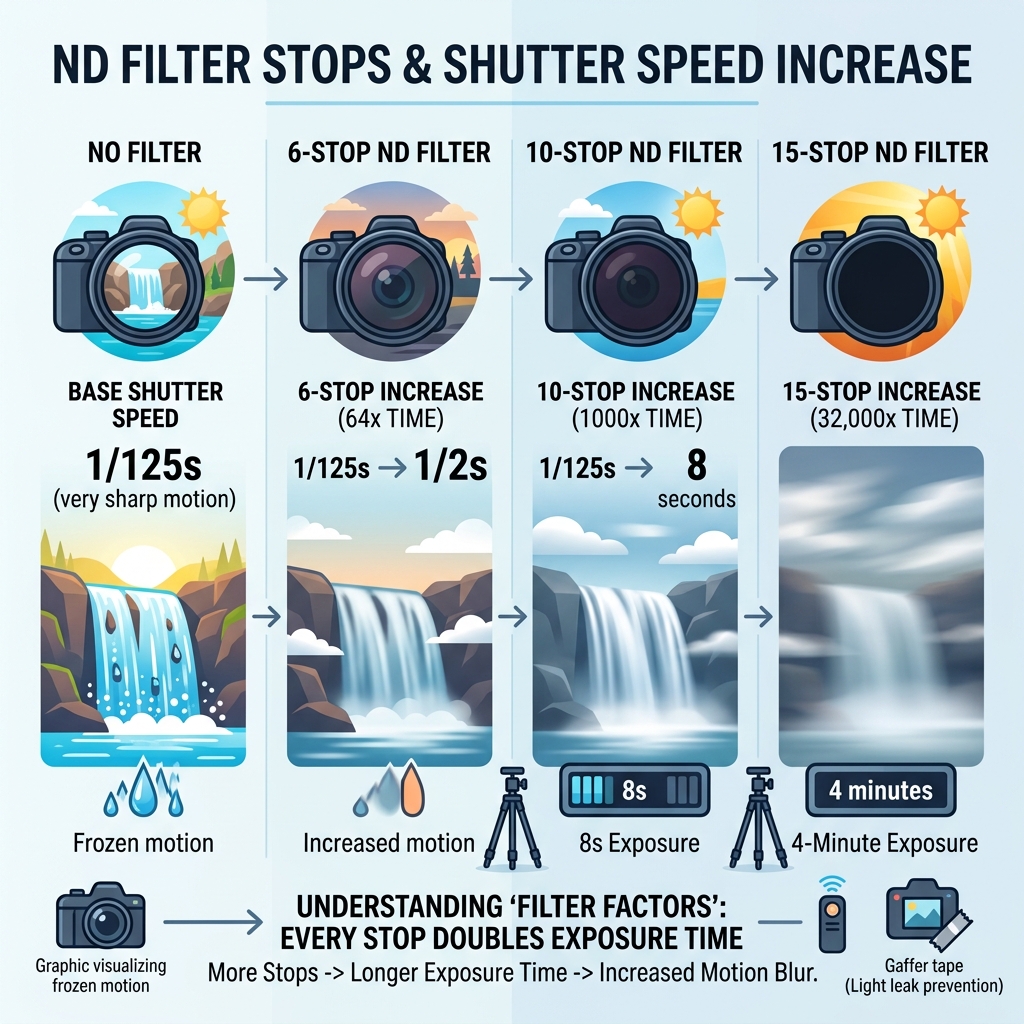
- Solid ND Filters: These come in different “stops.” A 6-stop filter is great for late afternoon, while a 10-stop filter is the industry standard for midday long exposures, turning a 1/125th second shutter speed into an 8-second exposure.
- Graduated ND Filters: These are dark at the top and clear at the bottom. They are crucial for balancing a bright sky with a dark foreground, ensuring your clouds aren’t “blown out” while your rocks remain visible.
Essential Accessories for Sharp Images
Beyond the basics, a few small items make a massive difference in fieldwork success. Always check if your camera has an eyepiece cover. During long exposures, light can actually leak in through the viewfinder and create strange purple streaks on your sensor. If you don’t have a built-in cover, a piece of gaffer tape works perfectly.
If you are shooting in harsh environments, such as snow, you should look into tips for winter long exposures to protect your battery life and gear from the cold.
Step-by-Step Camera Setup and Exposure Calculation
Success in long exposure is about being methodical. We suggest following a repeatable “checklist” to ensure you don’t miss a step.
- Compose and Focus: Set up your shot before putting the dark filters on. Once a 10-stop ND is attached, you won’t be able to see anything through the viewfinder.
- Lock Focus: Switch your lens to Manual Focus (MF) so the camera doesn’t try to hunt for focus once the filters are on.
- Base Exposure: Take a test shot in Manual Mode without filters. Aim for an aperture between f/8 and f/16 for maximum sharpness and an ISO of 100 to minimize noise.
- Calculate: Use the shutter speed from your test shot to calculate your new “long” shutter speed based on the ND filter you are using.
- Attach Filters and Shoot: Carefully slide in your filters, cover the viewfinder, and use your remote release.
For help with the math, there are several top mobile apps for exposure calculation that do the heavy lifting for you.
Calculating Shutter Speeds with a Long Exposure Guide PDF
Understanding “Filter Factors” is key. Every “stop” of an ND filter doubles the exposure time.
- 1-stop: Double the time (1s becomes 2s).
- 6-stops: 64x the time (1/60s becomes 1s).
- 10-stops: 1,000x the time (1/125s becomes 8s).
We always recommend bracketing your exposures. This means taking one shot at the calculated time, one slightly shorter, and one slightly longer. Motion is unpredictable, and sometimes a 10-second blur looks better than a 30-second blur. If you are using a phone, check out these smartphone long exposure tips for better manual control.
Overcoming Common Pitfalls: Light Leaks and Sensor Noise
Even pros run into issues. The most common “shot-killer” is the light leak. This happens when light enters the camera from somewhere other than the front of the lens. It usually appears as a magenta or purple haze across the image.
How to fix it:
- Seal the Filter Holder: Use gaffer tape to cover the gaps between the filter and the holder.
- Cover the Viewfinder: This is the #1 culprit on DSLR cameras.
- Check the Lens: Some older lenses have a “distance scale” window that can leak light; tape it up!
Another issue is sensor noise. When a sensor runs for minutes at a time, it gets hot, creating “hot pixels” or grainy artifacts. To combat this, enable Long Exposure Noise Reduction (LENR) in your camera settings. This will double your wait time, as the camera takes a second “dark frame” to identify and subtract the noise.
Finally, always shoot in RAW format. Long exposures often have slight color shifts (becoming too blue or too warm). Shooting in RAW allows you to perfectly correct the white balance in post-processing without losing image quality.

Where to Find a Legitimate Long Exposure Guide PDF
While blogs are great, a long exposure guide pdf is an essential tool for the serious landscape photographer. Why? Because when you are standing on a remote beach at 5:00 AM, you might not have cell service to look up an exposure chart.
A downloadable PDF allows you to:
- Access Info Offline: Keep it on your phone or tablet for instant reference.
- Print Exposure Tables: Many guides include “cheat sheets” you can tape to your tripod leg.
- Study Methodically: Guides like those by Kent DuFault or Breakthrough Filters offer 50 to 100+ pages of deep-dive technical knowledge that a 500-word blog post simply can’t match.
Investing time in a dedicated guide ensures you understand the why behind the settings, not just the how.
Frequently Asked Questions about Long Exposure
Is long exposure the same as night photography?
Not exactly. While night photography uses long exposures to capture dim light, “Long Exposure Photography” as a genre usually refers to using ND filters during the day to blur clouds and water. The equipment (filters) and the creative intent (artistic blur) are different.
Why do I need gaffer tape for photography?
Gaffer tape is the “duct tape” of the photo world but better because it doesn’t leave a sticky mess. It is essential for sealing light leaks, securing your focus ring so it doesn’t move, and even holding filters in place in an emergency.
How do I prevent purple color shifts in my images?
Purple shifts are usually caused by infrared light leaking through lower-quality resin filters. To prevent this, invest in high-quality pro-grade glass filters. You can also fix minor shifts in post-production by adjusting the “Tint” and “Temperature” sliders in your editing software.
Conclusion
At Pratos Delícia, we believe that photography is about more than just clicking a button; it’s about capturing a vision that the human eye can’t see on its own. Long exposure photography opens up a world of ethereal beauty, turning chaotic waves into calm mist and moving clouds into dramatic streaks.
By downloading a long exposure guide pdf and following the methodical steps of stabilizing your gear, calculating your stops, and guarding against light leaks, you’ll be well on your way to fieldwork success. Don’t be afraid to experiment with different shutter speeds to see how they change the “mood” of your composition.
Ready to take your skills to the next level? Explore more photography guides on our site to master everything from mobile editing to winter landscapes. Happy shooting!
