
Essential Gear for Long Exposure Light Trails
To capture high-quality long exposure light trails, we need to move beyond handheld shooting. Because the shutter stays open for several seconds (or even minutes), any tiny movement of the camera will result in a blurry mess rather than crisp, sharp streaks of light.
- A Sturdy Tripod: This is the single most important piece of equipment. It acts as the anchor for our camera. Even a slight breeze or a heavy truck passing by can cause “camera shake,” so a weighted or heavy-duty tripod is preferred.
- DSLR or Mirrorless Camera: You need a camera that allows for “Manual Mode” (M). This gives us full control over the shutter speed, aperture, and ISO.
- Wide-Angle Lens: While you can use any focal length, a wide-angle lens (like a 14mm to 35mm) is the industry standard for urban landscapes. It allows us to capture the vastness of the city and longer, more sweeping light paths.
- Remote Shutter Release: Even the act of pressing the shutter button with your finger can cause vibrations. A cable release or wireless remote allows us to trigger the shot without touching the gear. If you don’t have one, using the camera’s built-in 2-second or 5-second self-timer is a great “hack” to achieve the same result.
- Lens Hood: This helps block stray light from street lamps or buildings that might hit the lens at an angle and cause unwanted flare.
- Smartphone (Optional): Modern phones are surprisingly capable. If you are starting out without a dedicated camera, check out our guide on Capture the Night: Long Exposure Smartphone Photography to see how mobile apps can mimic these professional effects.
Mastering Camera Settings and Timing
Getting the exposure right in the dark is a balancing act. We aren’t just trying to make the photo “bright”; we are trying to record the movement of light over time.
The Manual Mode Formula
We always recommend shooting in Manual Mode. Here is the baseline we use to start:
- ISO 100: Keep your ISO as low as possible. Higher ISOs (like 1600 or 3200) introduce “noise” or grain, which can ruin the clean look of light streaks.
- Aperture (f/8 to f/16): A narrow aperture (higher f-number) does two things: it keeps the entire city scene in focus and it turns bright, stationary streetlights into beautiful “starbursts.”
- Shutter Speed (5 to 30 seconds): This is where the magic happens. You want the shutter to stay open long enough for a car to travel completely through your frame. If the car only gets halfway through when the shutter clicks shut, the trail will look cut off and awkward.
- RAW Format: Always shoot in RAW. This file type captures much more data than a standard JPEG, allowing us to recover details in the dark shadows or bright highlights during editing.
- Manual Focus: Autofocus often struggles in the dark. We suggest using autofocus on a bright distant building once, then flipping the switch on the lens to “M” (Manual) to lock it in place. Or, manually set your focus to “infinity.”
Timing and the “Blue Hour”
While you can shoot in total darkness, the most professional-looking long exposure light trails are often captured during the Blue Hour. This is the short window of time (about 20-40 minutes) just after the sun has set but before the sky turns pitch black. During this time, the sky is a deep, rich blue, which provides a stunning contrast to the warm orange and red light trails of the traffic.
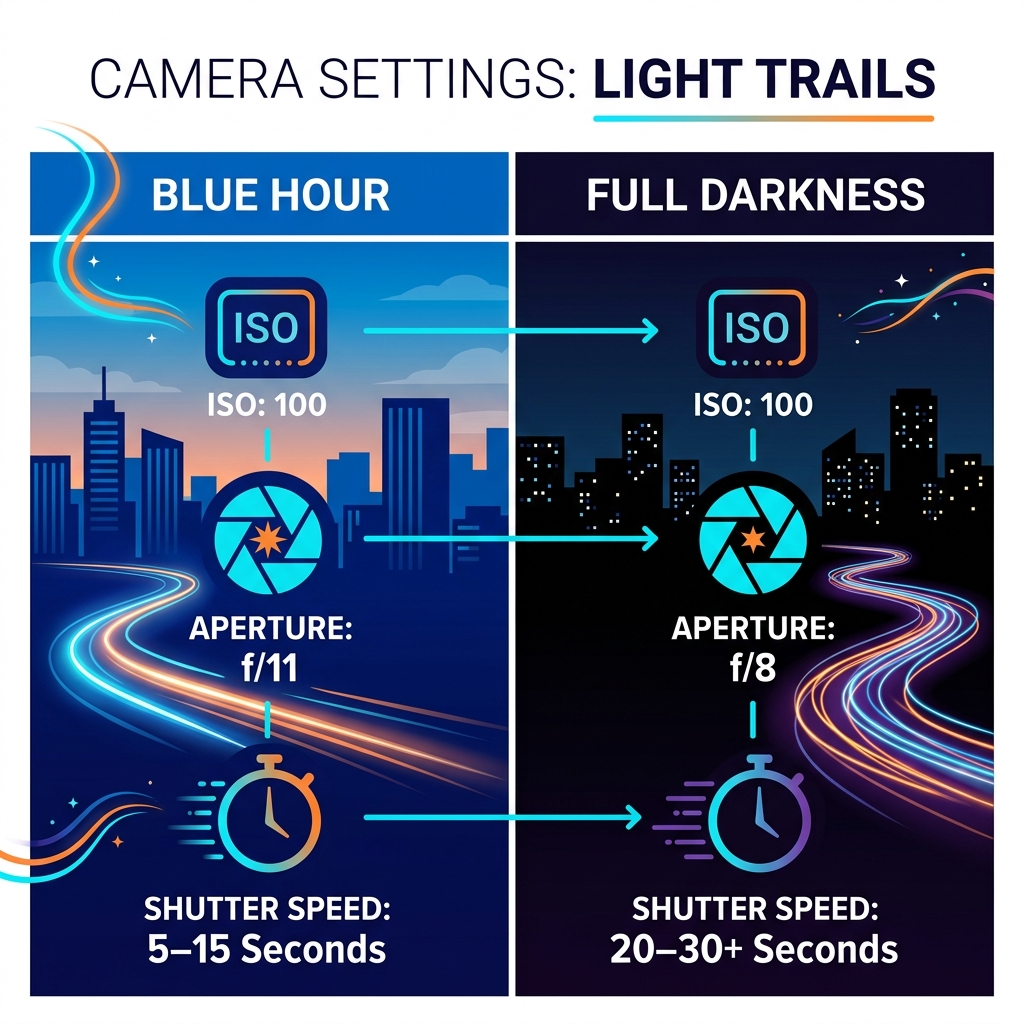
Table: Typical Settings Comparison
| Condition | ISO | Aperture | Shutter Speed |
|---|---|---|---|
| Blue Hour | 100 | f/11 | 5-15 Seconds |
| Full Darkness | 100 | f/8 | 20-30+ Seconds |
If you find that your phone is your primary tool, you can still achieve these results by using the Top Mobile Camera Apps for Long Exposure Shots to gain manual control over your sensor.
Composition and Urban Location Scouting
A road with light trails is cool, but a road with light trails and a beautiful background is a masterpiece. When scouting for locations, look for “vantage points”—places where you are slightly elevated above the traffic.
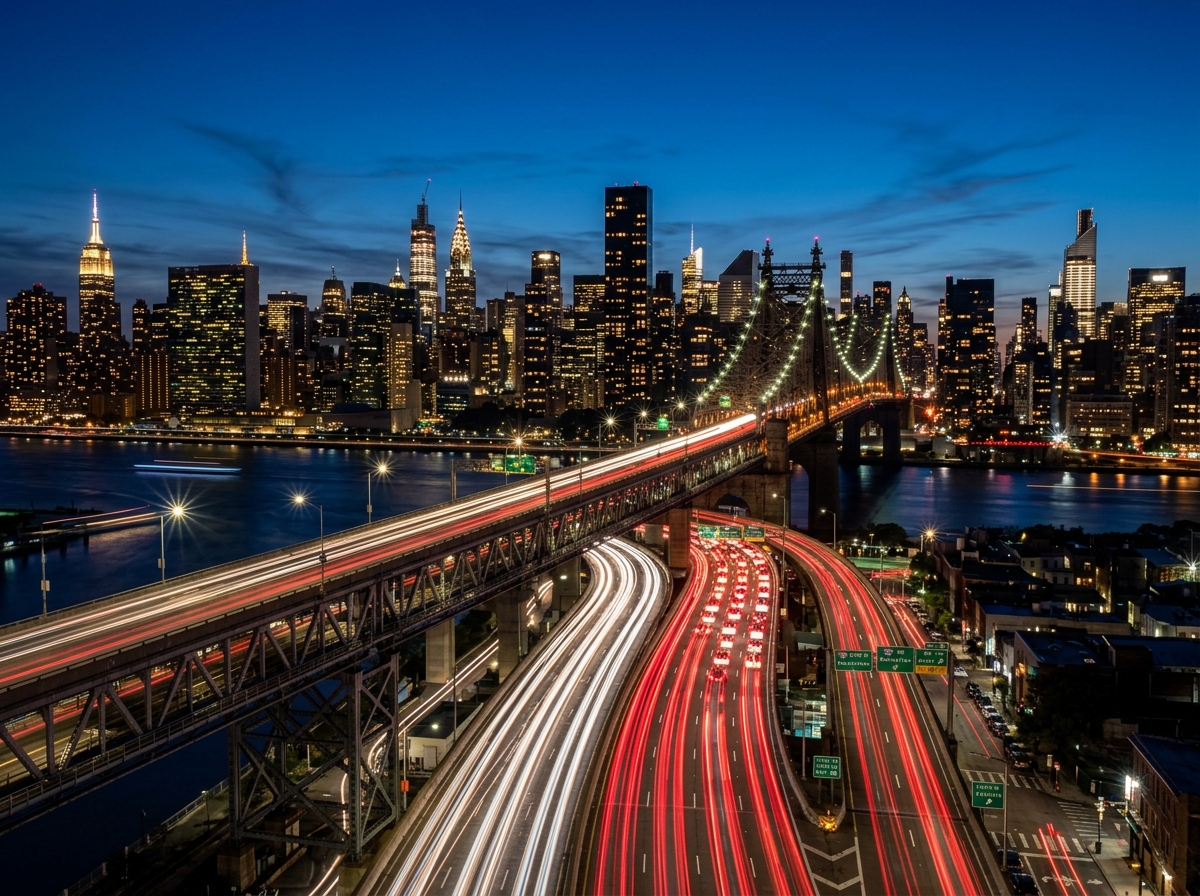
- Bridges and Overpasses: These are the “holy grail” for light trail photographers. They allow you to look down on the highway, capturing the symmetry of cars moving in both directions.
- Roundabouts: These create circular, swirling light patterns that look futuristic and dynamic.
- Leading Lines: Use the road itself as a “leading line.” Position your camera so the light trails start in a corner of the frame and lead the viewer’s eye toward a central subject, like a skyscraper or a monument.
- Symmetry: If you are on a pedestrian bridge over a highway, centering your camera can create a perfectly balanced image with white “headlight” trails on one side and red “taillight” trails on the other.
Using Leading Lines with Long Exposure Light Trails
In the concrete jungle, architecture provides the perfect framework. Use the diagonal lines of curbs, railings, and buildings to complement the flow of the traffic. This creates a sense of “visual flow” that keeps the viewer engaged. Interestingly, these same principles of motion and composition apply to other types of photography, such as How to Capture Frozen Beauty with Winter Long Exposures, where the movement of clouds or water replaces the movement of cars.
Safety Precautions for Night Photography
We cannot stress this enough: Safety is your priority.
- Be Visible: Wear high-visibility or reflective clothing if you are anywhere near active roadways.
- Stay on Sidewalks: Never step into the road to “get the shot.” Use a zoom lens if you need to get closer.
- Legal Considerations: Some bridges or private plazas have “no tripod” rules. Always check for signs or ask security to avoid being moved along mid-exposure.
- The Buddy System: Shooting in dark urban areas is safer and more fun with a friend.
Advanced Techniques and Post-Processing
Sometimes, a single 30-second exposure isn’t enough. If the traffic is sparse, your photo might only have one or two thin light lines. This is where image stacking comes in.
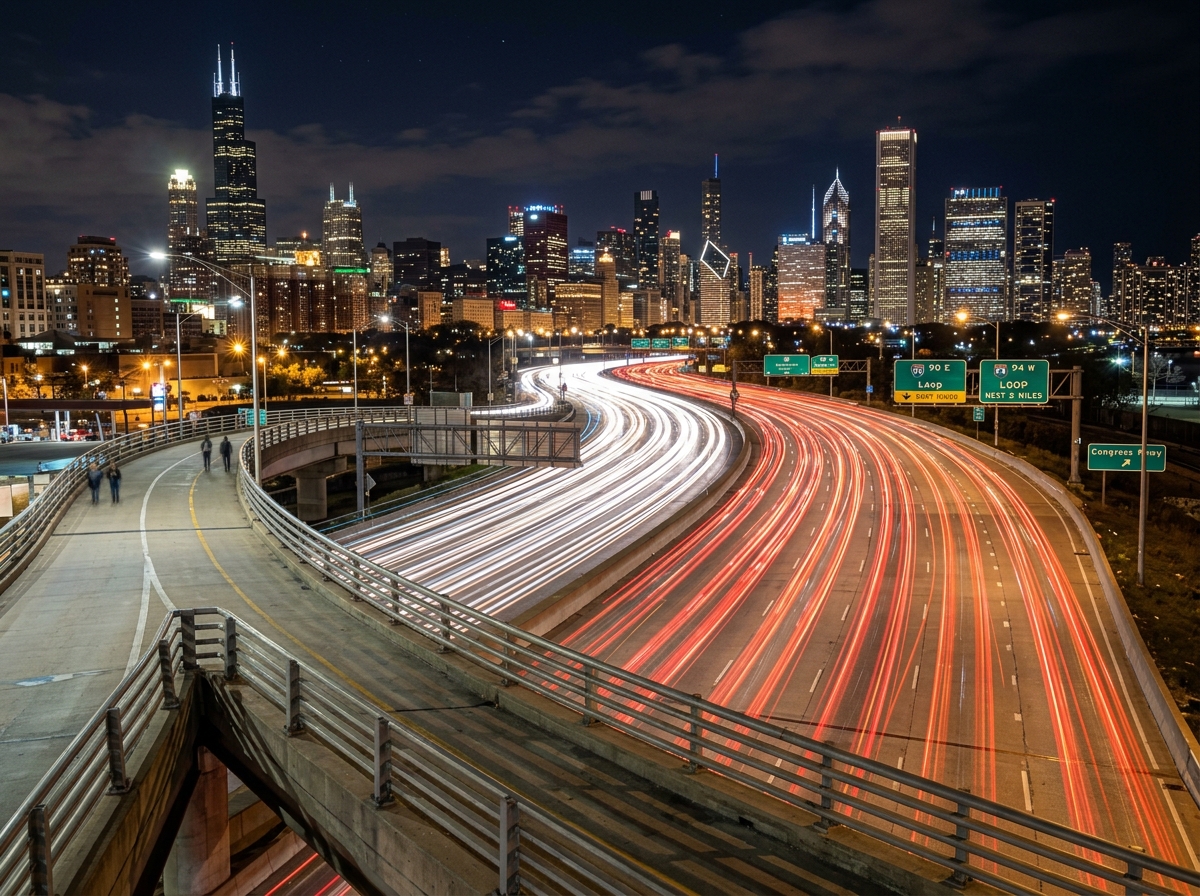
Image Stacking and Photoshop
Instead of taking one long shot, take ten 20-second shots in a row without moving the tripod. In post-processing software like Adobe Photoshop, you can “stack” these images. By setting the “Blend Mode” of the layers to Lighten, the software will only show the brightest parts of each layer. The result? A single image that looks like it has hundreds of light trails, even if only a few cars passed by at a time. This technique is very similar to how astronomers create star paths; you can learn more about the similarities in our guide on Star Trail Image Editing: A New Dimension to the Night Sky.
Creative Variations of Long Exposure Light Trails
- In-Car Shooting: Want a “warp speed” look? Secure your tripod in the backseat of a car and take a long exposure through the windshield while a friend drives. The city lights will rush toward the camera like stars in a sci-fi movie.
- Train and Plane Trails: Don’t limit yourself to cars. Trains entering a station or planes taking off at an airport create massive, thick ribbons of light that look incredible.
- Light Painting: You can become the light source! Use a flashlight or glow stick to “draw” in the air during a long exposure. For a cosmic twist, see how we use these same long-shutter techniques for Making the Night Sky Spin with Long Exposures.
Creating Digital Trails in Photoshop
If you missed the shot or the traffic was just too light, you can actually “paint” trails digitally.
- Pen Tool: Use the Pen tool to draw a smooth, curved path along the road.
- Stroke Path: Select a bright brush and “stroke” that path.
- Motion Blur Filter: Apply a Motion Blur filter to the line to give it that “streaked” look.
- Layer Masks: Use masks to hide the trail where it should go behind buildings or trees, ensuring it looks like it belongs in the 3D space of the photo.
Frequently Asked Questions about Night Photography
What are the best shutter speeds for light trails?
For most city streets, 10 to 20 seconds is the “sweet spot.” If you are on a fast-moving highway, you might only need 5 to 8 seconds. If you want to capture a very slow-moving bus or a train, you might need to go up to 30 seconds or use “Bulb Mode” for even longer durations.
How do I prevent blurry images on a tripod?
Aside from using a remote trigger, make sure to turn off Image Stabilization (IS or VR) on your lens. When a camera is on a tripod, the stabilization system can actually “hunt” for movement that isn’t there, creating a tiny internal vibration that blurs the shot. Also, avoid extending the center column of your tripod if it’s windy, as this makes the setup top-heavy and prone to wobbling.
Can I shoot light trails on a smartphone?
Yes! While the native camera app might struggle, third-party apps allow you to manually set a long shutter speed. You will still need a mobile tripod or a way to prop the phone up perfectly still. For more specific advice on mobile gear, check out our Long Exposure Tips for Smartphone Night Photos.
Conclusion
At Pratos Delícia, we believe that photography is about more than just documenting a scene—it’s about using your artistic vision to reveal the hidden energy of the world around us. Long exposure light trails transform the chaotic, noisy reality of city traffic into a serene, glowing work of art.
It takes a bit of practice to get the timing right, and you might spend an hour on a cold bridge just to get one perfect shot, but the reward is a photograph that captures the very pulse of the “Concrete Jungle.” Grab your tripod, wait for the blue hour, and start painting with light.
Ready to take your skills even further? Master more photography techniques in our full guides and discover how to capture the world in ways the human eye never could. Happy shooting!
