
Why Getting Sharp Stars Starts With Manual Focus
Manual focus night stars photography comes down to one core problem: your camera’s autofocus is essentially blind in the dark.
Here’s a quick summary of how to manually focus on stars:
- Switch your lens to manual focus (MF) mode
- Rotate the focus ring close to the infinity mark (infinity) on your lens
- Enable Live View and magnify 5x-10x on the brightest star you can see
- Slowly adjust the focus ring until the star shrinks to the smallest, sharpest pinpoint
- Take a test shot at ISO 12,800 for 5 seconds and review it zoomed in
- Lock the focus ring with gaffer’s tape so it doesn’t shift
Most beginner astrophotographers run into the same wall: they head out on a clear night, point their camera at the Milky Way, and come home with a memory card full of blurry, soft stars. It’s one of the most common frustrations in night photography.
The reason is simple. Autofocus works by detecting contrast between light and dark areas in a scene. Stars are tiny, faint, and scattered against a black sky – there’s almost nothing for the autofocus system to grab onto. Even advanced cameras that can autofocus in very low light typically fail completely on a dark, moonless night.
That’s where manual focus becomes an essential skill. And the good news? Once you learn it, it’s surprisingly straightforward.
This guide is useful for any website that publishes night photography education, and it is written as general informational content rather than a description of a specific product or local service.

Why Manual Focus Night Stars is Essential for Astrophotography
We often take our camera’s autofocus for granted. In the daytime, it’s a marvel of engineering. But at night, the rules change. Most autofocus systems rely on contrast detection or phase detection, both of which require a certain amount of light to “see” an edge.
Industry data shows that even high-end cameras like the Sony a7S II, which can autofocus in conditions as low as -4 exposure value (EV), will fail in the backcountry. On a moonless night, the environment can drop to -9 EV or lower. In these pitch-black conditions, your lens will simply “hunt”—moving back and forth without ever locking on.
If you leave your camera on autofocus, it might accidentally lock onto a nearby tree or, worse, just stop at a random point, leaving your stars looking like soft, blurry marshmallows. To get those crisp, “pinpoint” stars that make a Milky Way shot pop, you must take control. This is the first step in Night Sky Photography: A Beginner’s Guide. By switching to manual, you ensure the camera doesn’t change its mind right as you hit the shutter.
Step-by-Step: How to Manually Focus on Stars Using Live View
The most reliable way to achieve manual focus night stars is using your camera’s Live View screen. This allows you to see a real-time digital preview of what the sensor is seeing.
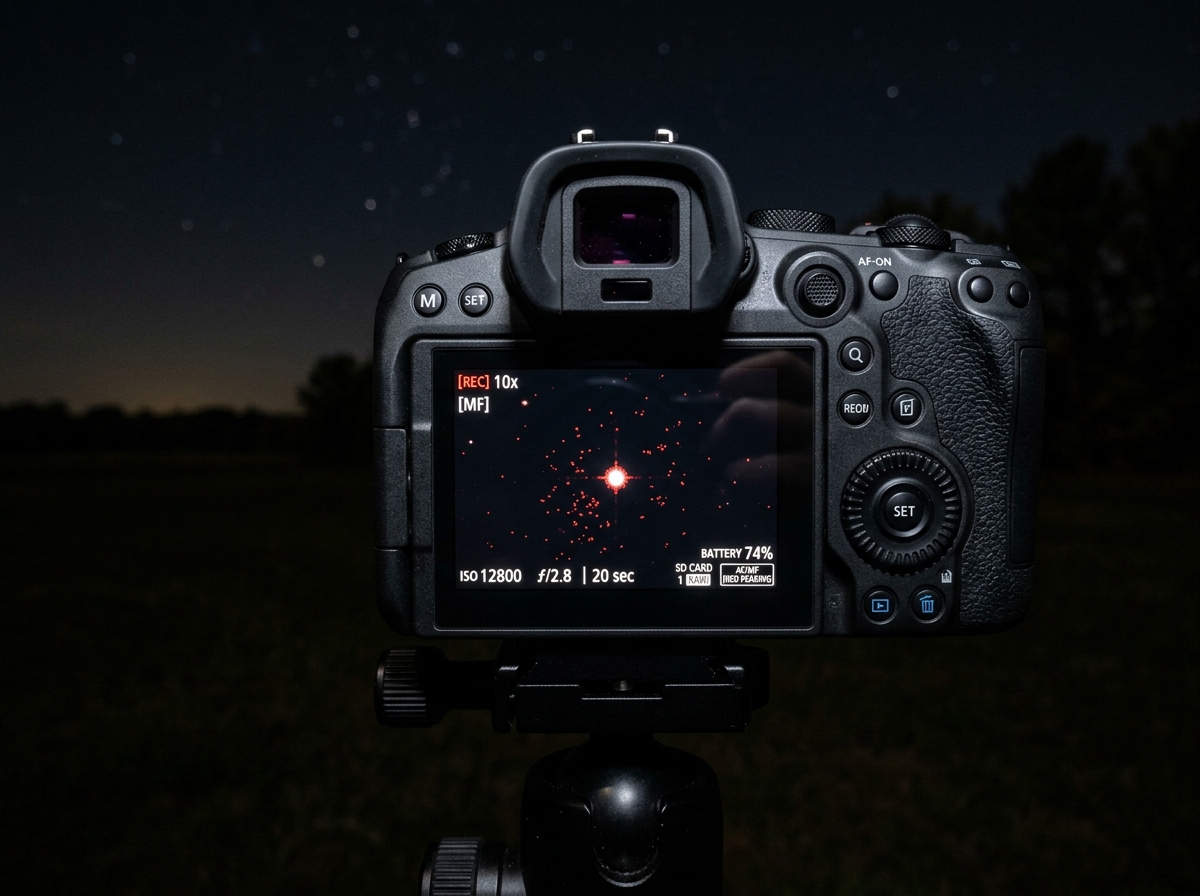
1. Prepare Your Settings
Before you even look at the screen, we need to make the stars visible. Set your camera to Manual Mode (M). Open your aperture to its widest setting (lowest f-number, like f/2.8 or f/4). Crank your ISO up to 6400 or 12800. This “exposure boost” isn’t for the final photo; it’s just to make the stars bright enough to see on the LCD.
2. Find a Bright Target
Point your camera toward the brightest object in the sky. This could be a planet like Jupiter or Venus, or a bright star like Sirius or Vega. If you’re struggling to find one, check out our guide on Mastering Mobile Astrophotography: A Beginner’s Guide for tips on identifying celestial objects.
3. Magnify and Adjust
Turn on Live View. Use the “magnify” button (usually a magnifying glass icon) to zoom in 5x or 10x on that bright star. Do not zoom the lens; zoom the digital preview. Now, slowly turn the focus ring. You will see the star change from a large, blurry circle into a tiny, sharp point of light.
Finding the Perfect Manual Focus Night Stars Setting
Getting the focus “close” isn’t enough. You want it perfect. As you rotate the focus ring, watch how the star behaves.
| Focus Stage | Appearance of Star on LCD | Action Needed |
|---|---|---|
| Far Out of Focus | Large, dim, translucent “bokeh” circle | Rotate ring significantly |
| Near Focus | Smaller circle, brighter center, some color | Fine-tune with tiny movements |
| Perfect Focus | Smallest possible pinpoint; dim stars appear | Stop! This is the spot. |
| Past Focus | Star begins to grow larger and dimmer again | Reverse direction slightly |
A great trick is to watch for the “faint companions.” As you hit the sweet spot of manual focus night stars, you’ll notice tiny, dim stars suddenly appearing on the screen that weren’t visible when you were slightly out of focus.
Using Visual Cues and Spherochromatism for Manual Focus Night Stars
If you have a very “fast” lens (f/1.4 to f/2.8), you might encounter a phenomenon called spherochromatism. This is a fancy word for color fringing that happens when you are slightly off-focus.
- Green Halos: If the star has a green tint around it, your focus is usually set a bit too far (past infinity).
- Magenta/Purple Shift: If you see a magenta or purple fringe, your focus is usually too close.
- Neutral White: When the star is a clean, neutral white pinpoint, you have achieved perfect focus.
Expert tip: If you have to err on one side, many photographers prefer a tiny bit of magenta shift, as it looks more natural in the final edit than green halos.
Advanced Tools and Locking Your Infinity Focus
Sometimes, your eyes can play tricks on you, or the atmosphere is too “wobbly” to see a clear pinpoint. This is where specialized tools come in.
The Bahtinov Mask
A Bahtinov mask (or a photography-specific version like the SharpStar2) is a plastic grid you place over the front of your lens. It creates a specific diffraction pattern: three bright lines (spikes) crossing the star.
When you are out of focus, the central spike will be shifted to the left or right. As you adjust your manual focus night stars ring, the central spike moves. When it is perfectly centered in the “X” pattern, your focus is mathematically perfect. It takes the guesswork out of the process!
The Flashlight and 100-Foot Rule
If there are no bright stars visible, we use the “Flashlight Method.” Have a friend stand at least 100 feet (30 meters) away and shine a bright light back at the camera. At this distance, most wide-angle lenses treat the light as being at “infinity.” Focus on the light, switch to manual, and you’re set for the stars. This is a great way to avoid Common Beginner’s Mistakes in Astrophotography and How to Avoid Them.
Locking it Down with Gaffer’s Tape
Once you’ve found that perfect focus, don’t touch it! It is incredibly easy to accidentally bump the focus ring in the dark or while moving your tripod. We always recommend using a piece of gaffer’s tape to secure the focus ring to the lens barrel. Unlike duct tape, gaffer’s tape doesn’t leave a sticky residue on your expensive gear.
Frequently Asked Questions about Focusing on Stars
Why is the infinity mark on my lens inaccurate?
You might notice an “L” or “∞” symbol on your lens, but simply turning the ring until it hits the stop rarely works. Modern lenses are designed to focus past infinity. This allows for thermal expansion (glass and metal expanding or contracting in different temperatures) and ensures the autofocus motor doesn’t hit a hard wall.
Additionally, many mirrorless lenses use “focus-by-wire” systems. This means the ring isn’t mechanically connected to the glass; it sends an electronic signal to a motor. These lenses often reset when the camera is turned off, making the physical markings even less reliable. For more on handling modern tech at night, see our Long Exposure Tips for Smartphone Night Photos.
How often should I re-check my focus during a session?
We recommend checking focus every 30 to 60 minutes. Night temperatures usually drop as the session goes on, causing the lens elements to shift slightly. Also, if you are using a zoom lens, be aware of “zoom creep”—the weight of the glass can cause the focal length (and focus) to shift if the camera is pointed straight up. Always take a high-ISO test shot (5 seconds at ISO 12800) and zoom in on the playback screen to verify the stars are still sharp.
Can I use autofocus on the moon instead of manual focus?
Yes! The moon is bright enough and has enough contrast (especially at the “terminator” line where light meets shadow) for autofocus to work. Since the moon is effectively at infinity, you can autofocus on it, then immediately switch your lens to “MF” to lock that position. Just be careful not to touch the ring afterward.
Conclusion
Mastering manual focus night stars is the “secret sauce” that separates amateur snapshots from professional-grade astrophotography. It requires patience, a sturdy tripod, and a bit of practice in the dark, but the results are worth it.
At Pratos Delicia, we share informative lifestyle and photography content designed to help readers build practical skills. Do not be discouraged if your first few shots are soft – even experienced photographers double-check focus throughout the night. Once you nail that pinpoint sharpness, you will be ready to keep exploring techniques like Unlocking the Galaxy: Photographing Stars with a Smartphone. Happy shooting, and keep looking up!
