
Why a Long Exposure Fireworks Guide Changes Everything You’ll Shoot This Summer
A long exposure fireworks guide gives you everything you need to turn a blurry, washed-out snapshot into a stunning image full of vivid light trails and color. Long-exposure photography is the secret to capturing the motion of light over time. Here’s the quick version:
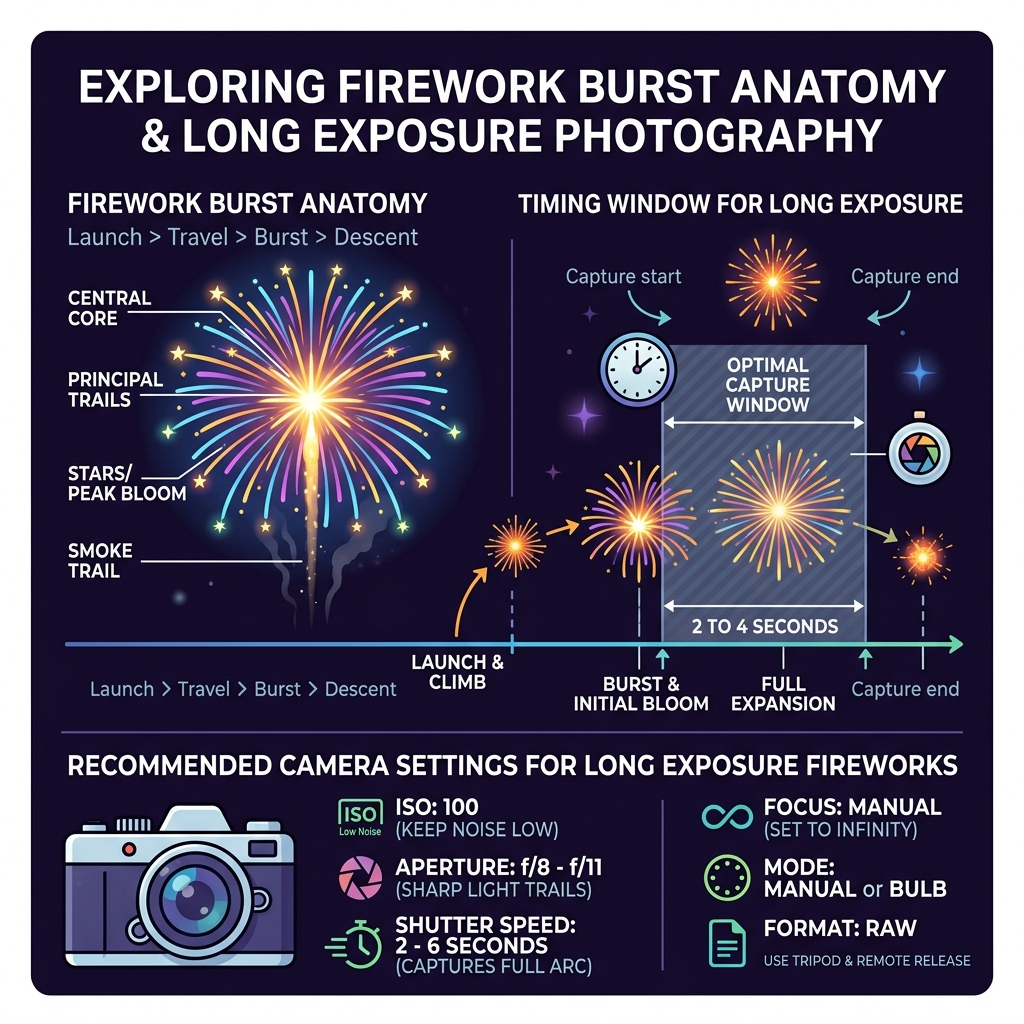
Quick-start settings for long exposure fireworks photography:
- ISO: 100 (keep noise low)
- Aperture: f/8 to f/11 (sharp, balanced brightness)
- Shutter speed: 2 to 6 seconds (captures the full arc of a burst)
- Focus: Manual, set to infinity
- Mode: Manual or Bulb
- Format: RAW
- Must-have gear: Sturdy tripod + remote shutter release
Most people point their camera at the sky, press the shutter button, and hope for the best. The result? Overexposed blobs or motion-blurred streaks that look nothing like what they saw with their eyes.
The good news: fireworks photography is more forgiving than it looks. Unlike other night photography, fireworks produce their own consistent light. That means you can dial in a fixed set of settings and use them all night.
A single firework burst takes roughly 2 to 4 seconds from launch to full bloom. That’s your window. Nail the timing, lock down your camera, and you’ll walk away with images that look like they belong on a magazine cover.
This guide walks you through every step — gear, settings, composition, and creative techniques — so you can stop guessing and start capturing.
Essential Gear for Your Long Exposure Fireworks Guide
To capture those crisp, bleeding-edge light trails, we need to move beyond handheld snapshots. When we talk about a long exposure fireworks guide, the most critical factor isn’t actually the camera body—it’s stability.

The Foundation: A Sturdy Tripod
Since we are leaving the shutter open for anywhere from 2 to 30 seconds, even the slightest vibration—a gust of wind or a heavy footstep nearby—can turn a sharp burst into a wiggly mess. We recommend a tripod that can handle the weight of your heaviest lens without drifting. If it’s windy, avoid hanging your camera bag from the center column; research suggests this can actually act like a pendulum and increase shake rather than dampen it.
Shutter Control: Remote Release
Even the act of pressing the shutter button creates a micro-vibration. To avoid this, we use a remote shutter release or a cable release. If you don’t have one, you can use your camera’s built-in 2-second self-timer, though this makes timing the exact moment of a burst much harder. For those using modern setups, capture the night with long exposure smartphone photography techniques often involve using a dedicated app to trigger the shutter wirelessly.
The Right Glass: Wide-Angle Zooms
While it’s tempting to zoom in tight, a wide-angle zoom (like a 24-70mm or 16-35mm) is usually the best choice. Fireworks are unpredictable; they often explode higher or wider than you expect. A wider focal length gives you “room to breathe,” allowing you to crop the image later in post-processing without losing the edges of the burst.
The “Little Things” That Matter
- Extra Batteries: Long exposures and “Live View” mode drain batteries quickly. If you’re shooting in cold weather, keep your spares in a pocket close to your body heat.
- Lens Hood: This helps block stray light from nearby streetlamps or flashlights that could cause unwanted flares.
- Flashlight/Penlight: You’ll be adjusting settings in the dark. A small light (or your phone) is essential for seeing your dials.
Mastering Manual Camera Settings for Fireworks
Auto mode is the enemy of great fireworks photos. Because the sky is dark, your camera’s internal meter will try to brighten the scene, resulting in a shutter that stays open way too long and fireworks that look like white, overexposed blobs. We need to take full manual control.
The “Golden Trio” of Settings
- ISO 100: We want the cleanest image possible. Fireworks are incredibly bright, so there is no need to “boost” the sensor’s sensitivity. Keeping the ISO at 100 (or your camera’s base) ensures the black sky stays black and free of digital noise.
- Aperture (f/8 to f/11): This is the “sweet spot” for sharpness. An aperture in this range ensures the light trails are well-defined. If the fireworks look too thin or dim, you can open up to f/5.6. If they are blowing out the color and looking too white, stop down to f/14 or f/16.
- Shutter Speed: This is where the magic happens. To capture the full “bloom” of a shell, we usually need 2 to 6 seconds.
| Scenario | Recommended Shutter Speed | Why? |
|---|---|---|
| Single Shell Burst | 2–4 Seconds | Captures the launch streak and the full expansion. |
| Multiple Overlapping Shells | 5–10 Seconds | Fills the frame with color but risks overexposure. |
| The Grand Finale | 1–2 Seconds | So many explosions happen at once that long exposures become a white mess. |
| Artistic Light Trails | 10+ Seconds | Best used with the “Black Card” technique (see below). |
Shooting in RAW
Always set your file format to RAW. Fireworks have a massive dynamic range—from the deep black of the night sky to the brilliant white core of an explosion. RAW files preserve all that data, giving us the flexibility to recover highlights or brighten a dark foreground during editing.
Using Bulb Mode in Your Long Exposure Fireworks Guide
Manual mode is great, but Bulb Mode is better. In Bulb mode, the shutter stays open as long as you hold down the remote button. This allows for “reactive” photography. We press the button the moment we hear the thump of the launch and release it once the burst has reached its full beauty. This ensures we don’t cut off a beautiful trail mid-air or leave the shutter open during a “dead” period of smoke.
The Black Card Technique
This is an old-school trick for the digital age. You set your camera to a very long exposure (say, 20 or 30 seconds). You hold a piece of black matte cardboard in front of the lens. When a firework explodes, you pull the card away to “record” the light, then put it back. This allows you to stack multiple bursts into a single image without overexposing the background or building up too much smoke haze.
Accurate Focusing in Your Long Exposure Fireworks Guide
Autofocus will struggle in the dark. If it hunts for focus the moment a firework goes off, you’ll miss the shot.
- Manual Focus to Infinity: Switch your lens to MF. If you can see a distant city skyline or bright stars, use “Live View” to zoom in on the screen and pull focus until that distant light is a sharp pinprick.
- The “Infinity” Trap: Don’t just turn the focus ring all the way to the end; most modern lenses actually focus past infinity. Find the true sharp point and leave it there.
- Back-Button Focus: If your camera supports it, use back-button focus to lock onto a distant object once, then leave it. This prevents the shutter button from trying to refocus every time you trigger a shot.
Advanced Composition and Artistic Techniques
A photo of a firework against a black sky is a “specimen” shot. It’s technically fine, but it lacks “soul.” To make your images stand out, you need to provide context and a sense of place.
Including Foreground Interest
The most breathtaking fireworks photos include silhouettes of trees, city skylines, or even the crowd. These elements give the viewer a sense of scale. Try to position yourself so that a famous landmark or a line of trees sits in the bottom third of your frame.
Reflections and Water
If you are near a lake, river, or even a large puddle, use it! Reflections double the amount of light and color in your shot. For the best results, use a vertical orientation to capture both the explosion in the sky and its twin dancing on the water’s surface.
The Rule of Thirds
Avoid placing the “center” of the explosion right in the middle of your frame. Use the rule of thirds to place the main burst off-center, allowing the trails to sweep across the empty space. This creates a much more dynamic and professional composition.
The Focus-Pull Technique for Spiky Effects
If you want to get truly creative, try the focus-pull technique. This creates “spiky” or “tentacled” fireworks that look like deep-sea creatures.
- The Setup: You’ll need a camera in Bulb mode and a lens with a smooth focus ring.
- The Action: Start the exposure with the lens completely out of focus (bokeh). As the firework explodes, quickly turn the focus ring until the image is tack-sharp.
- The Result: The light trails will start as fat, blurry blobs and taper down into sharp, needle-like points.
- Pro Tip: Use a Neutral Density (ND) filter for this. Since you might be using a wider aperture (like f/2.8 or f/4) to get those fat blur circles, an ND filter prevents the image from blowing out.
Overcoming Environmental Challenges and Common Mistakes
Even with the best long exposure fireworks guide, nature can throw a wrench in your plans. Smoke and wind are your biggest enemies.
Dealing with Smoke
Fireworks produce a lot of smoke. After the first few minutes of a show, the sky can become a hazy mess.
- Positioning: Always check the wind direction before the show starts. You want to be upwind (the wind blowing at your back toward the fireworks). If you are downwind, you’ll be shooting through a thick curtain of gray fog.
- Shoot Early: The cleanest shots usually happen in the first five minutes of the display before the smoke has a chance to build up.
Location Scouting and Arriving Early
Don’t show up five minutes before the show. Arrive at least an hour or two early to claim your spot and set up your tripod. This also gives you time to take test shots while there is still a little “blue hour” light in the sky. You can later blend a well-exposed “blue hour” landscape with your nighttime fireworks in post-processing.
Long Exposure Noise Reduction: Turn It Off!
Most cameras have a setting called “Long Exposure Noise Reduction.” While it sounds helpful, it works by taking a second “dark” exposure of the same length as your shot. If you take a 5-second photo, the camera will lock up for another 5 seconds to process it. During a show, this means you’ll miss half the fireworks. Turn it off and handle noise in post-processing instead. If you’re using a phone, check out the top mobile camera apps for long exposure shots to see which ones handle noise most efficiently without locking you out of the action.
Frequently Asked Questions about Fireworks Photography
Can I photograph fireworks without a tripod?
It is difficult, but not impossible. If you have no tripod, look for a “steady surface” like a fence post, a trash can, or a parked car to rest your camera on. Switch on your lens’s Image Stabilization (IS) or Vibration Reduction (VR), though remember to turn it off if you eventually move to a tripod. You can also try using a higher ISO (around 800) and a slightly faster shutter speed (1/10th or 1/20th of a second), but your trails will be very short. For more advice, see our long exposure tips for smartphone night photos.
How do I avoid overexposed firework bursts?
If your fireworks look like white lines with no color, your aperture is too wide or your ISO is too high. Check your histogram after the first few shots. If the “mountain” of data is smashed against the right side of the graph, you are “clipping” your highlights. Stop down your aperture (move from f/8 to f/11 or f/16) to thin out the light trails and bring back the saturated reds, greens, and blues.
What is the best way to handle smoke in my shots?
Beyond positioning yourself upwind, the best technique is timing. Wait for a brief pause in the action for the smoke to clear before triggering your next long exposure. In post-processing, you can use the “Dehaze” slider in tools like Lightroom to cut through some of the lingering clouds, but nothing beats a clear sky.
Conclusion
Mastering the art of fireworks photography is a rewarding journey that blends technical precision with creative flair. By following this long exposure fireworks guide, you’ve moved past the “point and pray” method and into the realm of intentional artistry.
At Pratos Delícia, we believe that the best memories are the ones captured with care. Once you get home with your RAW files, don’t be afraid to experiment with your post-processing workflow. A little boost in contrast, a slight reduction in the “Blacks” slider, and a touch of saturation can make those colors pop off the screen.
The most important tip we can give you? Once you’ve nailed a few great shots, step away from the viewfinder. Watch the show with your own eyes, enjoy the boom in your chest, and celebrate the moment. If you’re hungry for more ways to level up your photography, explore more photography guides on our site. Happy shooting!
