
Stop Wishing and Start Fishing for the Best Budget Telescopes
Finding the right budget telescope for astrophotography is one of the best decisions you can make as a beginner night sky photographer. The good news? You don’t need to spend thousands to get started.
Quick answer — best budget telescopes for astrophotography:
| Telescope | Aperture | Focal Length | Best For | Price Range |
|---|---|---|---|---|
| Sky-Watcher Evostar 80ED | 80mm | 600mm f/7.5 | Wide deep-sky | Under $1,000 |
| Svbony SV550 | 80mm | 480mm f/6 | Nebulae, galaxies | ~$574–$800 |
| Svbony SV503 70ED | 70mm | 420mm f/6 | Beginner imaging | ~$306 |
| Explore Scientific ED80 | 80mm | 480mm f/6 | Entry APO | ~$499 |
| William Optics Zenithstar 73 | 73mm | 430mm f/5.9 | Portable wide-field | Mid-range |
A few years ago, serious astrophotography required gear that cost as much as a used car. That’s changed dramatically. Affordable ED glass, compact star trackers, and free processing software have opened the door for beginners with modest budgets.
That said, budget doesn’t mean anything goes. Experts consistently point out that expect to spend at least $1,000 for a complete imaging-ready setup — telescope, mount, and camera included. The telescope itself is just one piece of the puzzle.
The most important shift in thinking? Your mount matters more than your optics. A great telescope on a shaky or non-tracking mount will produce blurry, frustrating results every single time.
This guide breaks down the best budget telescopes available today, what accessories you actually need, and how to avoid the most common beginner mistakes.

What Defines a Budget Telescope for Astrophotography?
When we talk about a budget telescope for astrophotography, we aren’t talking about the $50 plastic tubes you find at big-box toy stores. In long-exposure imaging, “budget” refers to entry-level precision instruments that provide a gateway to the hobby without requiring a second mortgage.
For most beginners, the price threshold for a brand-new, imaging-ready telescope sits between $300 and $900. However, as we mentioned, the total “kit” price—including a tracking mount and a camera—usually lands around the $1,000 to $1,500 mark.
Key Specifications for Beginners
If you are just starting out, bigger isn’t always better. In fact, large telescopes are often a nightmare for beginners because they are heavy and have a narrow field of view that magnifies every tiny tracking error. We recommend looking for:
- Focal Length: Stay within the 250–600 mm range. This provides a “wide-field” view, making it much easier to find targets like the Andromeda Galaxy or the Orion Nebula.
- Aperture: While visual astronomy relies on massive apertures to see faint light, astrophotography relies on time. A 60mm to 80mm aperture is the “sweet spot” for budget refractors.
- Weight: Look for tubes under 10 lbs (4.5 kg). This allows you to use more affordable, lightweight mounts or star trackers.
The Role of APO and ED Glass in a Budget Telescope for Astrophotography
The biggest enemy of a budget refractor is “chromatic aberration”—that annoying purple or blue fringe you see around bright stars. To fight this, you need a telescope with ED (Extra-low Dispersion) glass or an APO (Apochromatic) design.
An APO refractor uses specialized glass elements (like FPL-51 or FPL-53) to ensure all colors of light focus at the exact same point.
- Doublets: These use two lens elements. They are the most affordable and offer a massive upgrade over standard “achromatic” telescopes.
- Triplets: These use three elements and offer even better color correction. While usually expensive, models like the Svbony SV550 have brought triplet performance into the budget realm.
Understanding Focal Ratio and Speed
In astrophotography, “speed” refers to the focal ratio (f-number). A “fast” telescope (lower f-number) gathers light more quickly, allowing for shorter exposure times.
- f/5 to f/6: Considered fast and ideal for deep-sky imaging.
- f/7 and above: A bit slower, which is fine for the Moon and planets, but requires longer exposures for faint nebulae.
A popular choice like the SVBONY SV503 70F6 hits a perfect balance with an f/6 ratio, making it versatile enough for various targets without being overly demanding on your mount’s tracking accuracy.
Top Recommended Budget Telescopes for Beginners
Selecting your first piece of glass is a rite of passage. While there are many types of telescopes, refractors dominate the budget astrophotography scene because they are portable, require almost no maintenance (collimation), and produce high-contrast images.
| Feature | Svbony SV503 80ED | Sky-Watcher Evostar 80ED | William Optics RedCat 51 |
|---|---|---|---|
| Aperture | 80mm | 80mm | 51mm |
| Focal Length | 560mm | 600mm | 250mm |
| Glass Type | FPL-51 Doublet | FPL-53 Doublet | FPL-53 Petzval |
| Strengths | Best value for money | Incredible color correction | Ultra-portable, flat field |
| Weight | ~5.5 lbs | ~5.7 lbs | ~3.9 lbs |
The Sky-Watcher Evostar 80ED is often cited as the “gold standard” for budget APO refractors. It uses high-end FPL-53 glass, which provides color correction that rivals telescopes twice its price. Meanwhile, the William Optics RedCat 51 is a favorite for those who want a “point and shoot” experience; its Petzval design means you don’t even need a separate field flattener!
Choosing the Best Budget Telescope for Astrophotography Targets
What do you want to take pictures of? Your target dictates your gear.
- Large Nebulae (North America Nebula, Orion): You want a wide-field refractor (250-400mm).
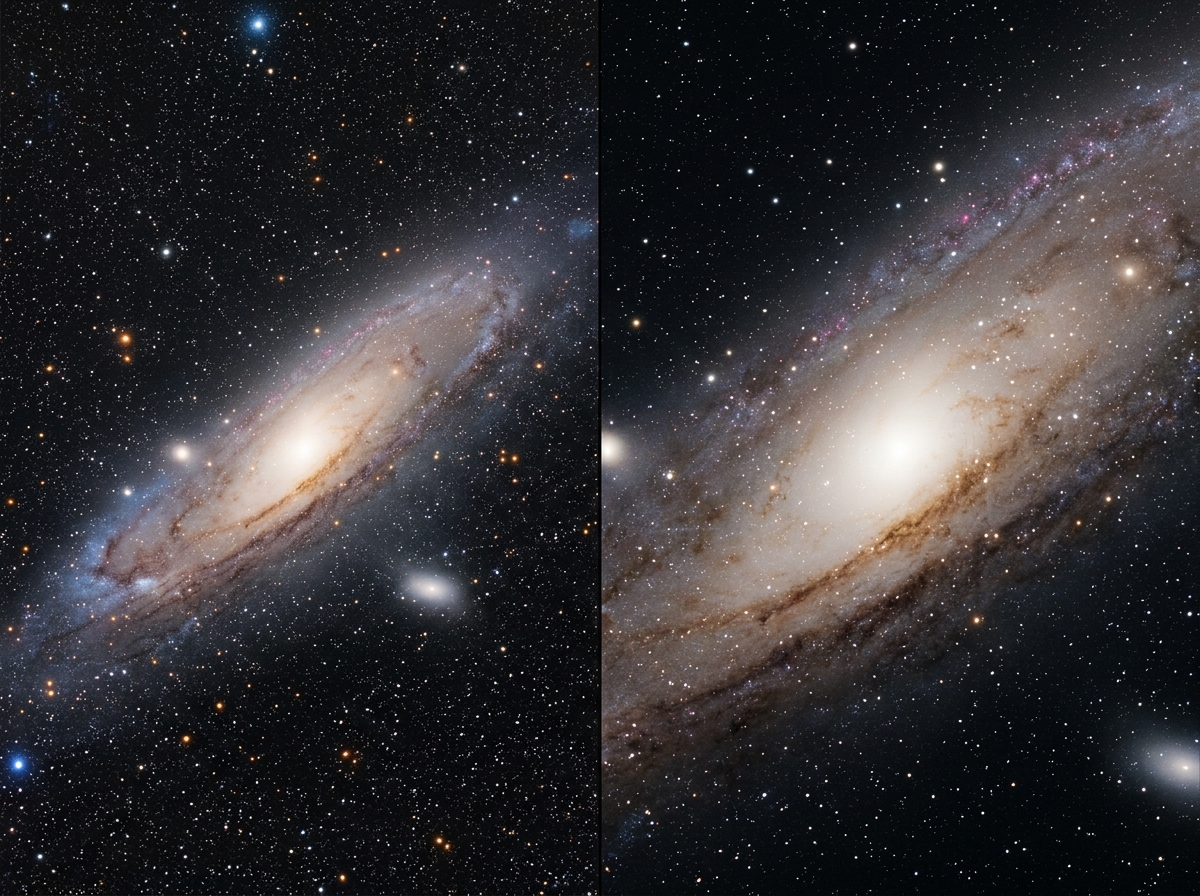
- Galaxies (Andromeda, Triangulum): A slightly longer focal length (400-600mm) helps bring out detail.
- The Milky Way: Sometimes, the best telescope isn’t a telescope at all. You can achieve stunning results with just a camera and lens. Check out our guide on night-sky-photography-without-a-telescope to see how.
Smart Telescopes: The All-in-One Budget Alternative
If the idea of balancing mounts and polar aligning sounds like a headache, “smart telescopes” are the modern solution. Devices like the ZWO Seestar S50 or Vaonis Hestia pack a camera, telescope, and motorized mount into one tiny package.
These are controlled entirely via a smartphone app. While they offer less flexibility than a custom rig, they are incredibly effective for absolute beginners. For more on this, dive into our mobile-astrophotography-for-beginners resource.
Essential Accessories to Complete Your Imaging Rig
Buying the telescope is just the first step. To get those pin-sharp stars you see on Instagram, you’ll need a few “helpers.”
- Field Flattener: Most refractors have a curved focal plane. This means stars in the center are sharp, but stars at the edges look like little seagulls. A field flattener fixes this.
- Dual-Speed Focuser: Focus is critical. A dual-speed focuser has a “fine-tune” knob (usually a 10:1 ratio) that allows you to make microscopic adjustments.
- T-Ring and Adapter: This is the “handcuff” that attaches your DSLR or dedicated camera to the telescope.
For a full breakdown of the small bits that make a big difference, visit our gear-essentials-for-mobile-night-photography page. And don’t forget a sturdy base—even the best scope fails on a wobbly leg. See our picks for affordable-tripods-for-night-sky-photography.
The Importance of the Mount and Star Trackers
We cannot stress this enough: The mount is the most important part of your setup. The Earth is rotating, and if your mount doesn’t cancel out that movement, your stars will look like streaks of light.
- Star Trackers: Options like the iOptron SkyGuider Pro or Sky-Watcher Star Adventurer 2i are affordable ($300-$400) and highly portable. They are perfect for small refractors and camera lenses.
- Equatorial (EQ) Mounts: For larger budget scopes like a 102mm refractor, you’ll need a full EQ mount with “GoTo” capabilities (automation).
If you’re looking for something specifically for your phone or a very light rig, check out the-best-portable-mounts-for-phone-astrophotography.
Cameras and Software for Budget Success
You don’t need a $5,000 cooled astro-camera to start.
- DSLRs: A used Canon or Nikon DSLR is the most cost-effective way to start.
- Dedicated CMOS: The ZWO ASI585MC is a fantastic “budget” dedicated camera that is uncooled but extremely sensitive, perfect for both planets and deep-sky objects.
Once you have your “raw” data, software is where the magic happens. We recommend Siril (free) for stacking your images and GraXpert (free) for removing light pollution gradients. You can learn more about mastering-mobile-astrophotography-no-expensive-gear-required to understand the processing workflow.
Common Mistakes and How to Avoid Them
We’ve seen it all, and we’ve made these mistakes ourselves! Here is how to stay on the right track:
- Over-mounting: Don’t put a massive telescope on a tiny mount. The general rule is that for astrophotography, you should only load your mount to 50% of its rated weight capacity.
- Ignoring Backfocus: If you add a field flattener or reducer, you must have the camera sensor at the exact distance (usually 55mm) specified by the manufacturer. If not, you’ll never get a sharp image.
- Skipping Polar Alignment: If your mount isn’t pointed exactly at the celestial pole, your tracking will fail. Take the extra 10 minutes to get it right.
- Used Gear Risks: Buying second-hand is a great way to save money, but always check the glass for fungus or scratches and ensure the focuser moves smoothly.
For more deep dives into specific gear, browse our category/equipment section.
Frequently Asked Questions about Budget Astrophotography
Can I use a budget telescope for both visual and photography?
Yes, but there is usually a trade-off. A telescope optimized for photography (like a 50mm RedCat) is too small to show much detail to your eye. Conversely, a large Dobsonian (great for visual) is very difficult to use for deep-sky photography. An 80mm ED refractor is the best “middle ground.”
Is it better to buy a new or used telescope?
If you are on a strict budget, the used market is incredible. Telescopes don’t “wear out” like cars do. However, as a beginner, buying new gives you the peace of mind of a warranty and customer support if you can’t figure out how to reach focus.
How much should I spend on a mount vs. the telescope?
A good rule of thumb is to spend 60% of your budget on the mount and 40% on the telescope. You can make a “cheap” telescope perform well on a great mount, but a “world-class” telescope will be useless on a cheap mount.
Conclusion
At Pratos Delícia, we believe that the beauty of the cosmos should be accessible to everyone, regardless of their bank account balance. Choosing a budget telescope for astrophotography is about finding the right balance between optical quality, mount stability, and ease of use.
Whether you choose a tried-and-true refractor like the Sky-Watcher 80ED or a modern “all-in-one” smart telescope, the most important step is to simply get outside and start shooting. The learning curve is steep, but the first time you see a galaxy appear on your camera screen, you’ll know it was worth every penny.
Start your journey into the stars today and turn your backyard into a gateway to the universe!
