
Why Sharp Stars Are So Hard to Get (And How Focus Peaking Changes That)
Focus peaking night stars is a camera technique that highlights the sharpest edges in your live view with a colored overlay — making it possible to manually focus on stars in near-total darkness, where autofocus completely fails.
Quick answer — how to use focus peaking for stars:
- Switch your lens to manual focus
- Enable focus peaking in your camera menu (choose red or yellow highlight color)
- Open live view and boost ISO temporarily to brighten the stars on screen
- Use live view magnification and point at the brightest star you can find
- Slowly rotate the focus ring until the colored peaking highlights appear on the stars
- Take a test shot and review at 100% zoom to confirm sharpness
- Lock the focus ring with gaffer tape so it doesn’t shift
Night sky photography is one of the most rewarding things you can do with a camera. The silence, the patience, the moment a Milky Way arch finally appears sharp on your screen — it’s genuinely addictive.
But getting there? That first session can feel like a mess.
Your autofocus hunts endlessly in the dark and gives up. The infinity mark on your lens turns out to be a rough guess at best. You take a 25-second exposure, excitedly zoom in on the stars, and they’re blurry blobs.
The problem isn’t your gear. It’s that standard daytime focusing tools don’t work at night — and most beginners don’t know what to use instead.
Focus peaking is the solution most cameras already have built in. It’s a real-time visual aid that shows you exactly where your lens is focused, even when the scene is nearly pitch black.
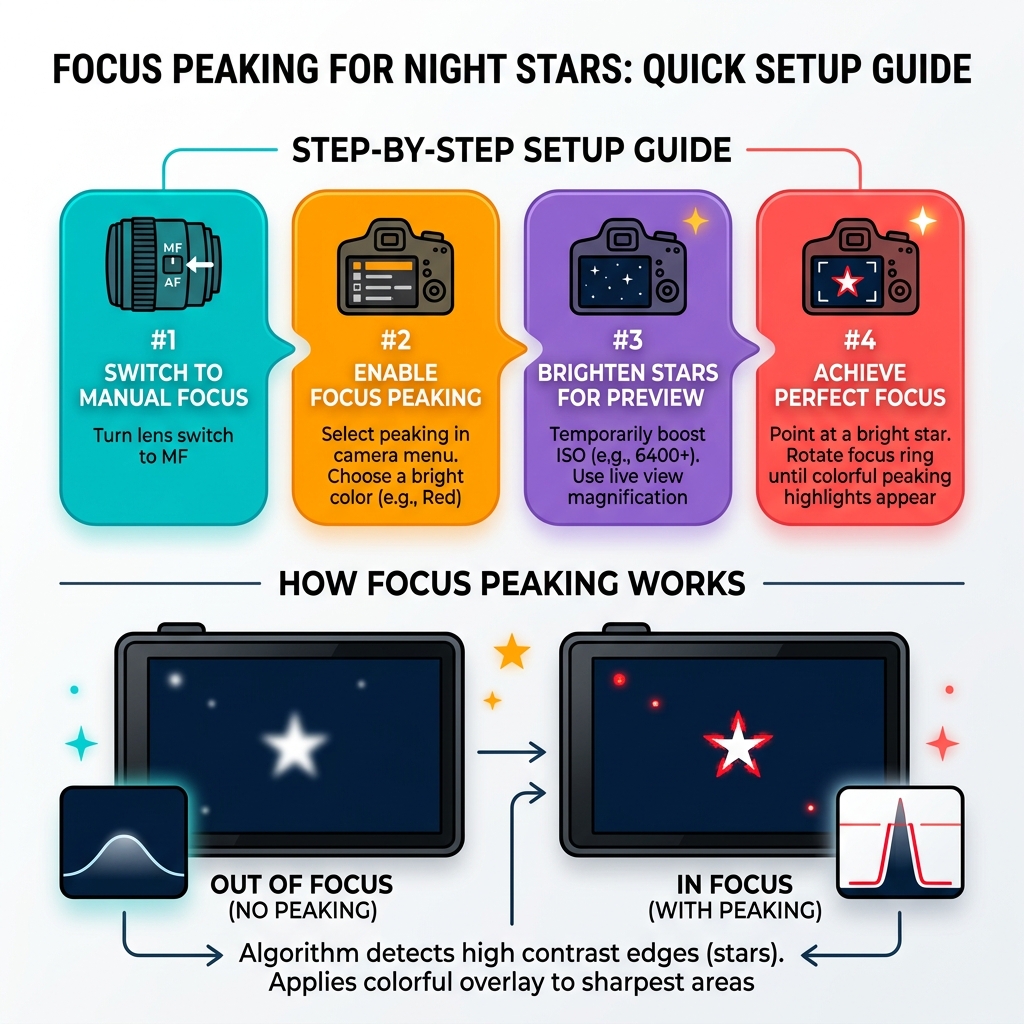
Why Autofocus Fails and How Focus Peaking Night Stars Works
If you’ve ever tried to take a photo of the moon or a bright star using autofocus, you’ve likely heard your lens “hunting”—that frustrating back-and-forth clicking sound as the camera tries to find a point of contrast. Most modern cameras, even high-end models like the Sony a7S II, can only autofocus down to about -4 EV. However, a moonless night sky in the backcountry can reach -9 EV or darker. In these conditions, autofocus is effectively blind.
This is where focus peaking night stars techniques become essential. But how does it actually work?
Focus peaking is an electronic processing feat. Your camera’s processor analyzes the live feed from the sensor and looks for areas of highest contrast. In optics, high contrast at an edge almost always means that edge is in sharp focus. The camera then overlays a bright color (usually red, yellow, or white) over those sharp edges.
When we use mastering-your-camera-settings-for-low-light-photography at night, we are essentially looking for the moment those tiny pinpoints of light—the stars—begin to “glow” with your chosen peaking color. According to Mastering Focus Peaking in Night Photography, this peak detection algorithm provides a real-time mathematical confirmation of focus that our naked eyes often miss on a small LCD screen.
Step-by-Step Guide to Using Focus Peaking for Stars
To master focus peaking night stars, we need to move away from “point and shoot” habits and embrace a deliberate manual workflow. Here is the exact process we use in the field:
- Switch to Manual Focus (MF): This is the most important step. If you leave your camera in AF, it will try to refocus the moment you hit the shutter button, ruining your hard work.
- Find a Bright Target: Don’t try to focus on a dim constellation first. Find the brightest star in the sky (or a distant planet like Jupiter) or even a distant terrestrial light like a far-off radio tower or a night-sky-photography-a-beginners-guide tent light.
- Boost Your ISO: Even if you plan to shoot at ISO 3200, boost your ISO to 12800 or higher just for the focusing stage. This makes the stars “pop” on the LCD, giving the peaking algorithm more signal to work with.
- Magnify the View: Use your camera’s “Focus Assist” or “Magnify” button to zoom in 5x or 10x on that bright star.
- The Rocking Technique: Slowly turn the focus ring toward the infinity mark. You will see the star go from a large, blurry blob to a tiny pinpoint. As it reaches its smallest size, the focus peaking color will suddenly shimmer across the star. Rock the ring back and forth slightly to find the “peak” of that color intensity.
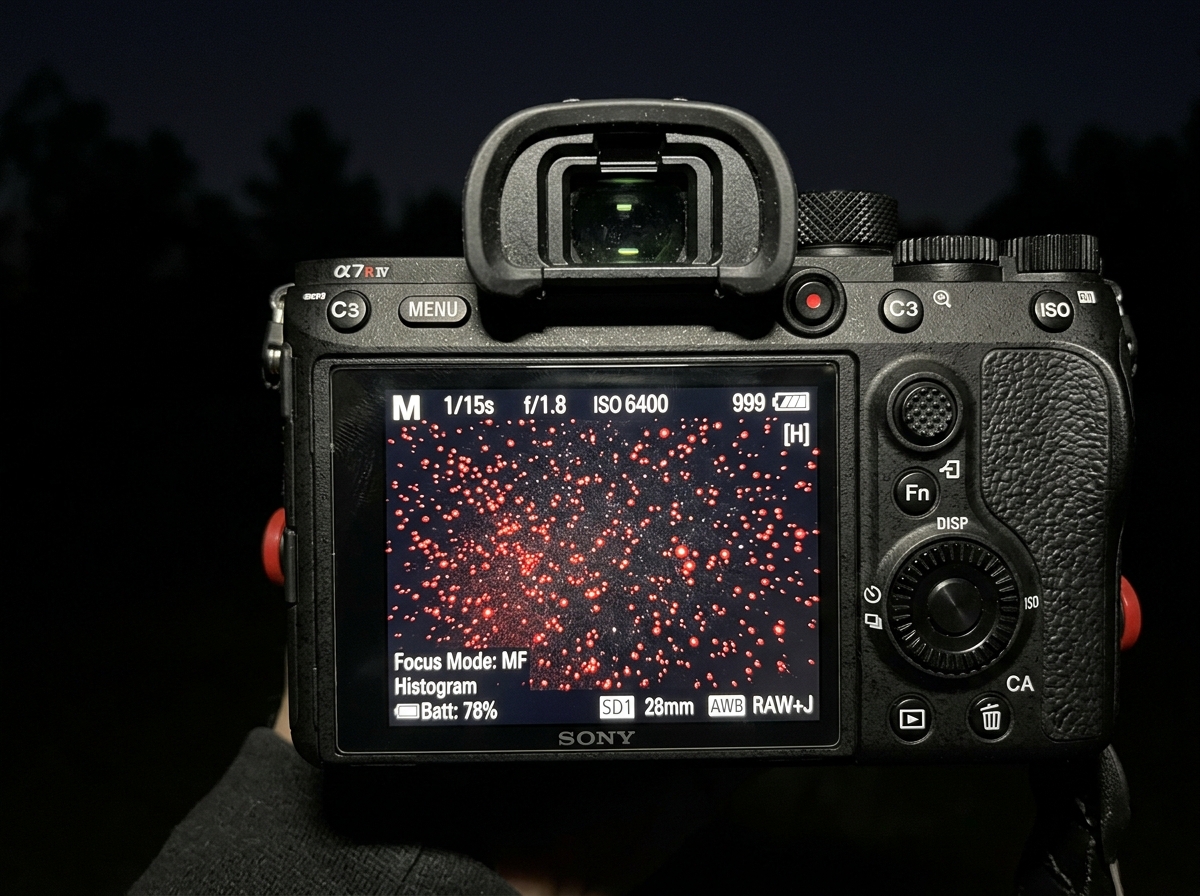
Optimizing Your Focus Peaking Night Stars Settings
Not all peaking is created equal. Most cameras allow you to change the Sensitivity (Level) and Color.
- Sensitivity: We usually recommend setting this to “High” for astrophotography. Stars are tiny and have relatively low contrast compared to a daytime subject, so the camera needs to be extra sensitive to “see” them.
- Color Selection: This depends on your environment.
| Sky Condition | Recommended Peaking Color | Why? |
|---|---|---|
| Deep Dark Sky | Red | Provides the highest contrast against blue/black sky. |
| Light Polluted Sky | Yellow or Blue | Red can get lost in the orange “airglow” of city lights. |
| Near Moon | White | White highlights are visible against the bright lunar glow. |
Always verify your focus with a test shot. Zoom in to 100% on the result. If the stars look like “seagulls” (coma) or have halos, you may need to refine further.
Refining Sharpness Beyond the Infinity Mark
A common trap for beginners is trusting the “L” or “∞” mark on the lens barrel. In reality, the infinity point shifts based on temperature. Glass expands and contracts; a lens focused at infinity on a 70°F afternoon will be out of focus at 20°F under the stars.
Furthermore, many modern mirrorless lenses use “focus-by-wire” systems. These don’t have a physical connection between the ring and the glass. When you turn the camera off, the focus often resets. This makes The Ultimate Guide to Focus Peaking in Astrophotography even more critical because you have to re-verify focus every time you power up or if the temperature drops significantly during the night.
Once you find that perfect spot, use a piece of gaffer tape to lock the focus ring in place. Unlike duct tape, gaffer tape won’t leave a sticky residue on your expensive lens.
Advanced Tools and Brand-Specific Features
Different camera brands handle focus peaking night stars in unique ways.
- Sony: Often considered the pioneer of this tech, Sony cameras like the α7 III allow for “Manual Focus Assist,” which automatically magnifies the image the moment you touch the focus ring.
- Nikon Z: These cameras provide a very helpful on-screen distance scale that works in tandem with red focus peaking highlights.
- Canon: Newer mirrorless models like the R5 and R6 have highly customizable peaking colors and a “Focus Guide” that uses Dual Pixel AF tech to show you exactly which way to turn the ring.
- Fujifilm: Known for high sensitivity, Fuji peaking is excellent but can sometimes be too sensitive, highlighting noise as focus. Adjusting the “Peaking Level” to Low or Medium can help here.
Avoid common-beginners-mistakes-in-astrophotography-and-how-to-avoid-them by learning your specific menu system before you head out into the dark.
Leveraging Starry Sky AF and Focus Peaking Night Stars
Some manufacturers have gone a step further. Companies like Panasonic (Lumix) and OM System (formerly Olympus) have introduced dedicated Starry Sky AF or Starlight AF.
On a Lumix S5 or G9II, for example, you can hold the AF button, and the camera will actually scan the sky, find the stars, and lock focus automatically. It even shows a green “STAR” icon when successful. Even with these automated tools, we still use focus peaking to visually verify that the camera got it right.
For those seeking ultimate precision, a Bahtinov Mask is a game-changer. This is a plastic grid you place over the front of your lens. It creates a specific diffraction pattern—three lines that intersect. When the middle line is perfectly centered between the other two, you are in perfect focus. Combining a Bahtinov mask with focus peaking makes the diffraction spikes glow, making it incredibly easy to see.
Another trick is watching for spherochromatism. In fast lenses (f/1.4 or f/2.8), out-of-focus stars often have color fringes. If the star has a green halo, you are focused too “close.” If it has a magenta/purple halo, you are focused “past” infinity. When the color disappears and the star is neutral, you’ve hit the sweet spot. As noted in the research, if you must err, err slightly toward the magenta side, as it looks more natural in capturing-the-milky-way-on-a-phone and DSLR shots alike.
Frequently Asked Questions about Star Focusing
Why are my stars still blurry even with focus peaking?
If your peaking highlights were visible but the stars are still blurry, check these three culprits:
- The 500 Rule: Even if you are in focus, the Earth is rotating. If your shutter speed is too long, the stars will trail. For a 14mm lens, 500 / 14 = 35 seconds. However, modern high-resolution sensors are less forgiving; we recommend a more conservative 20-25 seconds.
- Atmospheric Turbulence: On some nights, the air is “boiling.” This makes stars twinkle aggressively but also makes them impossible to focus sharply.
- Tripod Stability: Even a slight breeze can cause “micro-shakes.” Ensure your tripod is sturdy and avoid extending the center column. Check out our guide on night-sky-photography-a-complete-guide-for-beginners for more on stability.
Does focus peaking work on all lenses and telescopes?
Focus peaking relies on contrast. If you are using a very “slow” lens (like an f/5.6 or f/6.3) or a telescope with a narrow aperture, the camera might not receive enough light to generate peaking highlights. In these cases, you must rely on photographing-the-heavens-best-smartphone-settings-for-astrophotography techniques like using a high ISO boost and a Bahtinov mask.
How do I maintain focus during long exposures?
“Focus drift” is a real phenomenon. As the night gets colder, your lens barrel contracts, shifting the focus. If you are doing a 4-hour session for star trails or using a star tracker for deep-sky objects, we recommend re-checking your focus with peaking every 30 to 60 minutes.
Advanced users can utilize focus stacking, where you take one shot focused on the foreground (like a mountain or a tent) and another focused on the stars using peaking, then blend them in post-processing. This ensures everything from 3 feet to 3 light-years away is tack sharp. Learn more in our mastering-mobile-astrophotography-a-beginners-guide.
Conclusion
At Pratos Delícia, we believe that the night sky shouldn’t be a source of frustration. Mastering focus peaking night stars is the single biggest “level up” a beginner can make. It takes the guesswork out of the dark and gives you the confidence to know your shot is sharp before you even pack up your tripod.
Once you’re back at your computer, you can further enhance that hard-earned sharpness. Techniques like adding-sharpness-to-star-details-in-your-mobile-images involve using local contrast enhancements and star reduction filters to make the constellations pop against the black void.
The stars are waiting. Grab your camera, enable those red highlights, and go capture the magic. For more tips on mastering the elements, visit us at https://pratosdelicia.com/.
