
Workshop Your Way to Better Milky Way Photos
The Night Sky Is Waiting — Here’s How to Photograph It
Astrophotography workshop near me is one of the best searches you can make if you want to go from blurry star photos to jaw-dropping Milky Way shots — fast.
Here are the top workshop locations across the American West to get you started:
| Workshop Location | State | Skill Level | Price Range |
|---|---|---|---|
| Westcliffe (Dark Sky Community) | Colorado | Beginner–Intermediate | ~$500–$900 |
| St. George / Southwest Utah | Utah | Intermediate–Advanced | ~$3,245+ |
| Joshua Tree / Twentynine Palms | California | All Levels | ~$3,790 |
| Death Valley National Park | California/Nevada border | Intermediate–Advanced | ~$3,690–$3,890 |
| Flagstaff (Lowell Observatory) | Arizona | Beginner | ~$79/session |
| McDonald Observatory | Texas | Beginner | Low cost |
| Phoenix / Sonoran Desert | Arizona | Beginner–Intermediate | ~$600 |
Learning astrophotography on your own is hard. Long exposures, manual focus in the dark, ISO noise, star trailing — there’s a lot that can go wrong before a single good frame shows up on your screen.
That’s exactly why hands-on workshops exist.
In a single weekend under dark skies, you can learn more than months of solo trial and error. You get real-time feedback from experienced instructors, access to locations you’d never find alone, and a group of like-minded people around you.
The American West is home to some of the darkest skies on the planet. States like Colorado, Utah, California, and Texas host workshops ranging from $79 beginner sessions at historic observatories to multi-day advanced retreats costing nearly $4,000. Group sizes are deliberately small — often just 6 to 10 participants — so you actually get one-on-one time with your instructor.
Whether you’ve never shot a star in your life or you’re ready to capture hydrogen-alpha nebulae with a modified camera, there’s a workshop built for exactly where you are right now.
Top Astrophotography Workshops Near Me in the American West
When we look for the perfect astrophotography workshop near me, we aren’t just looking for a classroom; we are looking for a gateway to the cosmos. The American West offers a unique combination of high elevation, low humidity, and vast stretches of land protected from light pollution.
In Westcliffe, Colorado, participants can experience the state’s first International Dark Sky Community. At 7,867 feet, it is the second-highest designated dark-sky community in the world, a status recognized by DarkSky International. Workshops here often take place on private cattle ranches, offering foregrounds like historic barns and windmills that you simply cannot access as a lone tourist.
Southwest Utah, particularly near St. George, is another heavyweight. Utah boasts the most Certified Dark Sky Parks of any state in the U.S. Masterclasses in this region often focus on the “Mighty 5” national parks like Zion and Bryce Canyon, where the rock formations provide a dramatic “Earthly” anchor to the celestial dance above.
For those closer to the coast, Joshua Tree and Twentynine Palms, California, offer iconic silhouettes of Joshua trees against the winter Milky Way. Further north, Death Valley provides a “Gold Tier” dark sky experience—the highest rating possible—where the salt flats of Badwater Basin reflect the stars under perfectly still conditions.
If you are just starting out, check out our Night sky photography for beginners to get a head start on the basics before you head into the field.
Finding an Astrophotography Workshop Near Me for Deep-Sky Imaging
While many people start with wide-angle “nightscapes,” some of us want to go deeper—literally. Deep-sky imaging workshops focus on capturing distant nebulae, galaxies, and star clusters. These workshops, often found in locations like Twentynine Palms, move away from standard tripods and toward equatorial mounts and star trackers.
In these sessions, we learn to use advanced equipment like Planewave telescopes (some as large as 20 or 24 inches). The goal here is to master “tracking”—the process of moving the camera at the exact same speed as the Earth’s rotation to allow for multi-minute exposures without star trailing. This is how you capture the vibrant pinks of the Orion Nebula or the intricate spirals of the Andromeda Galaxy.
Specialized Training at Historic Observatories
There is something magical about learning the stars where professional astronomers work. Historic observatories offer a structured, academic, yet highly practical environment.
- Lowell Observatory (Flagstaff, AZ): Known for the discovery of Pluto, Lowell offers intensive 2-hour courses. For about $79, you can work with a 17-inch Planewave CDK telescope and take home the raw data to practice your editing.
- McDonald Observatory (Fort Davis, TX): Located in one of the darkest spots in the lower 48 states, these workshops are beginner-friendly and focus on using your own DSLR or mirrorless gear. They often include demonstrations of popular star trackers like the Sky-Watcher Star Adventurer.
- Kitt Peak National Observatory (Tucson, AZ): This site hosts one of the world’s largest collections of optical telescopes. Specialized retreats here allow us to visit these massive instruments while focusing on high-level data acquisition.
For a broader look at the hobby, our Astronomy photography guide covers the transition from casual stargazing to serious imaging.
Essential Gear and Software for Your Next Workshop
One of the most common questions we hear is: “Do I need a $10,000 rig to attend?” The answer is no, but there are some essentials. Most workshops require a DSLR or mirrorless camera with interchangeable lenses. If you’re serious about capturing the deep reds of nebulae, you might eventually look into astro-modified sensors, which have the internal IR-cut filter removed to let in more Hydrogen-alpha light.

Key gear includes:
- Wide-angle lenses: Usually 14mm to 24mm with an aperture of f/2.8 or wider.
- Sturdy tripod: Wind is the enemy of long exposures. A heavy, stable tripod is a must.
- Star trackers: Devices like the Benro Polaris or iOptron SkyGuider allow for longer exposures and cleaner images.
- Intervalometer: To take multiple shots without touching the camera.
To avoid the most frequent pitfalls, read up on Common beginners mistakes in astrophotography before you pack your bags.
Mastering Post-Processing Software
The “click” of the shutter is only 50% of the process. The real magic happens on the laptop. Modern workshops almost always include dedicated “editing days.”
- Adobe Lightroom Classic: Great for organization and basic color balancing.
- Adobe Photoshop: Essential for advanced masking and blending the sky with the foreground.
- PixInsight: The “gold standard” for deep-sky processing. It has a steep learning curve, but workshops often offer a “fast-track” to mastery, teaching you how to use plugins for star reduction and noise removal.
We recommend checking out More info about post-processing to familiarize yourself with the workflow.
Choosing the Right Experience: Group Size and Location
When searching for an astrophotography workshop near me, the instructor’s expertise is paramount. Many of these leaders are NASA Astronomy Picture of the Day (APOD) winners or have popular YouTube channels where they share their secrets.
Group size is a critical factor. To ensure you aren’t just a face in a crowd, many elite workshops limit attendance:
- Westcliffe workshops: Limited to 8 participants.
- Joshua Tree Deep Sky: Max 10 participants with 2 instructors (a 5:1 ratio).
- Phoenix workshops: Often limited to 6 people for maximum intimacy.
Smaller groups mean less “light pollution” from other students’ headlamps and more time for the instructor to help you find focus or troubleshoot a tracking mount. For more on what to expect, see our Night sky photography basics.
How to Select an Astrophotography Workshop Near Me Based on Skill Level
Be honest about your current abilities to get the most out of your investment:
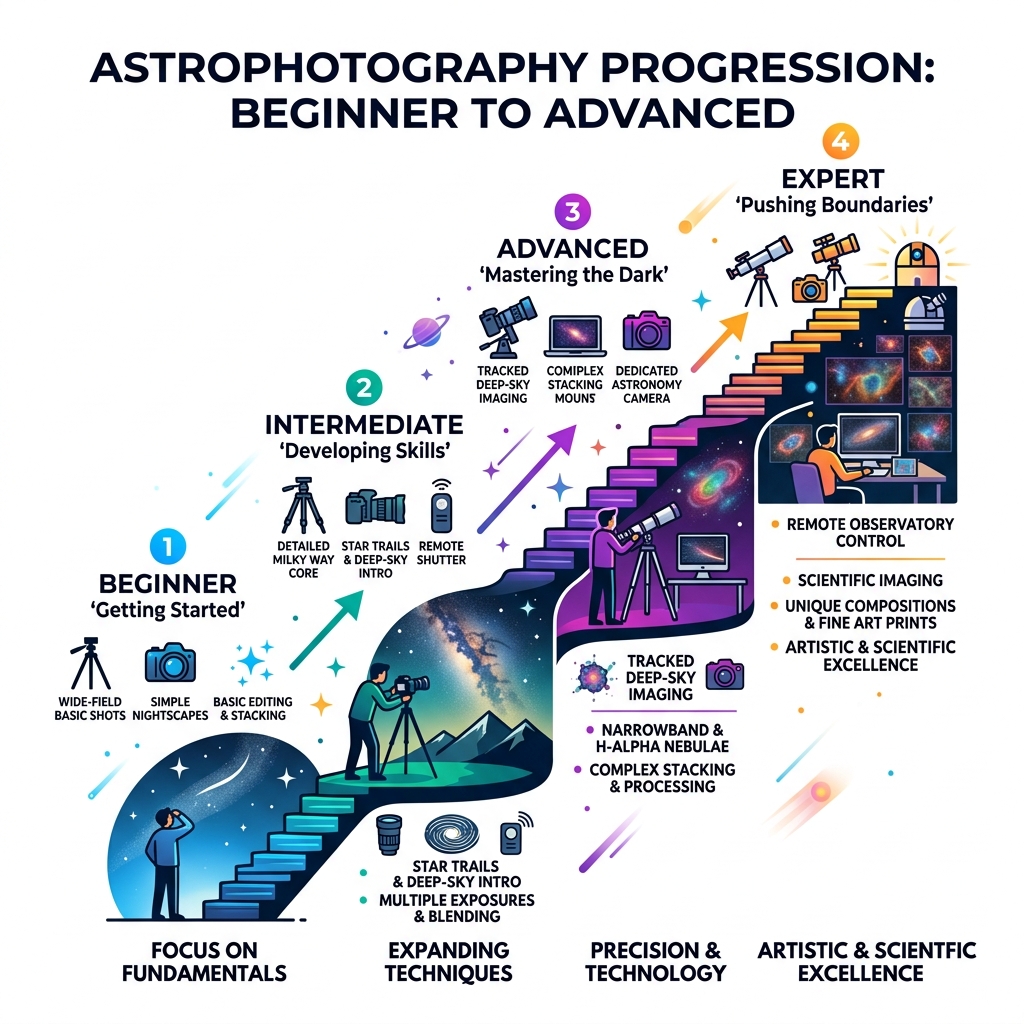
- Beginner: Look for “Nightscape” or “Milky Way 101” workshops. These focus on single-exposure shots, basic tripod setup, and finding the Milky Way using apps like PhotoPills.
- Intermediate: Seek out workshops that introduce star trackers. You’ll learn about polar alignment and “stacking” multiple images to reduce noise.
- Advanced: These workshops dive into H-Alpha techniques, multi-row tracked panoramas, and “Deepscapes”—where you blend a high-resolution deep-sky object (like the Orion Nebula) into a wide-angle landscape.
Planning Your 2025-2027 Astrophotography Adventure
The best workshops sell out 12 to 18 months in advance. As we look toward 2025, 2026, and 2027, planning becomes a logistical puzzle.
- Dates: Most workshops are timed around the New Moon. This ensures the sky is at its darkest, with no moonlight to wash out the stars. You can check the lunar cycle on the NASA Moon Phase Calendar to plan your trip.
- Costs: Expect to pay between $600 for a weekend and $3,900 for a 5-day “all-inclusive” retreat.
- Inclusions: High-end workshops often include lodging (like The Ranch at Furnace Creek in Death Valley) and sometimes meals. Budget-friendly options usually cover only the instruction, leaving you to handle your own “vampire-style” meal schedule.
Logistics, Safety, and Weather Contingencies
Astrophotography is an outdoor sport, and the desert can be unforgiving.
- Weather: Even the best instructors can’t control the clouds. Most workshops have “indoor” plans, focusing on post-processing or light painting in barns if the sky is overcast. Interestingly, McDonald Observatory workshops have only seen a few cloudy nights in nearly a decade of operation!
- Altitude: Locations in Colorado and Utah are high. Staying hydrated is the best way to avoid altitude sickness.
- Safety: Always bring a red-light headlamp. Red light preserves your night vision (and your neighbor’s). Layered clothing is also essential; desert temperatures can drop below freezing as soon as the sun sets.
- Refunds: Most organizers require a non-refundable deposit (often around $1,500) to hold your spot, as these small-group events are difficult to fill at the last minute.
Frequently Asked Questions about Astrophotography Workshops
What gear is absolutely required for a beginner workshop?
At a minimum, you need a camera that can shoot in “Manual” mode, a wide-angle lens (f/2.8 is ideal), and a sturdy tripod. Many beginner workshops at observatories may even provide telescopes, but for field workshops, your own tripod is your most important tool.
How do workshops handle poor weather or cloudy nights?
Instructors usually pivot to “Classroom Mode.” This is actually a blessing in disguise for many, as it allows for extra hours of deep-dive training in Photoshop or PixInsight. Some workshops also use the time to practice “light painting,” using handheld lights to illuminate foreground objects like old cabins or saguaro cacti.
Are non-photographer companions allowed to join the sessions?
Generally, no. Because these workshops operate on strict permits (like CUA permits in National Parks) and have very limited group sizes, every person present usually needs to be a paid participant. Additionally, the “vampire” schedule (sleeping all day, shooting all night) isn’t very fun for someone not taking photos!
Conclusion
Finding an astrophotography workshop near me is the first step toward mastering the night. Whether you are standing on a private ranch in Westcliffe or under the “Gold Tier” skies of Death Valley, these experiences offer more than just technical skills. They offer a community of people who find beauty in the dark and a profound connection to the universe.
At Pratos Delícia, we believe that everyone should have the chance to see the Milky Way in its full glory. By choosing the right workshop, bringing the right gear, and mastering the art of the “stack,” you can turn your celestial dreams into gallery-quality prints.
Start your journey with our complete guide and we’ll see you under the stars!
