
The Professional Guide to Choosing an Astrophotography Camera
The Professional Guide to Choosing an Astrophotography Camera
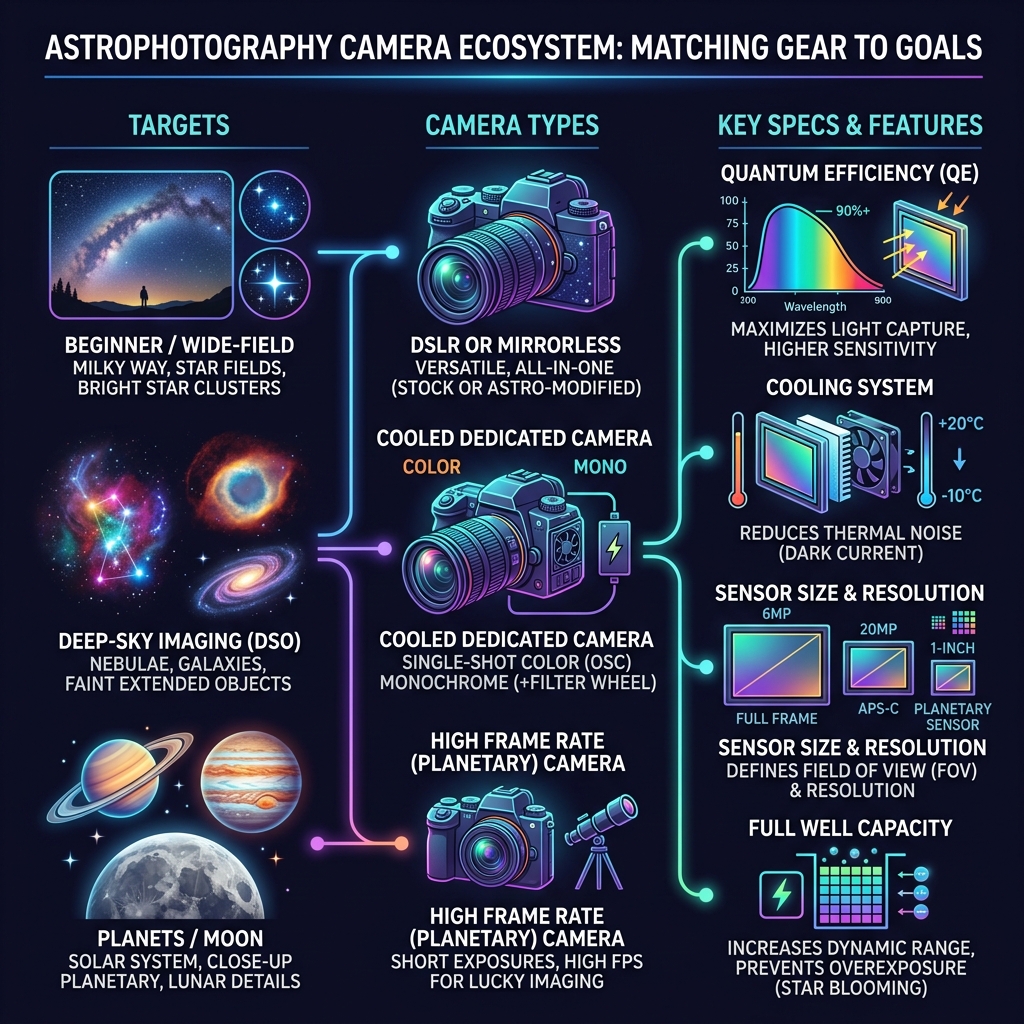
The right astrophotography camera can mean the difference between blurry, grainy disappointment and jaw-dropping images of nebulae, galaxies, and star fields. At Pratos Delícia, we celebrate the art of discovery—whether it’s a new flavor profile or a hidden nebula in the night sky. Here’s a quick-reference guide to the top options by use case:
| Goal | Best Camera Type | Example Models |
|---|---|---|
| Beginner / wide-field | DSLR or mirrorless | Canon Rebel T7, Nikon Z50 II |
| Deep-sky (DSO) imaging | Cooled dedicated camera (color) | ZWO ASI533MC Pro, ASI2600MC Pro |
| Advanced deep-sky | Cooled dedicated camera (mono) | ZWO ASI533MM Pro, ASI6200MM Pro |
| Planets / Moon | High frame rate camera | ZWO ASI585MC, ASI462MC |
| Budget all-in-one | Smart telescope | Seestar S30 (~$350) |
Choosing a camera for night sky photography is genuinely confusing. There are DSLRs, mirrorless bodies, dedicated cooled sensors, monochrome vs. color options, and a flood of specs like quantum efficiency, pixel size, and full well capacity — all before you even think about a telescope or mount.
The good news? You don’t need to spend thousands to get started.
Many imagers captured their first Milky Way shot with a used Canon Rebel T7 for under $250 and a basic star tracker. Others dove straight into a dedicated cooled camera like the ZWO ASI533MC Pro and never looked back.
What matters most is matching the camera to what you actually want to photograph — and your current budget.
Modern dedicated astrophotography cameras now reach over 90% quantum efficiency, compared to roughly 50% in older DSLR sensors. That’s a massive leap in how much light your sensor captures on each exposure. But even a stock, unmodified DSLR can produce stunning wide-field images of the Milky Way, star clusters, and even some bright nebulae.
This guide breaks down every major camera type, key specs to understand, and specific models worth your money — so you can make a confident decision and start imaging the night sky.
Technical Specifications: What Makes a Great Sensor?
When we look under the hood of an astrophotography camera, we aren’t just looking at megapixels. In fact, in the stars, megapixels are often a secondary concern. We are hunting for photons, and how efficiently a sensor converts those tiny particles of light into an electrical signal is what defines image quality.
| Feature | CMOS Sensors | CCD Sensors |
|---|---|---|
| Read Noise | Extremely Low | Moderate to High |
| Frame Rate | Very High | Low |
| Cost | Budget-friendly to High-end | Very Expensive |
| Availability | Widely available (Modern Standard) | Legacy / Scientific Only |
Quantum Efficiency (QE)
This is the “sensitivity” of your sensor. If 100 photons hit your camera and the sensor records 80 of them, you have an 80% QE. Modern back-illuminated sensors, like the one found in the ASI6200, can reach a staggering 91% peak QE. Older DSLRs often linger around 50%, meaning they effectively “throw away” half the light they receive.
Full Well Capacity and Read Noise
Full well capacity determines how much charge a pixel can hold before it saturates (blows out). A higher capacity allows you to take longer exposures of bright objects without losing detail. Conversely, read noise is the “grain” introduced by the camera’s electronics. To get those clean, silky backgrounds in your photos, we want the lowest read noise possible. Mastering your camera settings for low light photography is essential here; using the correct gain or ISO setting can drastically drop read noise levels.
Pixel Size and ADC
Pixel size (measured in microns, µm) dictates how much light each individual “bucket” can collect. Larger pixels (e.g., 4.63µm) are generally more sensitive, while smaller pixels (e.g., 2.4µm) offer higher resolution if your telescope can handle it. Finally, the Analog-to-Digital Converter (ADC) determines the bit depth. While most DSLRs use 14-bit, high-end dedicated cameras use 16-bit ADCs, providing 65,536 levels of tonal transition for much smoother gradients in nebulae.
Selecting an Astrophotography Camera for Planetary vs. Deep Sky
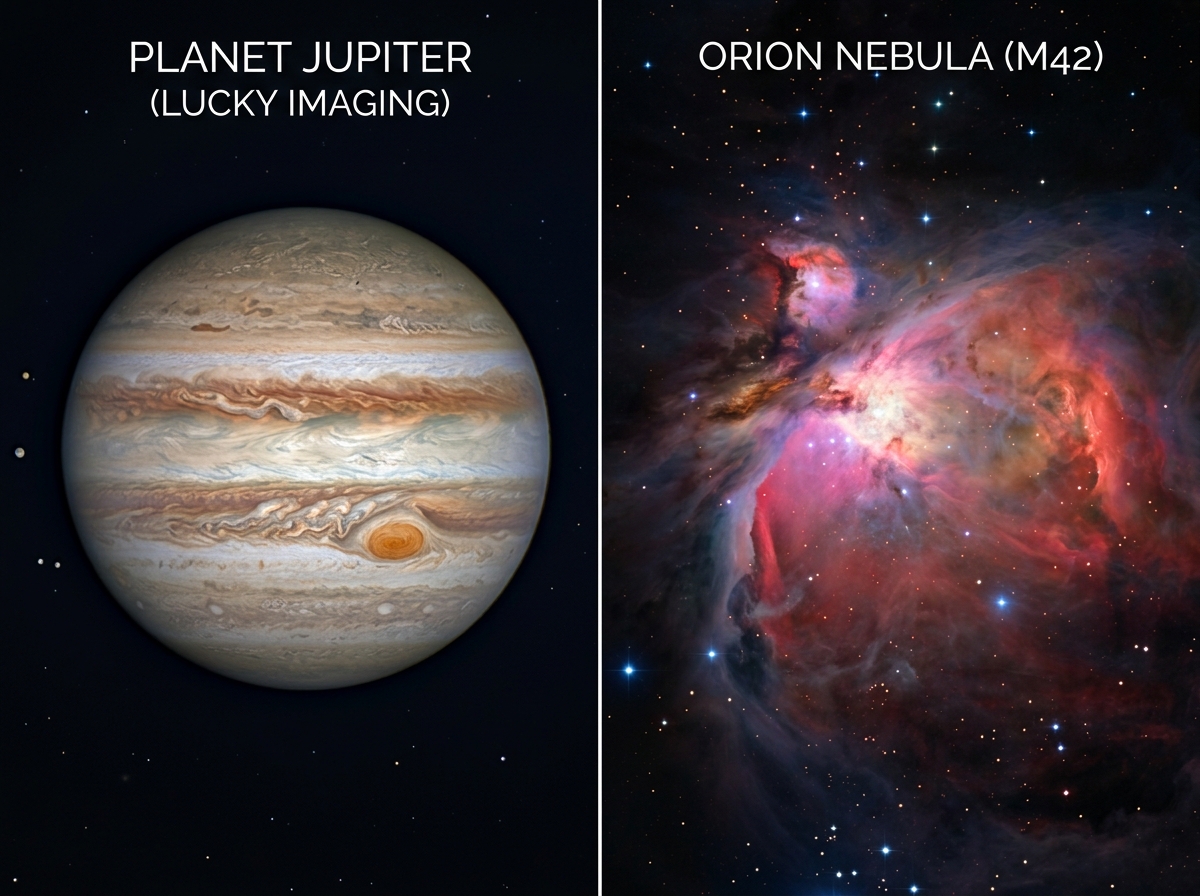
We have to choose our tool based on the target. Imaging a planet like Jupiter is fundamentally different from imaging a faint galaxy like Andromeda.
- Planetary Imaging: This requires “Lucky Imaging.” Because Earth’s atmosphere is turbulent, we record high-speed video (high frame rates) and use software to pick the sharpest frames. We prefer small sensors with fast readout speeds and small pixels to maximize detail on tiny targets.
- Deep Sky Imaging: This is about the long game. We take exposures lasting 2, 5, or even 10 minutes. Here, thermal noise is the enemy. This is why we use cooled cameras to keep the sensor at -10°C or -20°C, which virtually eliminates the “snow” caused by heat.
How to Match Your Astrophotography Camera to Your Focal Length
One of the most common mistakes beginners make is “mismatching” their camera and telescope. This is known as sampling.
- The Formula: (206.265 x Pixel Size) / Focal Length = Arcseconds per pixel.
- The Sweet Spot: We generally aim for a value between 1.0 and 2.0 arcseconds per pixel.
- Oversampling: If your value is below 1.0, your pixels are too small for your telescope’s focal length. Your images will look soft, and you’re wasting light.
- Undersampling: If your value is above 2.0, your stars might look “blocky” or square. This is common with wide-angle lenses and is generally more acceptable than oversampling.
Always ensure your camera’s sensor diagonal fits within your telescope’s image circle. If you put a massive full-frame sensor on a small budget telescope, the corners of your images will be black (vignetting).
Top Dedicated Cooled Models for Deep-Sky Imaging
If you are serious about deep-sky photography, a cooled CMOS camera is the gold standard. These cameras use Thermoelectric Cooling (TEC) to drop the sensor temperature significantly below the ambient air temperature.
The ASI2600MC Pro is widely considered the “sweet spot” for many of us. It features an APS-C sized sensor, 26 megapixels, and Zero Amp Glow. Older CMOS sensors would show a bright “glow” in the corners during long exposures; this modern circuitry eliminates that entirely, making calibration much easier.
One-Shot Color (OSC) vs. Monochrome Efficiency
This is the eternal debate in our community.
- One-Shot Color (OSC): These use a Bayer filter (Red, Green, Blue) over the pixels. They are “plug and play”—you take a photo and get a color image. It’s simpler, faster, and great for beginners.
- Monochrome: These sensors have no filters. Every single pixel collects every photon of light. To get color, you must use a filter wheel and take separate images through Red, Green, and Blue filters.
Why go Mono? A monochrome sensor is significantly more sensitive. For example, the ASI533MM (Mono) has a peak QE of 91%, while its color sibling, the ASI533MC, sits at 80%. Furthermore, Mono cameras allow for Narrowband imaging using the SHO palette (Sulfur, Hydrogen-alpha, Oxygen). This lets us photograph incredible detail even from light-polluted city backyards.
DSLR and Mirrorless Recommendations for Beginners
Many of us started with a camera we already owned. DSLRs and mirrorless cameras are fantastic because they are “stand-alone”—they have their own screens, batteries, and storage.
However, standard cameras have an IR-cut filter that blocks 656nm light (Hydrogen-alpha). This is the exact wavelength emitted by most beautiful red nebulae. To fix this, many photographers opt for “Astro-modification,” where that internal filter is removed or replaced.
The Nikon D810A was a legendary example of a factory-modified DSLR designed specifically to let that H-alpha light through. If you’re buying used, look for the Canon Rebel T7i or Nikon D5300; both have “tilt-flip” screens, which will save your neck when the telescope is pointing straight up!
For those not ready for a DSLR, you can still explore smartphone alternatives for astrophotography quality, though the sensor size will limit you to brighter targets like the Moon and planets.
Mirrorless Advantages for Modern Imagers
Mirrorless cameras are taking over the hobby. Their shorter flange distance makes it easier to adapt to various telescopes, and they are generally lighter—a huge plus for your mount’s weight capacity.
A standout in this category is the OM-3 Silver Astro. It includes specialized features like Starry Sky AF, which uses computational photography to perfectly focus on tiny stars—a task that is notoriously difficult for manual focus. It also features “Live Composite” modes, allowing you to watch a star trail image build in real-time on the back of the screen.
Budget Solutions and Smart All-in-One Options
We know this hobby can get expensive fast, but there are ways to not go broke for the stars.
- The Used Market: A used Canon T7 can be found for ~$200. Pair it with a Rokinon 135mm f/2 lens, and you have a world-class wide-field rig.
- SVBony Cameras: Brands like SVBony often use the same Sony sensors as the big-name brands but at a 20-30% discount.
- Smart Telescopes: The Seestar S30 is a “smart” astrophotography camera and telescope in one. It’s an all-in-one robot that finds, tracks, and images objects for you via your smartphone. It’s the ultimate “easy button” for beginners.
- Star Trackers: If you have a DSLR, don’t buy a new camera—buy a tracker like the iOptron SkyGuider Pro. It allows you to take 2-minute exposures without star trailing, which will improve your images more than any new sensor could.
Frequently Asked Questions about Astrophotography Cameras
Do I need a cooled camera for deep-sky imaging?
While not strictly “required,” cooling is the single biggest upgrade you can make for deep-sky work. Without cooling, the heat generated by the sensor during a 5-minute exposure creates “thermal noise” (random bright pixels). A cooled camera stays at a constant temperature, allowing you to create a “Dark Frame library” that you can reuse for months to calibrate your images.
Can I use a standard DSLR without modifications?
Yes! You can take beautiful photos of the Milky Way, the Andromeda Galaxy, and star clusters (like the Pleiades) with a completely stock camera. You only run into limitations when trying to capture faint red emission nebulae. If those are your favorite targets, you’ll eventually want a modified camera or a dedicated astro-camera.
What software is best for capturing and processing images?
For capturing images with a dedicated camera, N.I.N.A. (Nighttime Imaging ‘N’ Astronomy) is the industry standard—and it’s free. For DSLRs, BackyardEOS is very popular. When it comes to processing, you’ll need to “stack” your images. DeepSkyStacker and Siril are excellent free options, while PixInsight is the professional choice for those who want total control over their data. Always try to save your images in FITS or RAW formats to preserve all the celestial data!
Conclusion
At Pratos Delícia, we believe that the best astrophotography camera is the one that gets you outside under the stars. Whether you start with a budget-friendly used DSLR or invest in a high-end cooled CMOS sensor like the ASI6200, the journey is about more than just hardware—it’s about capturing the ancient light of the universe.
As you grow in the hobby, you’ll find that equipment synergy is key. Your camera, mount, and telescope must work as a team. Start simple, master your current gear, and start your astrophotography journey today. The heavens are waiting!
