
Why Smooth Long Exposure Waterfalls Are Worth Mastering
Smooth long exposure waterfalls are created by using a slow shutter speed — typically between 1/2 second and 30 seconds — to blur the motion of moving water into a silky, dreamy effect.
Here’s a quick look at the tools you need to get started:
| Tool | Why You Need It |
|---|---|
| Sturdy tripod | Keeps the camera still during long exposures |
| ND filter (3, 6, or 10-stop) | Blocks light so you can use slower shutter speeds in daylight |
| Circular polarizer | Cuts glare on wet rocks and boosts color |
| Remote shutter release | Fires the shutter without touching the camera |
| Low ISO setting (100-200) | Reduces noise in long exposures |
Making water look silky is one of the most rewarding effects you can pull off with a camera. But it’s also one of the most misunderstood.
Many beginners assume you need expensive gear or perfect sunny conditions. You don’t. What you really need is the right combination of tools and settings — and a basic understanding of how shutter speed affects moving water.
This guide covers exactly that: the best tools to turn an ordinary waterfall into a flowing, silk-like cascade.
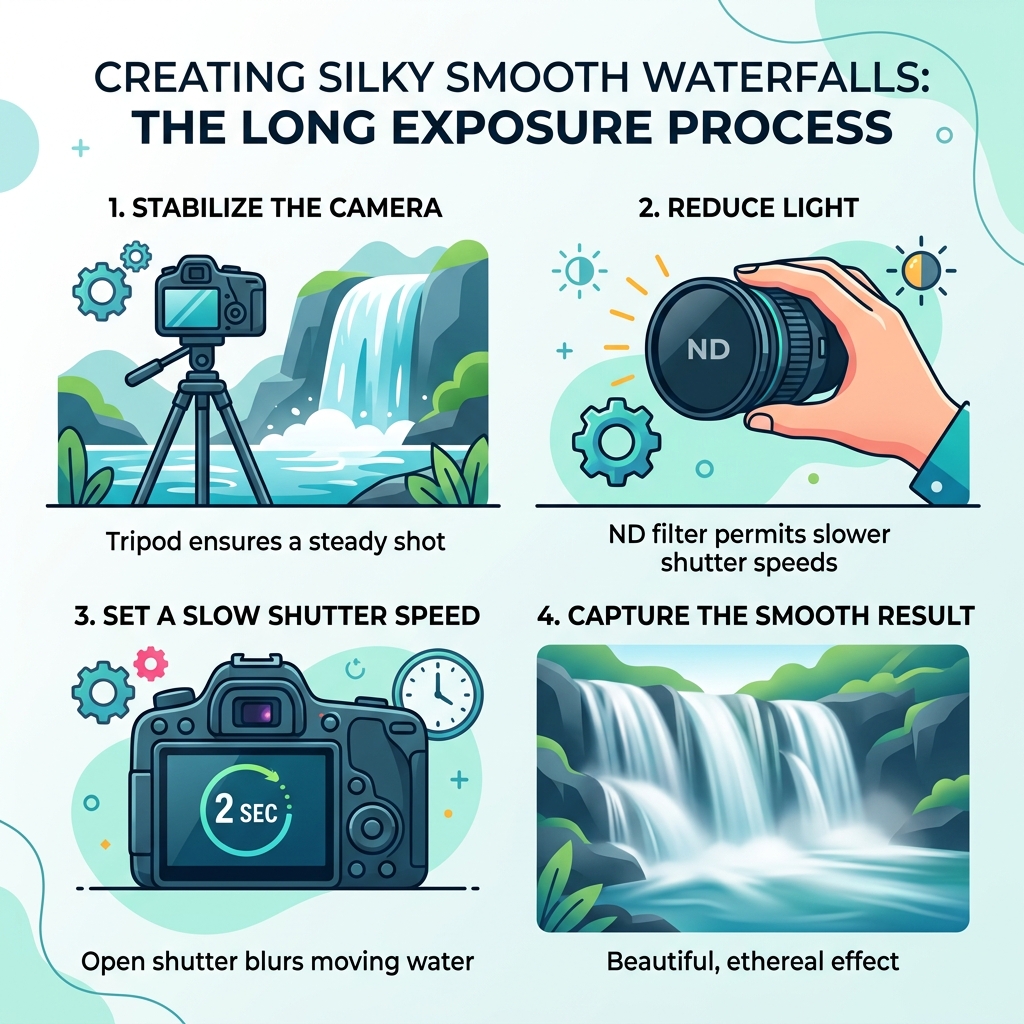
Quick smooth long exposure waterfalls terms:
Essential Gear for Smooth Long Exposure Waterfalls
When we head out to capture the perfect cascade, we aren’t just bringing a camera and a prayer. The secret to those professional, ethereal images lies in stability. Because we are leaving the shutter open for seconds at a time, any vibration—even a slight breeze or the click of the shutter button—can turn a masterpiece into a blurry mess.
The most critical tool in your kit is a sturdy tripod. While a cheap, lightweight tripod might work for a quick family photo, waterfall environments are often windy and the ground is frequently uneven or slippery. Many professionals prefer carbon fiber tripods because they are incredibly stiff and dampen vibrations better than aluminum, not to mention they are much lighter to carry on a long hike. If you’re serious about your craft, check out the-ultimate-guide-to-capturing-milky-waterfalls-and-waves for a deeper dive into stability.
Beyond the tripod, a remote shutter release (or a wireless remote) is essential. This allows us to fire the camera without physically touching it, eliminating “shutter shock.” If you don’t have one, using the camera’s built-in 2-second or 5-second timer is a great “hack” to achieve the same result. Finally, ensure your gear has decent weather sealing. Waterfalls create mist, and that mist will find its way into every nook and cranny of your camera.

Selecting the Right Lens
The lens you choose drastically changes the “story” of your smooth long exposure waterfalls.
- Wide-Angle Lenses (15-30mm): These are the classic choice. They allow us to capture the entire scene, including the surrounding forest, the pool at the bottom, and the sky above. They provide a sense of grandeur and scale.
- Telephoto Lenses (70-200mm): Don’t leave these at home! A telephoto lens allows for telephoto compression, which pulls the background closer. This is perfect for isolating specific sections of a waterfall, focusing on the abstract patterns of the water or the mossy rocks. Sometimes, a tight shot of a small section of falling water is more powerful than the wide view.
Regardless of the focal length, always use a lens hood. It’s not just for sun glare; it acts as a physical shield against stray water droplets hitting your front glass element.
Stability and Protection Tools
Choosing the right tripod head is just as important as the legs. Ball heads are popular for their speed and flexibility, allowing us to point the camera in almost any direction quickly. However, for precise compositions, some photographers prefer geared heads, which allow for tiny, incremental adjustments.
Because we are working in wet environments, protection is paramount. We always carry:
- Rain sleeves: Inexpensive plastic covers that keep the camera body dry.
- Microfiber cloths: You will be wiping mist off your lens constantly. Bring more than you think you need!
- Shower caps: A great emergency hack to cover your camera while waiting for the light to change.
For more field-tested advice on keeping your gear safe, you can download-this-long-exposure-guide-pdf-for-fieldwork-success to keep as a handy reference on your phone.
Mastering Camera Settings for Silky Motion
To get that “silk” look, we need to take control away from the camera’s computer and handle the settings ourselves. We recommend using Manual Mode or Aperture Priority.
Our goal is to keep the ISO at its base (usually 100 or 200). This ensures the highest image quality and the least amount of digital noise. For the aperture, we typically stay between f/8 and f/11. This is generally the “sweet spot” for lens sharpness. While you might be tempted to go to f/22 to get a longer shutter speed, be careful—this can cause “diffraction,” which actually makes your image look softer and less detailed.
| Water Flow Type | Recommended Shutter Speed | Effect Created |
|---|---|---|
| Rushing/Powerful Falls | 1/20 to 1/4 second | Retains some texture and power |
| Standard Cascades | 1 to 4 seconds | Classic silky, smooth look |
| Slow Trickles/Streams | 5 to 20 seconds | Dreamy, ethereal mist effect |
| Very Large/Distant Falls | 20+ seconds | “Cloud-like” or “shaving cream” appearance |
Choosing the Right Shutter Speed for Smooth Long Exposure Waterfalls
There is no “perfect” shutter speed because every waterfall moves at a different velocity. A massive, thundering fall might look like a white blob if you expose it for 30 seconds. Conversely, a tiny forest stream might just look “blurry” rather than “silky” if your exposure is too short.
A good starting point is 1 second. Take a shot, look at the screen, and zoom in. If the water looks too “chunky,” increase the time to 2 or 3 seconds. If all the detail is gone and it looks like frozen fog, speed it up to 1/2 a second. If you find the technical side overwhelming, don’t worry; how-to-do-long-exposure-photography-without-losing-your-mind has some great tips for keeping the process simple.
Focus Techniques for Long Exposures
Autofocus often struggles with moving water—it doesn’t know where to “lock on.” We recommend using Manual Focus.
- Focus before adding filters: If you are using a dark ND filter, the camera won’t be able to see well enough to focus. Set your focus first.
- Use Live View Zoom: Turn on your camera’s screen, zoom in 10x on a stationary object (like a rock or a branch next to the water), and twist the focus ring until it’s tack sharp.
- Back-button focus: This is a pro technique where you move the focus function away from the shutter button to a button on the back of the camera. This prevents the camera from trying to re-focus when you go to take the shot.
For those who want to master the art of patience in photography, we suggest reading the-complete-guide-to-long-exposure-photography-for-patient-people.
Using ND Filters and Polarizers Like a Pro
If you try to shoot a 2-second exposure in the middle of a sunny day, your photo will likely be a solid white rectangle. There is simply too much light. This is where Neutral Density (ND) filters come in. Think of them as sunglasses for your camera. They reduce the amount of light entering the lens without changing the color of the scene.
Neutral Density Filters for Smooth Long Exposure Waterfalls
ND filters are categorized by “stops” of light reduction:
- 3-stop (ND8): Great for overcast days or when you only need a slightly slower shutter speed.
- 6-stop (ND64): The “Goldilocks” filter. Perfect for most waterfall situations to get that 1-4 second range.
- 10-stop (ND1000): Used for very long exposures (30 seconds+) or shooting in direct, bright sunlight.
You can choose between screw-on filters (which match your lens size) or drop-in square systems (which allow you to stack multiple filters easily). Variable ND filters are also available, but be wary of cheap ones, as they can create a dark “X” pattern across your beautiful smooth long exposure waterfalls.
The Role of the Circular Polarizer
If we could only bring one filter to a waterfall, it would be the Circular Polarizer (CPL). Waterfalls are surrounded by wet rocks and leaves, which act like tiny mirrors reflecting the white sky. This creates “glare” that washes out color.
A polarizer allows us to “dial out” those reflections. By rotating the filter, you can watch the glare on the rocks disappear, revealing the deep blacks of the stone and the vibrant greens of the moss. As a bonus, a CPL usually reduces light by about 1 to 2 stops, which helps us get closer to that slow shutter speed we desire. You can even stack a CPL on top of an ND filter for the ultimate control.
Composition and Field Techniques for Better Results
A silky waterfall is beautiful, but a silky waterfall with a great composition is art. Don’t just stand at the designated “lookout” point. Move around!
- Leading Lines: Look for fallen logs, rows of rocks, or the curve of the stream to lead the viewer’s eye toward the base of the falls.
- Foreground Interest: Including a sharp, stationary object in the foreground—like a colorful leaf on a rock—provides a point of contrast against the blurred water.
- Low-Angle Perspectives: Getting your tripod low to the ground (or even putting the legs in the water!) makes the waterfall look much more imposing and powerful.
For more on navigating difficult environments to find the best shot, see a-guide-to-shooting-long-exposure-fog-without-losing-your-way.
Optimal Lighting and Weather Conditions
Believe it or not, a bright, sunny day is actually the worst time for waterfall photography. The sun creates harsh shadows and “hot spots” on the white water that are impossible to fix in editing.
The best conditions are:
- Overcast Skies: The clouds act as a giant softbox, providing even, diffused light.
- The “Golden Hour”: Just after sunrise or before sunset, when the light is soft and warm.
- Rainy Days: Wet foliage looks much more vibrant, and the water flow is often stronger.
Advanced Shooting Methods
Sometimes, a single photo isn’t enough to capture the whole scene.
- Exposure Bracketing: We take three or more shots at different brightness levels. This helps us capture detail in the dark rocks and the bright white water simultaneously.
- Focus Stacking: If you have a leaf 2 feet away and a waterfall 50 feet away, it’s hard to get both sharp. We take one shot focused on the leaf and another on the falls, then blend them later.
- Multiple Exposure Blending: If the wind is blowing the trees and making them blurry during your long exposure, take one fast shot to “freeze” the leaves and one slow shot for the water, then combine them.
Interestingly, you can even start practicing these concepts on your phone! Check out long-exposure-tips-for-smartphone-night-photos to see how mobile tech is catching up.
Frequently Asked Questions about Smooth Long Exposure Waterfalls
Can I shoot smooth waterfalls handheld without a tripod?
While we always recommend a tripod, modern technology is making handheld shots possible. Many new cameras have incredible In-Body Image Stabilization (IBIS) that allows for handheld exposures of up to 1 or 2 seconds if you have steady hands. You can also lean against a tree or rest your camera on a flat rock to stay still. If you’re using a phone, there are top-mobile-camera-apps-for-long-exposure-shots that use software to “stack” images and mimic the long exposure look without a tripod.
How do I prevent my waterfall photos from looking “blown out”?
The “blown out” look happens when the white water becomes so bright it loses all detail. To prevent this, always check your histogram on the back of the camera. If the graph is “piled up” against the right side, your highlights are clipped. Use exposure compensation to underexpose the shot slightly. It is much easier to brighten dark rocks in post-processing than it is to recover detail from pure white water. Always shoot in RAW format to give yourself the most flexibility.
What are the biggest safety risks when shooting near waterfalls?
Safety should always be your first priority.
- Slippery Rocks: Moss-covered rocks are like ice. Wear shoes with good grip or even felt-bottomed wading boots.
- Flash Floods: If it’s been raining heavily upstream, water levels can rise in seconds.
- Tripod Stability: Never leave your tripod unattended, especially if the legs are in moving water. A sudden surge can tip your gear into the river.
- Spray and Moisture: Keep your gear covered when you aren’t shooting to prevent internal fogging.
Conclusion
At Pratos Delícia, we believe that photography is about more than just settings; it’s about the feeling of being in nature and capturing its movement. Creating smooth long exposure waterfalls is a journey of patience and practice. Don’t be discouraged if your first few shots don’t look like the ones in magazines. Experiment with different shutter speeds, try new angles, and most importantly, enjoy the sound of the water while you work.
The more you practice, the more you will develop your own “creative vision” for how water should look. Whether you prefer a subtle silkiness or a total misty blur, the tools we’ve discussed today will give you the foundation to succeed.
Ready to take your skills further? Explore More photography guides and tutorials to continue your journey into long exposure. Happy shooting!
