
The Best Night Sky Photography Techniques for Desert Imaging
Why Night Sky Photography Techniques Can Transform Your Desert Shots
Night sky photography techniques are the core set of camera settings, planning methods, and composition skills that let you capture sharp, stunning images of stars, the Milky Way, and more.
Here is a quick-start summary:
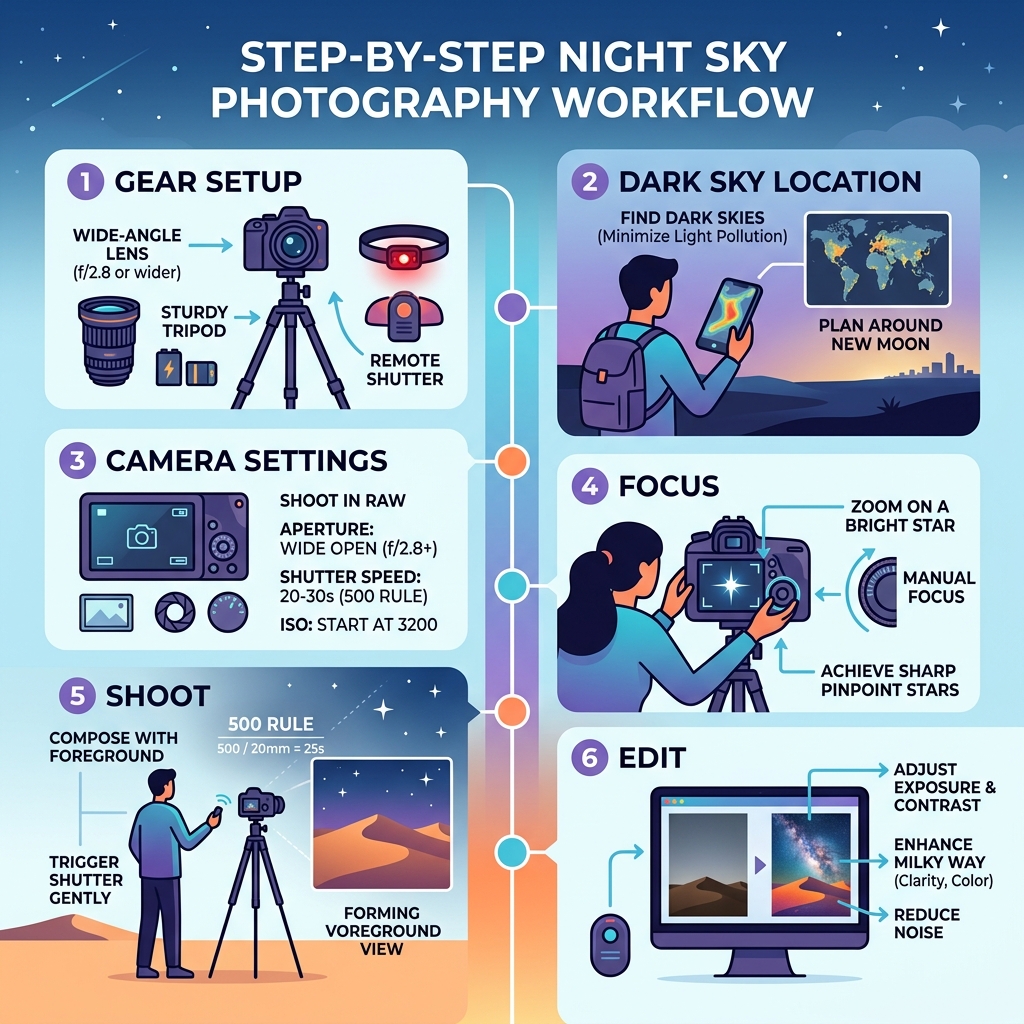
- Use a wide-angle lens (14-24mm for full-frame, 10-20mm for APS-C) with an aperture of f/2.8 or wider
- Set your shutter speed using the 500 Rule: divide 500 by your focal length (e.g., 25 seconds for a 20mm lens on full-frame)
- Start at ISO 3200 and adjust based on your camera’s noise performance
- Shoot in RAW format for maximum editing flexibility
- Manually focus by zooming in on a bright star in Live View and sharpening until it becomes the smallest pinpoint
- Find dark skies using a light pollution map and plan around the new moon
- Use a sturdy tripod and a remote shutter release to eliminate camera shake
- Include a foreground element — desert rock formations, dunes, or lone trees — to give your image scale and story
These steps work for beginners with basic gear. You do not need expensive equipment to get breathtaking results.
The desert is one of the best environments on Earth for night sky photography. Why? Minimal light pollution. Dry air. Dramatic natural foregrounds. And vast, open horizons that let you see the Milky Way stretch from edge to edge.
But pointing your camera at the sky and pressing the shutter rarely works. Stars come out blurry. Images look dark and noisy. The settings that work in daylight fail completely at night.
The good news: once you understand a handful of core techniques, the night sky becomes one of the most rewarding subjects you can photograph. Cameras reveal far more stars and vivid colors than the naked eye can ever see — and that first successful Milky Way shot tends to be genuinely life-changing.
This guide walks you through everything, from gear and settings to advanced methods like star trails and image stacking.
Important night sky photography techniques terms:
Essential Gear for Professional Night Sky Photography
When we head into the desert for a night shoot, our gear choices are the foundation of our success. While you don’t need a $10,000 setup, certain items are non-negotiable for capturing the heavens.

The Camera: Full-Frame vs. APS-C
A camera with a full-frame sensor is the gold standard for night sky photography techniques. These sensors are larger, meaning they can capture more light and handle high ISO settings with significantly less noise. However, modern APS-C (crop sensor) cameras are incredibly capable. If you are using a crop sensor, just keep in mind that you’ll need to account for the “crop factor” (usually 1.5x or 1.6x) when calculating your shutter speed.
The Lens: Wide and Fast
You want a wide-angle lens to capture the vastness of the desert sky. For full-frame, look for something between 14mm and 24mm. For crop sensors, 10mm to 17mm is ideal. Speed is equally important; an f/2.8 aperture or wider (like f/1.8 or f/1.4) is necessary to let in enough light during your exposure. Even a kit lens can work, but you’ll likely need to push your ISO higher to compensate for the smaller aperture.
Support and Accessories
- Sturdy Tripod: Desert winds can be surprisingly strong. A heavy, stable tripod is essential to prevent camera shake during 20-30 second exposures.
- Red Light Headlamp: White light ruins your night vision for up to 30 minutes. A red light allows you to see your dials without blinding yourself or other photographers.
- Intervalometer or Remote Release: Touching the camera to take a photo causes micro-vibrations. An intervalometer or the camera’s built-in self-timer (set to 2 or 5 seconds) ensures the camera is perfectly still when the shutter opens.
- Extra Batteries: Long exposures and cold desert nights drain batteries quickly. We always carry at least three.
For a deeper dive into the technicalities of your equipment, check out our guide on mastering your camera settings for low light photography.
Mastering Night Sky Photography Techniques: Settings and Calculations
Capturing the stars is a balancing act. You need enough light to see the Milky Way, but if your shutter stays open too long, the Earth’s rotation will turn those pinpoints of light into blurry streaks.
The 500 Rule vs. The NPF Rule
The most famous of all night sky photography techniques is the 500 Rule. It’s a simple formula to find your maximum shutter speed: divide 500 by your focal length.
- Full-frame example: 500 / 20mm = 25 seconds.
- APS-C example: 500 / (20mm x 1.5 crop factor) = 16.6 seconds.
While the 500 Rule is a great starting point, modern high-resolution sensors are so sharp they sometimes reveal “trailing” even at these speeds. Many pros now use the NPF Rule, which is a more complex calculation involving aperture and pixel pitch, but generally results in shorter, sharper exposures (often around 10-15 seconds).
Finding the Exposure Sweet Spot
We generally recommend starting with these baseline settings in Manual Mode:
- Format: Always shoot in RAW format. JPEGs discard too much data that you’ll need during editing.
- Aperture: Widest possible (f/2.8 or lower).
- ISO: Start at ISO 3200. If the image is too dark, move to 6400. If it’s too noisy, drop to 1600.
- White Balance: Set this manually to around 4000K to 4500K (Kelvin) to avoid the “muddy yellow” look of Auto White Balance.
| Focal Length | Full-Frame Shutter (500 Rule) | APS-C Shutter (500 Rule) |
|---|---|---|
| 14mm | 35 Seconds | 22 Seconds |
| 18mm | 27 Seconds | 17 Seconds |
| 24mm | 20 Seconds | 13 Seconds |
| 35mm | 14 Seconds | 9 Seconds |
Finding Dark Skies for Night Sky Photography Techniques
You can have the best gear in the world, but if you are standing under city lights, you won’t see the stars. We use light pollution maps (like lightpollutionmap.info) to find areas with a low Bortle scale rating. A Bortle 1 or 2 site is a “true” dark sky where the Milky Way casts a shadow.
Timing is just as critical. You must plan your shoot around the New Moon phase. A full moon is essentially a giant light bulb in the sky that washes out the faint light of the stars. We aim to shoot in the window of four days before to four days after a new moon. Also, wait for astronomical darkness—this occurs when the sun is at least 18 degrees below the horizon, usually about 90 minutes after sunset.
For more help on picking the perfect spot, see our location scouting tips for night sky photos.
Manual Focus for Sharp Night Sky Photography Techniques
Autofocus does not work in the dark. If you rely on it, you’ll end up with “donuts” instead of stars. The most reliable method is using Live View magnification.
- Find the brightest star or planet (like Jupiter or Venus) in the sky.
- Center it in your screen and zoom in to the maximum magnification (5x or 10x).
- Slowly turn your focus ring until the star becomes the smallest, sharpest pinpoint possible.
- Pro Tip: Once you find focus, use a piece of gaffer tape to lock the focus ring in place so it doesn’t nudge during the night.
If your camera has focus peaking, it can be a helpful guide, but your eyes and the magnification tool are your best friends here. For a step-by-step walkthrough, visit our focusing on stars guide.
Advanced Methods for Star Trails and Milky Way Core
Once you’ve mastered the basics, it’s time to explore techniques that separate the hobbyists from the professionals.
The Art of Star Trails
If you want to embrace the Earth’s rotation rather than fight it, you can create star trails. While you could leave your shutter open for 30 minutes, this often results in massive sensor heat and digital noise. The modern professional approach is image stacking. We take a series of 50 to 100 consecutive 30-second exposures and then use software like StarStaX or Sequator to blend them together. This creates smooth, long trails while keeping noise to a minimum.
Star Trackers
For the ultimate Milky Way detail, we use a star tracker. This is a motorized mount that sits on your tripod and rotates at the same speed as the Earth. This allows us to take exposures of 2, 3, or even 5 minutes without the stars blurring. The result is a much lower ISO and an incredibly clean, “noise-free” image.
Foreground Light Painting and Composition
A photo of just stars can be a bit boring. To create a “nightscape,” you need a compelling foreground. In the desert, this could be a jagged rock formation or a Joshua tree.
- Light Painting: During a long exposure, we briefly “paint” the foreground with a dimmed flashlight or a phone screen to reveal texture and color.
- Histogram Review: Never trust your LCD screen at night; it looks brighter than it is because your eyes are adjusted to the dark. Always check your histogram. We use the ETTR (Exposing to the Right) technique, pushing the “mountain” of data toward the right side of the graph without touching the edge. This captures the most signal and the least noise.
Post-Processing: The Final Polish
The “magic” often happens in front of the computer. Using noise reduction software (like Topaz DeNoise or Adobe’s AI Noise Reduction) can save an image shot at ISO 6400. We also use selective adjustments to boost the contrast of the Milky Way’s “dust lanes” while keeping the desert floor looking natural.
For those starting their editing journey, we recommend astrophotography post-processing for beginners.
Frequently Asked Questions about Night Sky Photography
What is the 500 Rule and how do I use it?
The 500 Rule is a formula used to calculate the longest shutter speed you can use before stars start to look like lines (trails) instead of points. You divide 500 by your lens’s focal length. For example, with a 24mm lens on a full-frame camera, 500 / 24 = 20.8, so you should keep your shutter speed at 20 seconds or less.
How do I avoid noise in high ISO night shots?
Noise is the “grainy” look in dark photos. You can minimize it by using a full-frame camera, shooting in colder temperatures (which keeps the sensor cool), and using the “Expose to the Right” (ETTR) technique. If noise is still an issue, image stacking—where you take multiple shots of the same scene and average them in software—is the most effective professional solution.
When is the best time of year to photograph the Milky Way?
In the Northern Hemisphere, “Milky Way Season” runs from March to October. The “Galactic Core” (the brightest, most colorful part) is most visible in the southern sky. In the early season (March/April), it rises in the early morning. By mid-summer (June/July), it is visible for most of the night and appears more vertical.
Conclusion
Mastering night sky photography techniques is a journey of patience and persistence. There is something deeply humbling about standing in the silent desert, watching the core of our galaxy rise over a sand dune while your camera captures light that has traveled for thousands of years.
By combining the right gear—a sturdy tripod and a fast lens—with precise calculations like the 500 Rule and careful manual focusing, you can achieve professional results that most people only dream of. Remember to plan your trips around the new moon, scout your locations during the day, and always review your histogram to ensure a perfect exposure.
The desert is waiting to reveal its celestial wonders to you. Grab your gear, head away from the city lights, and master the night sky with our complete guide. At Pratos Delícia, we believe every photographer has a unique perspective to share—now go out there and capture yours!
