
Introduction
The world of astrophotography can sometimes feel like a lonely pursuit, spent in the dark with only your gear and the stars for company. However, joining a community through astrophotography challenge monthly themes transforms this hobby into a collaborative journey. These challenges provide a structured way to improve your skills, whether you are just learning how to avoid common beginners mistakes in astrophotography and how to avoid them or you are an experienced imager looking for a new technical hurdle.
By participating in these events, we align our telescopes with celestial events and join thousands of others in capturing the same corner of the universe. From processing raw data on rainy nights to hunting for asteroids during global festivals, these themes keep our passion for the night sky burning bright all year long.
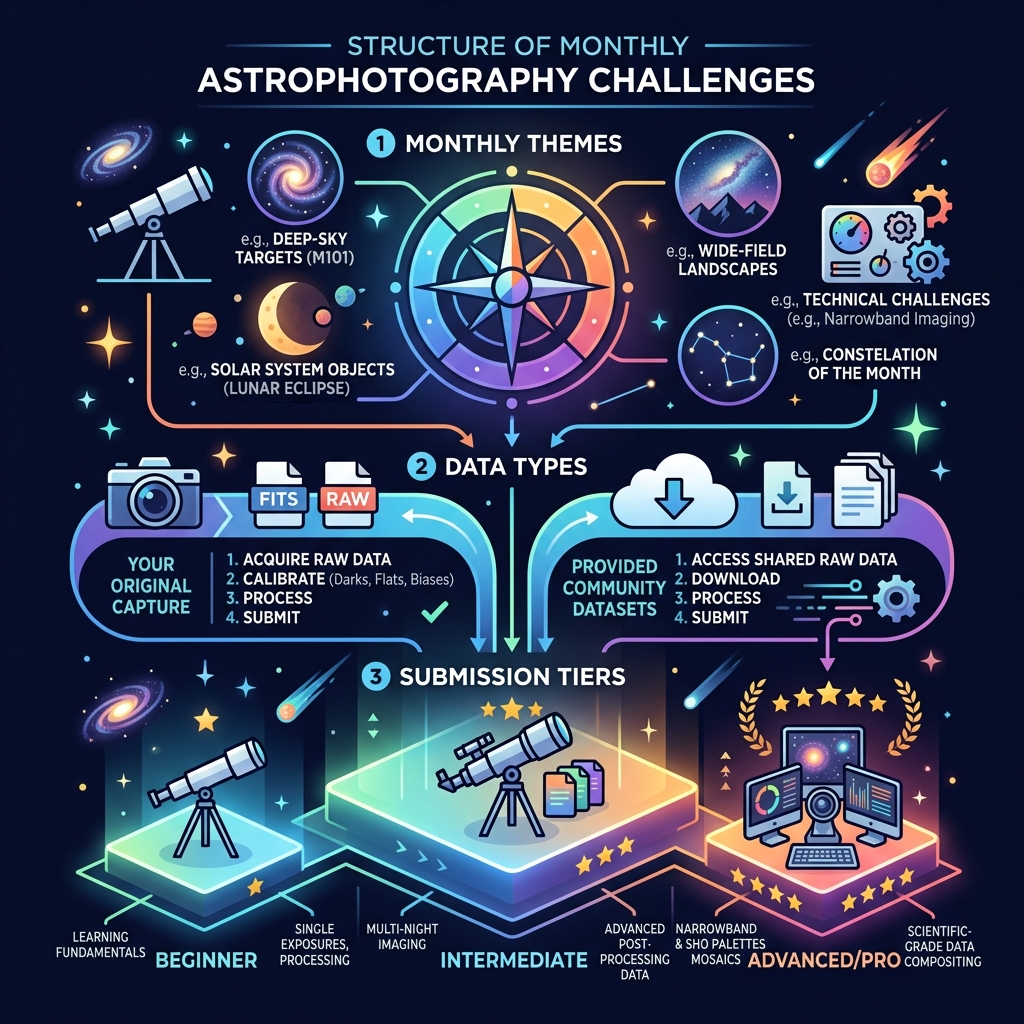
Top Global Programs and Astrophotography Challenge Monthly Themes

When we look for the most influential astrophotography challenge monthly themes, we often find them hosted by large-scale international organizations. These programs are designed to unite observers from every corner of the globe, regardless of their equipment or location.
One of the most significant events is Global Astronomy Month (GAM), held every April. Organized by Astronomers Without Borders, GAM is a flagship program that features a variety of contests. It isn’t just about the best photo; it includes AstroArts and AstroPoetry contests that receive hundreds of entries from both children and adults. For those interested in the scientific side, the Asteroid Search Campaign during GAM has historically led to the discovery and numbering of 62 asteroids by the International Astronomical Union (IAU).
Beyond GAM, several platforms offer recurring monthly themes:
- AstroWorld Image of the Month: This contest is highly structured, offering gift certificates of up to $300. It features separate brackets for “Novice” and “Experienced” photographers, ensuring that everyone has a fair shot at being featured in their annual calendar.
- Astrospheric Photo of the Month: This program highlights member-submitted photos, often showcasing incredible feats of integration time—some winners have spent over 500 hours capturing a single target from light-polluted backyards!
- Nebula Photos Monthly Challenge: Hosted on AstroBin, this community-voted challenge focuses on specific regions like Orion, Cygnus, or Cassiopeia. It’s a fantastic way to see how different photographers interpret the same region of space.
For those who want to tie their hobby to professional science, the NASA Observing Challenges and Special Awards provide a pathway to earn certificates recognized by the Astronomical League and NASA.
NASA and Hubble Night Sky Challenge Monthly Themes
NASA’s involvement in amateur astronomy provides some of the most prestigious astrophotography challenge monthly themes. A standout for 2025 is the Hubble 35th Anniversary Challenge. This program encourages us to observe or image the same iconic objects that the Hubble Space Telescope has made famous over its decades of service.
The challenge is divided into monthly targets from the Messier and Caldwell catalogs. For example, a typical year of targets might include:
- January: M1 (The Crab Nebula)
- June: M83 (The Southern Pinwheel Galaxy)
- September: M27 (The Dumbbell Nebula)
- November: M33 (The Triangulum Galaxy)
Participants can aim for Silver or Gold awards. A Silver award requires at least one outreach activity and one object per month, while Gold requires four or more outreach events and four or more objects monthly. This structure emphasizes that astrophotography is not just about the image, but about sharing the wonders of the universe with others. If you are just starting out, our night-sky-photography-a-beginners-guide can help you get your first shots of these famous targets.
Community-Driven Astrophotography Challenge Monthly Themes
While NASA challenges focus on the “capture,” community-driven challenges often focus on the “process.” On forums like TheSkySearchers, we find a recurring “Processing Challenge” that is perfect for those times when the weather doesn’t cooperate.
In these challenges, an experienced member shares a “master” raw dataset. For instance, the June 2024 challenge featured 10 hours of LRGB data of Barnard 150 (the Seahorse Nebula) captured from a dark Bortle 3 site. Members then download this data and use software like PixInsight or Photoshop to create their own version.
These challenges are invaluable for learning. You get to see exactly how different people handle noise, enhance dark nebulae, or manage star colors. It’s a safe space to experiment with workflows like Arcsinh Brightness Enhancement or Masked Stretching without the pressure of a formal competition. As many participants say, “everyone is a winner” because the goal is shared knowledge. This is a great way to learn how to fix common-beginners-mistakes-in-astrophotography-and-how-to-avoid-them by comparing your results with seasoned pros.
Popular Monthly Targets and Technical Requirements
Choosing a target for astrophotography challenge monthly themes usually depends on the time of year and the equipment available. Different targets require vastly different approaches to integration time and filtering.
Common Challenge Targets:
- The Cygnus Region (Summer/Fall): Home to the North American Nebula and the Pelican Nebula. This is a favorite for wide-field challenges. Using a dual-band filter like the L-Ultimate can help pull out incredible detail even from suburban skies.
- Barnard 150 (The Seahorse Nebula): A challenging “dark nebula” that requires significant integration time (often 10+ hours) to separate the dark dust from the background sky.
- Orion Molecular Cloud (Winter): Perhaps the most popular challenge target for beginners. It’s bright, colorful, and offers targets for both wide-field and long-focal-length telescopes.
When participating, we must consider the Bortle Scale of our location. While deep-sky objects like the Andromeda Galaxy can be shot from a Bortle 7 backyard with enough time, faint nebulae often benefit from “narrowband” filters that block out light pollution. For a full breakdown of what to shoot when, check out our Astrophotography Targets by Month – Best List for Beginners.
How to Succeed in Monthly Astrophotography Contests
Success in these challenges isn’t just about having the most expensive telescope. It’s about following the rules and presenting your work effectively. Many contests, like the AstroWorld Image of the Month, have very specific submission requirements to ensure a fair playing field.
| Feature | Novice Bracket | Experienced Bracket |
|---|---|---|
| Equipment | Often allows entry-level DSLR/Lens setups | Usually involves cooled astro-cameras & mounts |
| Processing | Focus on basic stretching and color | Advanced techniques (deconvolution, star removal) |
| Submission | Smaller file sizes, simpler descriptions | Full technical logs and equipment lists required |
| Judging | Often community-voted or peer-reviewed | Expert juries focusing on technical perfection |
Tips for Success:
- Read the Rules: Some contests, like AstroWorld, require a specific file format (e.g., WEBP) and resolution (1200×800). Submitting the wrong format can lead to disqualification.
- Avoid Popularity Contests: Look for challenges judged by expert juries. Contests decided by “likes” on social media often favor those with large followings rather than the best photographers.
- Ethical Editing: Be clear about your process. While Photoshop is a standard tool, many challenges have rules against “compositing” elements that weren’t actually there (like adding a fake moon to a deep-sky shot).
- Mobile Success: Don’t count yourself out if you only have a phone. We have seen amazing entries in overcoming-challenges-in-smartphone-astrophotography that rival traditional setups, especially for bright targets like the Moon or planets.
If you are aiming for a specific event, like a meteor shower, preparation is key. Our a-beginners-guide-to-photographing-meteor-showers can give you the edge you need for the next “Night Sky” theme.
Benefits of Joining Monthly Imaging Challenges
Joining astrophotography challenge monthly themes offers benefits that go far beyond a trophy or a gift certificate. It’s about being part of a “Global Star Party” that never ends.
1. Skill Acceleration When you are forced to shoot a specific target, you learn how to handle its unique difficulties. A “Dark Nebula” month will teach you about noise reduction and contrast, while a “Galaxy” month will teach you about capturing fine structural detail.
2. Peer Feedback Platforms like AstroBin and TheSkySearchers allow you to post your work and receive constructive criticism. This feedback loop is the fastest way to improve. You might learn that your stars are slightly out of focus or that your color balance is leaning too far into the green—things that are hard to notice on your own.
3. Citizen Science Some challenges contribute to real scientific data. Programs like “Globe at Night” ask participants to evaluate the darkness of their sky and submit data to help track light pollution. Others, like the Asteroid Search Campaign, involve analyzing image sets to find moving objects that might have been missed by professional surveys.
For those just starting their journey, we recommend reading our astronomy-photography-a-beginner-friendly-guide to understand the core concepts before diving into your first challenge.
Frequently Asked Questions about Astrophotography Challenges
How do I find the best monthly targets for beginners?
The best way to find beginner targets is to look at the Messier Catalog. These 110 objects are generally large and bright enough to be seen with modest equipment. Many monthly challenges, such as the Hubble Night Sky Challenge, select targets from this list precisely because they are accessible. You can also use apps like Astrospheric or Stellarium to see what is high in the sky during your specific month.
What are the typical prizes for winning an astrophotography contest?
Prizes vary widely. Some community forum challenges offer “bragging rights” and a special badge next to your username. Larger contests, like AstroWorld, offer gift certificates ranging from $100 to $300 and a featured spot in a physical calendar. NASA-affiliated challenges usually provide digital or physical certificates of achievement that are highly respected in the astronomy community.
Can I participate in these challenges using a mobile camera?
Absolutely! While deep-sky nebulae are difficult with a phone, many challenges have “Nightscape” or “Solar System” categories. With modern smartphones, you can capture stunning images of the Moon, planets, and even the Milky Way. If this is your primary gear, check out our guide on mobile-astrophotography-for-beginners to see how to maximize your phone’s sensor for these contests.
Conclusion
At Pratos Delícia, we believe that the night sky belongs to everyone. Astrophotography challenge monthly themes are the perfect bridge between a personal hobby and a global community. They push us to go outside, point our cameras upward, and capture the fleeting beauty of the universe.
Whether you are participating in Global Astronomy Month, chasing a NASA certificate, or simply trying to process a shared dataset on a forum, you are contributing to a legacy of exploration. These challenges foster dark sky awareness and help us all grow as artists and observers.
So, grab your gear, check the monthly target, and join the next challenge. We can’t wait to see what you capture!
