
Stop Squinting at the Sky with the Best Star Trail Lenses
Why the Best Lens for Star Trails Changes Everything
The best lens star trails photographers use share a few key traits: wide focal length, fast aperture, and clean corner performance. Here’s a quick look at the top picks:
| Lens | Focal Length | Max Aperture | Best For |
|---|---|---|---|
| Sony 14mm f/1.8 GM | 14mm | f/1.8 | Full-frame, portability |
| Sigma 14mm f/1.8 DG HSM | 14mm | f/1.8 | Full-frame, premium quality |
| Nikon 14-24mm f/2.8 S | 14-24mm | f/2.8 | Full-frame, zoom flexibility |
| Rokinon/Samyang 14mm f/2.8 | 14mm | f/2.8 | Budget, APS-C and full-frame |
| Tokina 11-16mm f/2.8 | 11-16mm | f/2.8 | APS-C crop sensor |
| Tamron 35mm f/1.4 Di USD | 35mm | f/1.4 | Mosaics, detailed trails |
Star trail photography is one of the most rewarding things you can do with a camera at night. You point it at the sky, let Earth’s rotation do the work, and end up with gorgeous arcs of light sweeping across your frame.
But here’s the thing: your lens matters more than almost anything else in your bag.
A slow or optically weak lens will turn pinpoint stars into blurry smears at the edges of your frame. A fast, sharp lens with good aberration control keeps those trails clean and crisp all the way to the corners.
The good news? You don’t need to spend a fortune. Whether you’re shooting on a full-frame Sony or a crop-sensor Canon, there’s a lens that fits your budget and your setup.

Simple best lens star trails glossary:
Introduction
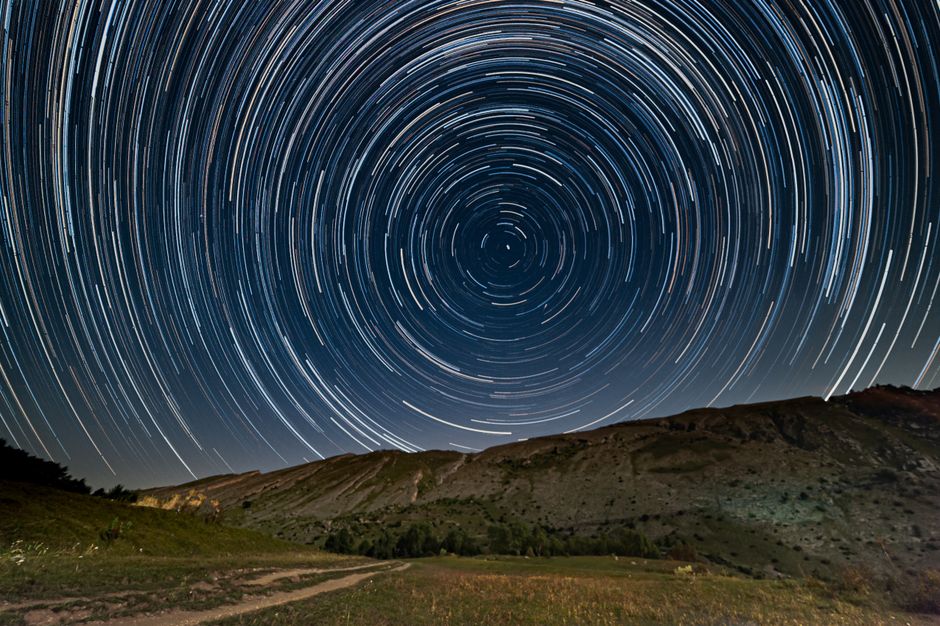
When we look up at the night sky, everything seems still. But our planet is actually a giant spinning top, rotating at roughly 1,000 miles per hour at the equator. In photography, we can turn this constant motion into art. By leaving the shutter open for long periods—or stacking hundreds of shorter images—we capture the “path” stars take across the sky.
If you point your camera north toward Polaris (the North Star), you’ll see stars creating perfect concentric circles. If you point east or west, they’ll appear as straight lines or gentle arcs. To make these paths look like smooth ribbons of light rather than jagged dashes, you need a lens that can handle the unique “torture test” of astrophotography.
What Makes a Lens Ideal for Star Trails?
Not every landscape lens is a great star trail lens. When we are hunting for the best lens star trails performance, we look for specific optical “superpowers.”
Focal Length and Field of View
The wider the lens, the more “sky” you can fit in. A 14mm lens on a full-frame camera provides a massive 114-degree view, allowing you to capture both the celestial pole (the center of the circles) and a significant foreground like a mountain or a lonely tree. Wider lenses also make the trails look longer and more curved within the frame.
Aperture Speed and Light Gathering
While star trails are often shot over hours, we still want a “fast” lens (f/1.4 to f/2.8). Why? Because a larger aperture allows the camera to record fainter stars. If you use a kit lens at f/5.6, you might only see the brightest stars in your trails. An f/1.4 lens gathers significantly more light, filling your sky with thousands of delicate, colorful streaks.
Aberration Control: Coma and Astigmatism
This is the deal-breaker. Many lenses suffer from “coma” in the corners—an aberration that turns pinpoint stars into shapes that look like little seagulls or flying saucers. For star trails, coma makes the edges of your image look “mushy.” We prioritize lenses that maintain sharp, round stars from the center to the very edge.
Build Quality and Weather Sealing
Since we’ll be leaving our gear out in the damp night air for hours, weather sealing is vital. A lens that can handle dew and temperature drops without fogging up internally is worth its weight in gold. To learn more about the physics behind these shots, check out our guide on making the night sky spin with long exposures.
Top Picks: Finding the Best Lens Star Trails Performance
When we evaluate the best lens star trails options, we look at real-world data. For example, the Sigma 14mm f/1.4 DG DN is a beast, but it shows a -2.5 EV vignette wide open. Stopping it down to f/2.5 or f/2.8 often yields the “sweet spot” for sharpness.
Best Lens Star Trails for Full-Frame Systems
If you are shooting with a full-frame mirrorless or DSLR, you have some incredible options:
- Sony 14mm f/1.8 GM: This is a favorite for many. It weighs only 460g—half the weight of some competitors—and delivers clean, pinpoint stars to the corners. It’s arguably the most portable professional astro lens on the market.
- Sigma 14mm f/1.8 DG HSM: A heavy-hitter (1,120g) that is legendary in the astro community. While it shows some coma wide open, it becomes near-perfect at f/2.8.
- Nikon 14-24mm f/2.8 S: For Nikon Z users, this 650g zoom is a miracle. It matches the sharpness of top-tier primes while giving you the flexibility to zoom in and frame your foreground perfectly.
- Tamron 35mm f/1.4 Di USD: Often called the best 35mm lens ever made for astrophotography. It delivers near-perfect star shapes at f/1.4. While 35mm is tighter than 14mm, it’s perfect for creating high-resolution “mosaics” where you stitch multiple panels together for a massive star trail image.
Best Lens Star Trails for APS-C and Budget Shooters
You don’t need a $2,000 lens to get pro results. In fact, some of the most famous star trail images were taken with “budget” glass.
- Rokinon/Samyang 14mm f/2.8: This lens is a “steal” at around $300. It consistently tops lists for best ultra-wide performance on high-resolution cameras like the Canon 5DS R. It’s manual focus, but for stars, that’s actually a benefit!
- Tokina 11-16mm f/2.8: A classic for APS-C (crop sensor) users. It’s affordable, rugged, and provides a very wide field of view.
- Samyang 12mm f/2 NCS CS: If you use a Fujifilm or Sony APS-C camera, this tiny prime is incredibly sharp and fast enough for deep-sky work.
If you’re just starting out, we have a guide on one simple way to capture star trails that works with almost any lens you already own.
Prime vs. Zoom: Trade-offs in the Field
Choosing between a prime (fixed focal length) and a zoom lens is a classic dilemma. Here is how they stack up for star trails:
| Feature | Prime Lenses | Zoom Lenses |
|---|---|---|
| Max Aperture | Usually f/1.4 or f/1.8 (Faster) | Usually f/2.8 (Slower) |
| Weight | Often lighter and more compact | Heavier due to complex glass |
| Sharpness | Generally sharper with less coma | Good, but can have edge distortion |
| Flexibility | You have to move the tripod | You can frame from where you stand |
| Price | Can be very affordable (Rokinon) | Usually more expensive for f/2.8 |
Our Take: For the absolute best lens star trails quality, a wide prime like a 14mm or 20mm is hard to beat. However, if you are hiking into a location and only want to carry one lens, a high-quality 14-24mm f/2.8 zoom is a versatile workhorse.
Technical Mastery: Exposure and Stacking
Once you have your lens, you need to decide how to use it. There are two main methods: the “Single Long Exposure” and “Image Stacking.”
The Single Long Exposure
This is the “old school” way. You set your ISO low (200-800), stop your lens down slightly (f/4), and leave the shutter open for 30 minutes to 2 hours.
- Pros: Simple, one file to edit.
- Cons: Massive sensor heat (which causes “hot pixel” noise), risk of a single car headlight or plane ruining the whole shot, and battery drain.
The Stacking Method (Highly Recommended)
Most modern pros use stacking. You take hundreds of shorter exposures (e.g., 30 seconds each at f/2.8, ISO 1600) and “stack” them using software like StarStaX or Photoshop.
- Pros: Dramatically lower noise, you can “delete” a frame if a plane flies through, and you can create a time-lapse video as a bonus!
- Cons: Requires post-processing time and more storage space.
To get the best results, we use the NPF Rule or the 500 Rule to calculate exposure. For star trails, we actually want trailing, but we want each individual frame to be bright and clear. Using an intervalometer is key—set it to a 1-second gap between shots to ensure your trails don’t have gaps. For more on this, read about star trail image editing a new dimension to the night sky.
Frequently Asked Questions about Star Trail Lenses
Is f/2.8 fast enough for star trails?
Absolutely. While f/1.4 lenses are great for the Milky Way, f/2.8 is the “industry standard” for star trails. Because you are often stacking dozens or hundreds of images, the total light collection is massive. Even an f/4 lens can work if you are in a very dark Bortle 1 sky, but f/2.8 gives you much more flexibility with your ISO settings.
Should I use manual focus lenses for star trails?
Yes! In fact, many of the best lens star trails recommendations (like the Rokinon 14mm) are manual focus only. Autofocus doesn’t work in the dark. You’ll be using “Live View” to zoom in on a bright star and turning the focus ring until the star is a tiny, sharp pinprick. Once it’s set, you usually tape the focus ring down so it doesn’t budge during the night.
How does sensor size affect my lens choice?
Sensor size changes your “effective” focal length. If you put a 14mm lens on an APS-C camera (like a Canon Rebel or Sony a6000), it acts like a 21mm lens. This means you lose some of that ultra-wide field of view. If you’re on APS-C, look for lenses specifically designed for crop sensors, like the Samyang 12mm, to get that wide-angle look back.
Conclusion
Finding the best lens star trails performance is a journey that combines technical specs with your personal shooting style. Whether you choose the featherweight Sony 14mm GM or the budget-friendly Rokinon 14mm, the key is to get out there and start shooting.
At Pratos Delícia, we believe the best gear is the gear that gets you excited to stand under the stars. Remember to bring a sturdy tripod—even the most expensive lens won’t help if your camera is shaking in the wind! Look for dark skies, pack an extra battery, and prepare to be amazed at what your camera can see in the dark.
Explore more night photography guides to master your craft and turn the night sky into your personal canvas. Happy shooting!
