
Stop Guessing and Start Focusing with These Pro Tips
Why Sharp Focus is the Hardest Part of Astrophotography (And How to Fix It)
Focus peaking astrophotography tips can make the difference between a night full of blurry disappointments and a frame packed with crisp, pinpoint stars.
Here’s a quick answer to get you started:
- Switch to manual focus – autofocus fails in the dark
- Enable focus peaking in your camera menu (set to red, medium sensitivity)
- Point at the brightest star in your frame
- Boost ISO temporarily to make stars visible in live view
- Rock the focus ring slowly until the peaking highlights glow on the star
- Magnify 5x-10x in live view to fine-tune
- Take a test shot and zoom in to confirm pinpoint stars
- Tape the focus ring so it doesn’t shift during your session
Focusing during the day is easy. Focusing at 2am in a dark field, pointed at a sky full of faint lights millions of miles away? That’s a different challenge entirely.
Autofocus fails. The infinity mark on your lens is often wrong. And a tiny mistake means every shot from the night is lost – you can’t fix blur in post-processing.
The good news: focus peaking changes everything. It’s a real-time visual tool built into most modern mirrorless cameras that highlights the sharpest edges in your frame with a colored overlay. For astrophotography, that means you can see when a star snaps into focus, even in near-total darkness.
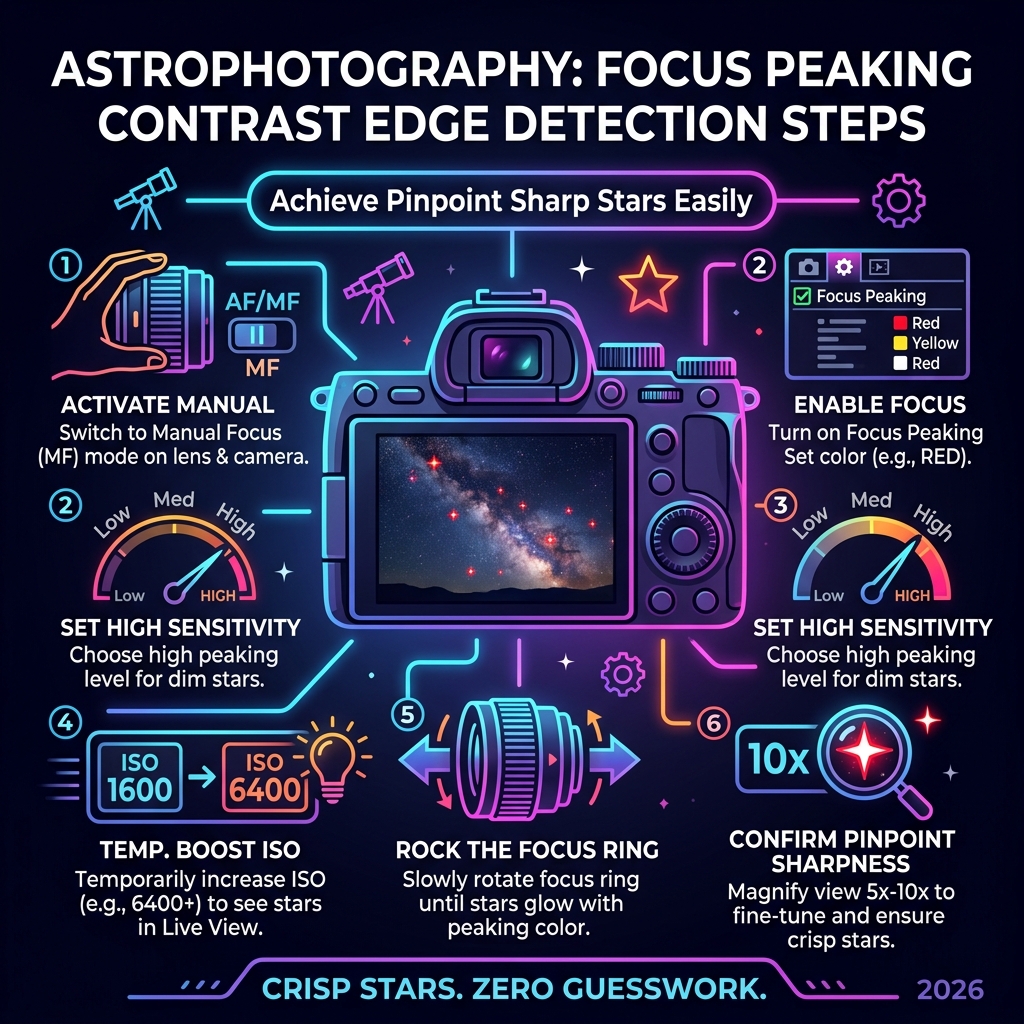
What is Focus Peaking and Why is it Essential for Stars?
At its heart, focus peaking is a focus aid based on contrast detection. Our cameras analyze the live image from the sensor and look for areas of high contrast—the “sharp edges” where light meets dark. When the camera identifies these sharp edges, it overlays a bright, colored highlight (usually red, yellow, or white) on the screen or through the electronic viewfinder (EVF).
In astrophotography, stars are the ultimate high-contrast subjects. They are tiny pinpoints of light against a void of black. When a star is out of focus, it looks like a soft, bloated “bokeh” ball. As you turn the focus ring and the star becomes smaller and sharper, the contrast increases. Once it hits that sweet spot of perfect sharpness, the focus peaking algorithm detects the sudden spike in contrast and “paints” the star with your chosen color.
This is essential because focusing on stars presents unique challenges:
- Low-Light Limitations: Most autofocus systems reliably fail below -4 EV. A moonless night sky can be -9 EV or darker, leaving your camera’s brain completely blind.
- Infinity Mark Inaccuracies: You might think turning your lens to the “∞” symbol is enough, but most lenses don’t have a true infinity stop at that exact mark. Temperature changes and atmospheric variations shift where “true infinity” actually sits.
- The “Bloat” Factor: Without a visual aid, it is incredibly difficult to tell the difference between a “mostly sharp” star and a “perfectly sharp” star on a tiny 3-inch LCD screen.

Setting Up Your Camera: Focus Peaking Astrophotography Tips for Sony, Canon, and Nikon
Every camera brand handles focus peaking slightly differently, but the logic remains the same. Before you head out into the cold, we recommend diving into your menus to find these settings.
- Sony: Sony was a pioneer in this tech. You’ll find “Peaking Setting” in the Shooting Menu. Ensure “Peaking Display” is ON. You can choose from three Peaking Levels (Low, Mid, High) and several colors.
- Canon: On mirrorless models like the EOS R series, look for “MF peaking settings” under the AF menu tab. You can toggle the peaking on and off and adjust the sensitivity and color.
- Nikon: On Z-series cameras, look in the Custom Setting Menu under “Peaking highlights.” On some older Nikon DSLRs, focus peaking is only available in Live View or Movie mode, not through the optical viewfinder.
For a deeper dive into these brand-specific settings, check out our guide on focus peaking and other tricks for perfect star focus. You can also read more about the technical implementation of focus peaking to understand how it highlights contrast.
Comparing Peaking Sensitivity Levels
Choosing the right sensitivity is a balancing act. If it’s too high, the screen becomes a “false positive” mess; if it’s too low, you won’t see any highlights at all.
| Sensitivity Level | Best Use Case | Pros/Cons |
|---|---|---|
| Low | Critical precision on very bright stars or the Moon. | Most accurate but can be hard to see on faint stars. |
| Mid | The “Goldilocks” zone for most Milky Way shots. | Good balance of visibility and precision. |
| High | Quick scouting or very dark conditions. | Very visible, but can “glow” even when slightly out of focus. |
Choosing the Right Color: Focus Peaking Astrophotography Tips for High Contrast
Most cameras offer Red, Yellow, White, or Blue. While personal preference plays a role, we have found that Red is almost always the superior choice for the night sky.
White and Yellow highlights can easily blend in with the natural color of stars or the glow of light pollution on the horizon. Red provides a stark, unnatural contrast against the deep blues and blacks of space, making it immediately obvious when your target is sharp. If you are shooting in an area with heavy orange light pollution, Blue is a great secondary backup.
Combining Tools: Focus Peaking Astrophotography Tips with Live View Magnification
Focus peaking is powerful, but it reaches its full potential when paired with Live View Magnification.
Even with peaking highlights, a star is just a few pixels wide on your screen. By using your camera’s “Zoom” or “Magnify” button (usually 5x or 10x), you can blow up that single star to fill a larger portion of the display.
When you magnify, the focus peaking becomes even more sensitive. You can watch the star diameter shrink as you turn the focus ring. The moment the star becomes the smallest possible dot and the peaking color is at its brightest, you’ve achieved critical focus. For more on this technique, see our article on focusing on stars a guide to sharp night skies.
Practical Field Techniques for Razor-Sharp Focus
Once you’re in the field, follow this workflow to ensure your stars are pinpoints:
- Select a Bright Star: Don’t try to focus on the faint “star dust” of the Milky Way. Find a prominent star (like Sirius, Vega, or a planet like Jupiter) and center it in your frame.
- The ISO Boost Trick: Your screen might look black even in Live View. Temporarily crank your ISO to 6400 or 12800 and open your aperture wide (f/2.8 or faster). This isn’t for the final photo; it’s just to “brighten” the stars so the focus peaking algorithm has more signal to work with.
- Rock the Focus Ring: Turn your focus ring back and forth past the point of focus. You’ll see the peaking highlights appear, grow bright, and then fade away as you go past. “Rock” it back and forth, narrowing the movement until you settle exactly where the color is most intense.
- Use a Display Hood: Ambient light or even the glow from your own headlamp can wash out the LCD screen. A display hood or a simple dark cloth over your head helps you see the subtle peaking highlights much more clearly.
Advanced Applications: From Deep-Sky to Planetary Imaging
Focus peaking isn’t just for wide-angle Milky Way landscapes; it’s a versatile tool for all types of celestial photography.
- Lunar Photography: The Moon provides massive amounts of contrast. When using focus peaking for the Moon, focus on the “terminator” line (the shadow line between the light and dark sides). The craters and mountains along this line provide sharp edges that will light up brilliantly with peaking.
- Planetary Imaging: When shooting Jupiter or Saturn through a long telephoto lens or telescope, use focus peaking combined with 10x magnification. You can actually use the peaking highlights to sharpen the edges of the planet’s disk or even the rings of Saturn.
- Bahtinov Masks: For telescope users, focus peaking can be used alongside a Bahtinov mask. The mask creates a diffraction pattern (three crossing lines). Focus peaking will highlight the central “spike,” making it easier to see exactly when it is perfectly centered between the other two.
- Focus Stacking: If you have a prominent foreground object (like a rock or a tree) very close to the lens, you may need to focus stack. Use focus peaking to ensure your foreground is sharp in one shot, then use it again to ensure the stars are sharp in the next.
Troubleshooting Common Night Sky Focusing Issues
Even with the best focus peaking astrophotography tips, things can go wrong. Here is how we handle the most common hurdles:
- Temperature Drift: As the night gets colder, the glass and metal in your lens physically contract. This shifts your focus point. We recommend re-checking your focus every 30 to 60 minutes, or whenever you notice a significant drop in temperature.
- Lens Heaters: If your lens gets too cold, dew can form on the front element, making everything look soft and “foggy.” Use a USB-powered lens heater to keep the glass slightly above the dew point.
- Atmospheric Turbulence: Sometimes the stars “twinkle” aggressively. This is actually atmospheric turbulence (bad “seeing”). This can make focus peaking flicker. In these cases, try to find the “average” sharpest point or wait for a moment of stability.
- Coma) and Astigmatism: Many wide-angle lenses distort stars in the corners of the frame, making them look like little seagulls. Always focus on a star in the center of the frame, as this is where the lens is optically best.
- The “Gaffers Tape” Solution: Once you have perfect focus, it is incredibly easy to accidentally bump the focus ring in the dark. Keep a small strip of gaffers tape on your tripod leg. Once you’re focused, tape the ring down to the lens barrel so it can’t move.
Frequently Asked Questions about Focus Peaking
Does focus peaking work with all lenses and telescopes?
Yes! Since focus peaking is a function of the camera body and its sensor, it works with any manual lens, vintage glass, or telescope attached via a T-ring. As long as the camera can “see” the image, it can analyze the contrast.
How do I maintain focus during long exposures as temperatures drop?
The best defense is a good offense. Use a lens heater to stabilize the temperature of the optics. Additionally, many advanced astrophotographers use “electronic focusers” that can automatically adjust for temperature shifts, but for most of us, a manual check every hour is the best practice.
Can focus peaking replace a Bahtinov mask for deep-sky objects?
While focus peaking is fantastic for quick setup and wide-field shots, a Bahtinov mask is still the “gold standard” for ultra-precise telescope focusing on deep-sky objects. Think of focus peaking as your primary tool for speed and convenience, and the mask as your “surgical” tool for the highest possible precision.
Conclusion
Mastering focus peaking astrophotography tips is one of the fastest ways to improve your night sky images. It removes the guesswork, helps you avoid a full session of soft frames, and gives you a reliable way to confirm sharp focus before committing to a long series of exposures.
The best tool in your kit is patience. Spend those extra five minutes at the start of your session to nail your focus, and the results will speak for themselves.
If you want to keep improving your technique, master your night sky captures with our expert techniques and explore more guides for photographing the night sky.
