
Why ISO for Low Light Photography Is the Key to Better Night Shots
ISO for low light photography is one of the most important camera settings you’ll ever learn — and also one of the most misunderstood.
Here’s a quick answer before we dive deeper:
- ISO 100-400 — Bright daylight, tripod shots, long exposures
- ISO 800-1600 — Indoors, overcast, dim rooms
- ISO 3200-6400 — Dark streets, concerts, indoor events
- ISO 6400-12800+ — Very dark scenes, astrophotography, handheld night shots
The higher the ISO, the more sensitive your camera becomes to light — but the more digital noise (grain) appears in your image.
Many beginners feel stuck at night. The scene looks magical. But the photo comes out dark, blurry, or full of ugly grain. The instinct is to keep ISO low to “protect” image quality.
That instinct is wrong — or at least, incomplete.
A professional wildlife photographer once described it perfectly: pushing ISO high with proper exposure actually produces less noise than shooting at low ISO and trying to brighten a dark image in post-processing. You lose nearly half your sensor’s data by underexposing even a single stop.
The fear of high ISO is holding a lot of photographers back. This guide will fix that.
Understanding ISO for Low Light Photography
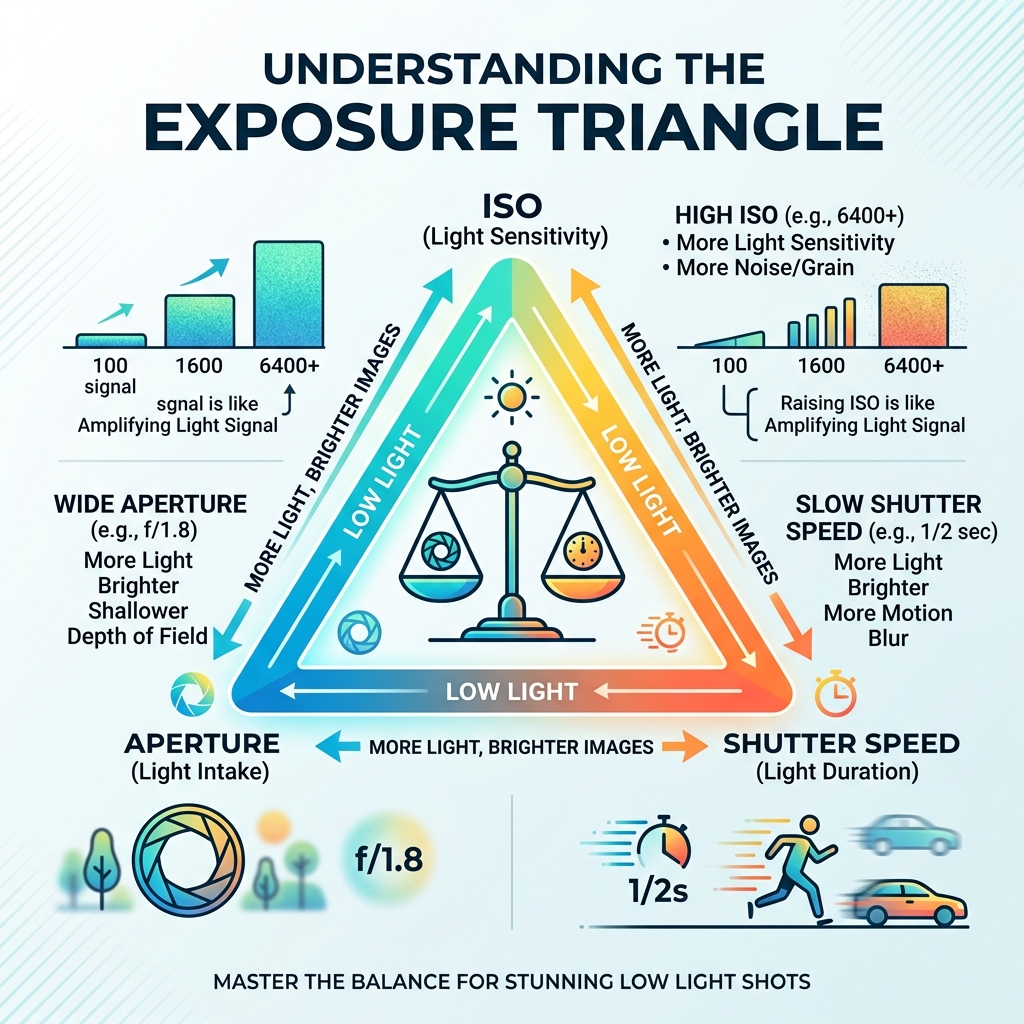
To master iso for low light photography, we first need to understand what ISO actually does. In the days of film, ISO (or ASA) referred to how sensitive the physical film was to light. In our digital world, it’s a bit different. Your camera sensor has a fixed sensitivity; when you raise the ISO, you aren’t actually making the sensor “see” more light. Instead, you are telling the camera to take the light signal it captured and amplify it digitally.
Think of it like a volume knob on a radio. If the signal is weak (low light), turning up the volume (ISO) makes the music louder so you can hear it. However, if you turn it up too high, you start to hear a “hiss.” In photography, that hiss is called digital noise.
Signal-to-Noise Ratio
The goal is to maintain a high signal-to-noise ratio. When we have plenty of light, the “signal” is strong, and the “noise” is buried. In low light, the signal is weak. If we don’t use enough ISO, the noise takes over. According to Adobe, ISO is one of the three pillars of the exposure triangle, and understanding this digital amplification is the first step toward cleaner night shots.
Base ISO vs. Native and Extended ISO
Every camera has a Base ISO, usually ISO 100. This is the setting where the sensor produces the cleanest image with the highest dynamic range.
- Native ISO: The range of settings (e.g., 100 to 51,200) that the camera manufacturer has calibrated to provide acceptable results.
- Extended ISO: These are “simulated” settings, often labeled as “H1” or “L.” We generally recommend avoiding these because they are processed in-camera after the shot, often leading to a loss of detail that you can’t fix later.
Sensor Size Matters
The physical size of your sensor plays a massive role in iso for low light photography.
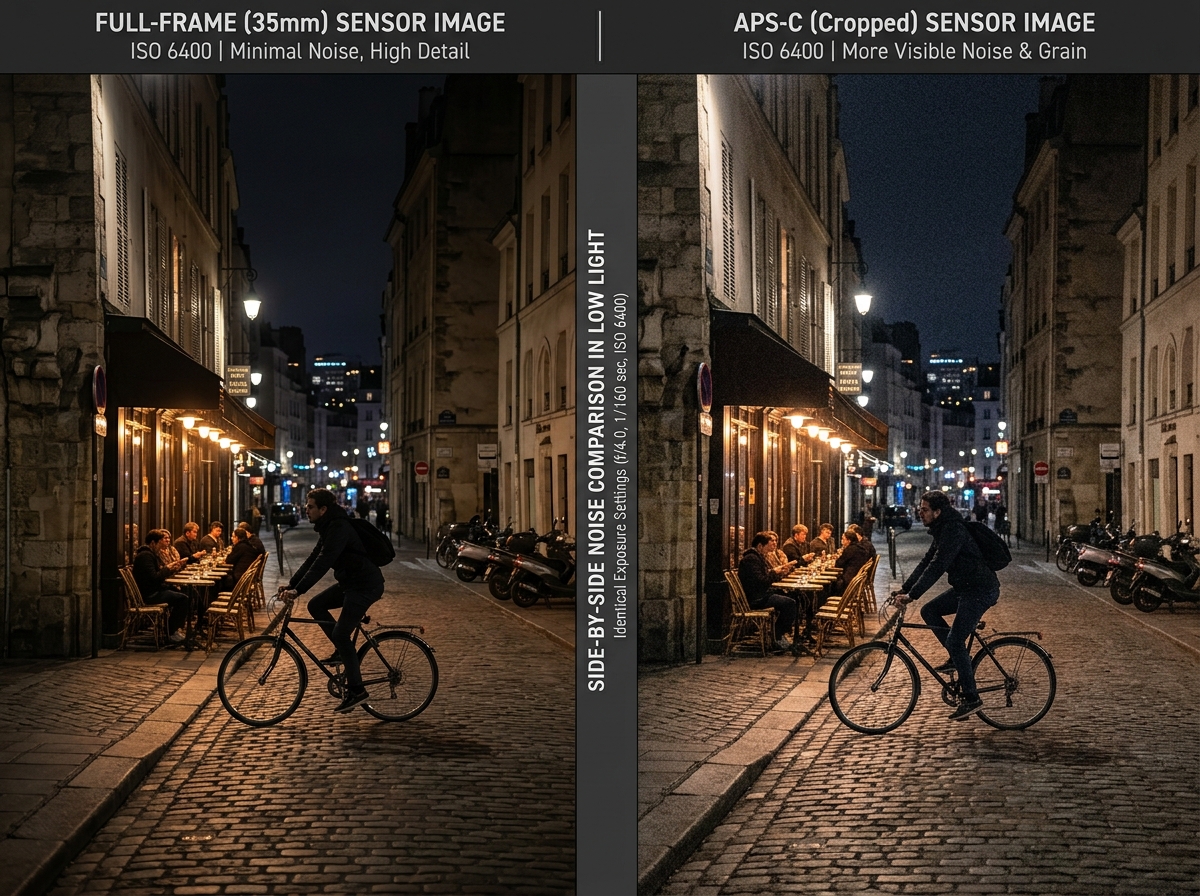
- Full-frame sensors: These have larger pixels (photocells) that can capture more light. Modern full-frame cameras like the Sony Alpha 7 III or Canon EOS R6 Mark II can shoot at ISO 6400 or even 12,800 with incredibly clean results.
- APS-C sensors: Found in cameras like the Canon EOS R7 or R10, these are smaller but still perform admirably. While they might show noise a bit sooner than full-frame, they are lightyears ahead of smartphone sensors.
The Role of the Exposure Triangle
We cannot talk about ISO without mentioning its partners: Aperture and Shutter Speed.
- Aperture: The “window” of your lens. A wide aperture (like f/1.8) lets in a huge volume of light, allowing you to keep your ISO lower.
- Shutter Speed: How long the “curtain” stays open. A slow shutter speed lets in more light but risks motion blur.
In low light, we are often forced to make compromises. If we want a fast shutter speed to freeze a moving subject, we must either open the aperture or increase the ISO.
Why High ISO Is Essential Without Flash
Many of us prefer the natural look of ambient light. Flash can be, as some pros call it, the “ultimate mood killer.” It flattens the scene and destroys the atmosphere of a candlelit dinner or a neon-lit street.
To preserve that mood, we must embrace high ISO. It allows us to maintain handheld stability (avoiding camera shake) and freeze motion without the need for artificial lighting.
The Golden Strategy: As Low as Possible, As High as Necessary
This is the mantra of the professional photographer. We always want the lowest ISO to ensure the cleanest image, but we must use as much as is necessary to get a sharp, well-exposed shot.
A “clean” photo that is blurry because the shutter speed was too slow is a wasted file. A “noisy” photo that is sharp is a memory you can save.
The Noise Threshold and Fast Glass
Every camera has a “noise threshold”—the point where grain becomes distracting. For older cameras, this might be ISO 1600. For modern mirrorless systems, it could be ISO 6400 or higher.
To fight noise, we use “fast glass”—lenses with wide maximum apertures like f/1.4 or f/2.8. Pairing a fast lens with In-Body Image Stabilization (IBIS) allows us to shoot handheld at slower shutter speeds, which keeps the ISO from skyrocketing. If you’re interested in taking this to the next level, check out our night-sky-photography-a-beginners-guide/.
Avoiding the “Underexposure Trap”
This is the most common mistake in iso for low light photography. Photographers fear noise, so they keep their ISO at 400 in a dark room. The resulting image is way too dark. They think, “I’ll just fix the brightness in Lightroom.”
Stop! When you brighten a dark image in post-processing, you amplify the noise far more than if you had simply used a higher ISO in the first place. Research shows that 50% of the data a camera captures is in the brightest 20% of the histogram. By underexposing, you are literally throwing away half of your image quality. For more on this, see our guide on common-beginners-mistakes-in-astrophotography-and-how-to-avoid-them/.
When to Use Auto ISO
We love Manual mode, but in dynamic low-light situations like night clubs or concerts, light changes in a split second.
- Auto ISO with a Minimum Shutter Speed: This is a lifesaver. You can tell your camera, “Don’t let the shutter speed go below 1/125s, and keep the aperture at f/1.8. Adjust the ISO automatically to make sure the exposure is right.” This allows you to focus on the moment rather than the dials.
Advanced Techniques to Master ISO for Low Light Photography
Exposing to the Right (ETTR)
ETTR is a technique where you intentionally make your image as bright as possible without “clipping” (losing detail in) the highlights. By pushing your histogram to the right, you capture the maximum amount of sensor data.
In post-processing, you can then “pull” the exposure back down. This results in much cleaner shadows and significantly less noise. This is especially effective when shooting in RAW format. Learn more about adjusting-iso-and-exposure-in-editing-for-clearer-night-sky-images/.
Finding Your Camera’s ISO Limits
We recommend doing a “stress test” on your gear.
- Place your camera on a tripod in a dimly lit room.
- Take the same photo at ISO 400, 800, 1600, 3200, 6400, and 12,800.
- Open them on your computer and zoom in to 100%.
At what point does the grain become “too much” for you? Knowing this limit prevents panic in the field. Sensor technology is constantly improving, and features like Dual Native ISO in high-end cameras can provide a “second base” for clean images at high settings. Avoid these common-beginners-mistakes-in-astrophotography-and-how-to-avoid-them-2/ to ensure your tests are accurate.
Managing Noise and Grain in Post-Processing
Even if you do everything right, iso for low light photography will eventually introduce some noise. There are two types:
- Luminance Noise: Looks like film grain (sandiness).
- Chromatic Noise: Looks like random purple or green splotches.
The Power of Editing
Modern software is magic. Lightroom and other apps for eradicating noise have dedicated sliders for both types of noise.
- Masking: Use the masking tool to apply noise reduction only to the “flat” areas (like the sky) while keeping the sharp details on your subject.
- AI Denoising: New AI-powered tools can analyze an image and remove noise while actually reconstructing lost detail. It’s a game-changer for high-ISO shots.
Embracing Noise as an Artistic Tool
Sometimes, noise isn’t a bug; it’s a feature. In street photography or moody portraits, grain can add a “vintage vibe” or gritty texture that feels more authentic. If an image is very noisy, try converting it to black and white. This turns distracting color noise into classic-looking film grain. Check out these long-exposure-tips-for-smartphone-night-photos/ for more creative ideas.
Real-World ISO for Low Light Photography Scenarios
| Scenario | Recommended ISO | Aperture | Shutter Speed | Tripod Needed? |
|---|---|---|---|---|
| Indoor Party | 1600 – 3200 | f/1.8 – f/2.8 | 1/125s | No |
| City Streets at Night | 800 – 1600 | f/2.8 – f/4.0 | 1/60s | No (with IBIS) |
| Concert / Stage | 3200 – 6400 | f/2.8 | 1/250s | No |
| Milky Way | 3200 – 12800 | f/2.8 | 15 – 25s | Yes |
| Light Trails | 100 | f/8 – f/11 | 10 – 30s | Yes |
Indoor Events and Night Streets
For these scenes, we often use ISO 1600 to 6400 paired with fast prime lenses. If you want to get creative, try “shutter drag”—using a slightly slower shutter speed (like 1/15s) while moving the camera to create artistic light streaks. For mobile users, our mastering-mobile-astrophotography-a-beginners-guide/ offers great tips for urban environments.
Astrophotography and the Heavens
This is the ultimate test of iso for low light photography. Because the Earth is rotating, you can’t leave your shutter open for too long, or the stars will turn into “trails” (unless that’s what you want!).
To capture sharp stars, we usually need ISO 3200 or higher. A sturdy tripod is non-negotiable here. For specific settings on capturing the night sky, see our detailed guides on photographing-the-heavens-best-smartphone-settings-for-astrophotography/ and photographing-the-heavens-best-smartphone-settings-for-astrophotography-2/.
Frequently Asked Questions about Low Light ISO
Is a noisy photo better than a blurry one?
Yes, 100%. You can fix noise in post-processing. You cannot fix a blurry face or a missed moment. If you need to push your ISO to 12,800 to get a sharp shot of your child blowing out birthday candles, do it.
Does high ISO reduce the dynamic range of my image?
Yes, technically. As you increase ISO, the “ceiling” for highlight detail drops. This means it’s easier to “blow out” bright lights (like streetlamps). This is why ETTR is so important—it helps you balance the light you have.
What is the best ISO for night portraits?
We usually aim for ISO 800 to 3200. This range allows for a fast enough shutter speed to capture sharp eyes (especially with modern Eye-AF technology) while keeping skin tones looking natural. Pair this with an f/1.8 lens for that beautiful blurred background (bokeh).
Conclusion
At Pratos Delícia, we believe that technical hurdles should never stand in the way of your creativity. Mastering iso for low light photography is about more than just numbers; it’s about gaining the confidence to shoot in any environment, from a dimly lit kitchen to the vastness of the night sky.
Don’t let the fear of “grain” stop you from capturing the magic of the dark. Experiment with your settings, push your camera to its limits, and remember: the best photo is the one you actually take.
Ready to dive deeper into photography? Explore more of our guides and tips at https://pratosdelicia.com/. Happy shooting!
