
What Every Beginner Needs to Know About Astrophotography
At Pratos Delícia, we believe in savoring life’s most beautiful experiences, from a perfectly prepared meal to the awe-inspiring sight of a star-filled sky. Astrophotography tips for beginners come down to a handful of core ideas you can apply on your very first night out.
Quick-start checklist:
- Use manual mode — set ISO 1600, aperture f/2.8, shutter speed ~20 seconds
- Focus manually — use Live View at 10x zoom on a bright star
- Apply the 500 Rule — divide 500 by your focal length to find your max shutter speed before stars trail
- Shoot RAW — gives you far more flexibility when editing
- Find dark skies — get away from city lights using a free dark sky map
- Use a tripod — stability is non-negotiable for long exposures
- Shoot near a new moon — less moonlight means more visible stars
That’s the short version. The rest of this guide goes deeper on each one.
You’ve looked up at the night sky and thought: “I want to capture that.” Then you picked up your camera, pointed it at the stars, and got a blurry, grey, noisy mess. Sound familiar?
You’re not alone. Almost every astrophotographer started exactly there — frustrated, confused, and wondering if they needed thousands of dollars of gear to get a decent shot.
The truth? You don’t. A camera with manual controls, a tripod, and the right settings can produce genuinely stunning night sky images. The learning curve is real, but it’s not nearly as steep as it looks.
This guide walks you through everything — from your first camera settings to editing your images — in plain language, no jargon required.
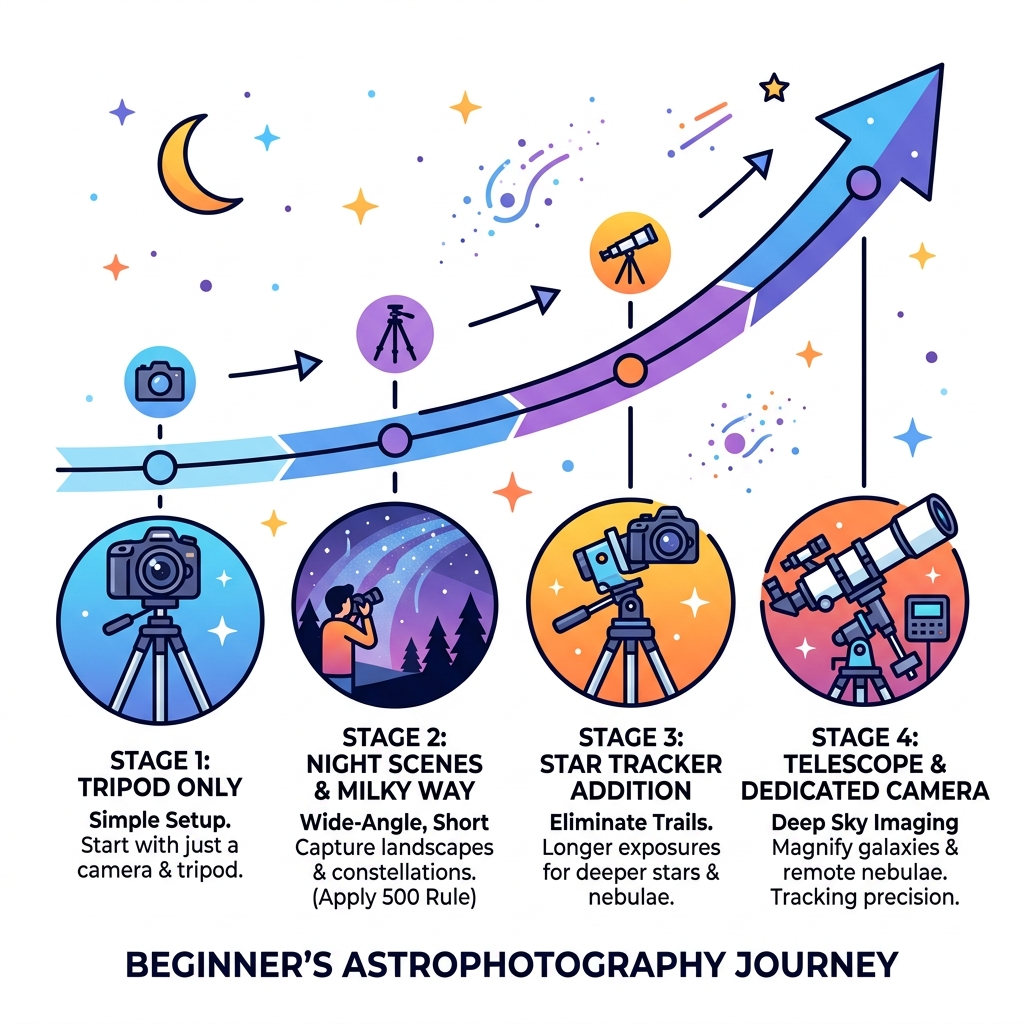
Essential Equipment for Astrophotography Tips for Beginners
When we talk about astrophotography tips for beginners, the first question is always: “What do I need to buy?” It is tempting to browse high-end telescopes immediately, but we recommend starting with gear you might already own or can find affordably.
The Camera: DSLR or Mirrorless
You don’t need a $5,000 flagship camera. Any DSLR or mirrorless camera that allows for full manual control (M mode) will work. The most important feature is the ability to control the shutter speed, aperture, and ISO independently.
While full-frame sensors are legendary for their low-light performance and wide dynamic range, crop-sensor (APS-C) cameras are fantastic for beginners. In fact, crop sensors can be an advantage for lunar or planetary shots because they offer a narrower field of view, effectively “zooming in” on your target. For more on keeping costs down, check out our guide on Budget Astrophotography: A Beginner’s Guide to the Galaxy.
The Lens: Wide and Fast
For those breathtaking Milky Way shots, you want a wide-angle lens. Look for something in the 14mm to 24mm range. The “fast” part refers to the aperture. You want a lens with a low f-number, ideally f/2.8 or lower (like f/1.8 or f/1.4). This allows the camera to collect as many photons as possible in a short amount of time. The lens often has a bigger impact on your final image than the camera body itself!
The Tripod: Your Best Friend
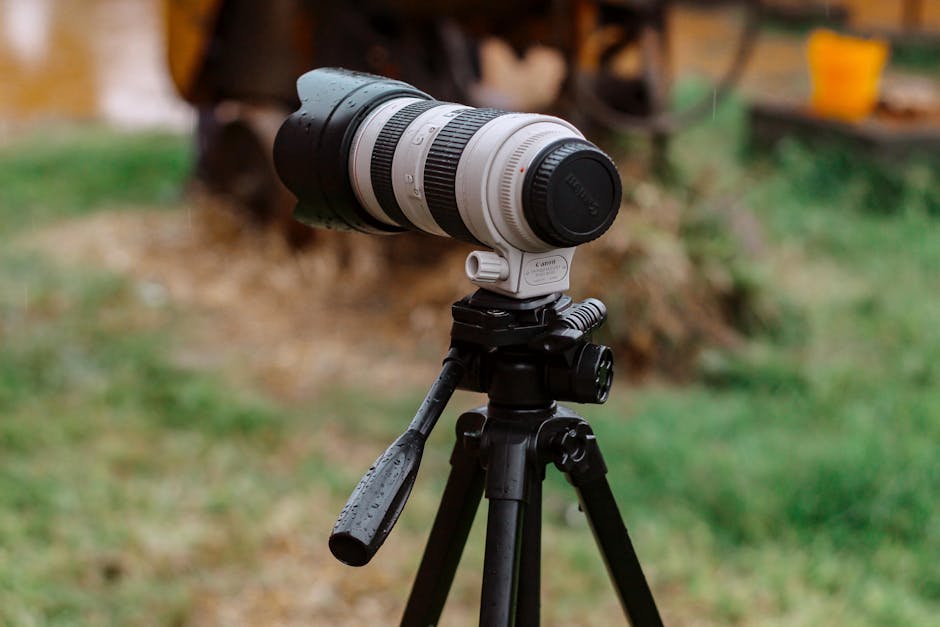
In long exposures, even the slightest vibration can ruin a shot. A sturdy tripod is non-negotiable. If you are shooting in a breeze, a flimsy tripod will shake, resulting in “fuzzy” stars. Look for a tripod that is rated to handle at least 60% more weight than your camera and lens combined for maximum stability.
Accessories
- Remote Shutter Release: Pressing the shutter button with your finger causes a tiny vibration. A remote cable or using the camera’s built-in 2-second timer solves this.
- Red Light Headlamp: White light ruins your night vision (and the vision of anyone near you). A red light allows you to see your gear without resetting the 20-30 minutes it takes for your eyes to adjust to the dark.
- Extra Batteries: Long exposures and cold night air drain batteries faster than a midday hike. Always carry a spare.
Mastering Camera Settings and the 500 Rule
Once we are out in the field, we need to tell the camera exactly what to do. The camera’s “Auto” mode is useless in the dark; it will try to fire the flash or give up entirely.
The Big Three: ISO, Aperture, and Shutter Speed
- Aperture: Set this to the lowest number your lens allows (e.g., f/2.8). We want the “window” of the lens wide open to let in every bit of starlight.
- ISO: This is your sensor’s sensitivity. For most modern cameras, ISO 800 to 3200 is the sweet spot. Higher ISO makes the image brighter but introduces “noise” (graininess).
- Shutter Speed: This is where it gets tricky. Because the Earth rotates, the stars appear to move across the sky. If your shutter is open too long, the stars will look like little sausages or lines instead of pinpoints. This is called “star trailing.”
The 500 Rule
To avoid star trailing on a stationary tripod, we use the 500 Rule. This simple math tells us the maximum number of seconds we can leave the shutter open before the stars start to blur.
The Formula: 500 / (Focal Length * Crop Factor) = Max Shutter Speed
- Full Frame: 500 / 24mm = ~20 seconds.
- Crop Sensor (1.5x): 500 / (24mm * 1.5) = ~13 seconds.
| Focal Length | Full Frame Max Exposure | Crop Sensor (1.5x) Max Exposure |
|---|---|---|
| 14mm | 35 seconds | 23 seconds |
| 18mm | 27 seconds | 18 seconds |
| 24mm | 20 seconds | 13 seconds |
| 35mm | 14 seconds | 9 seconds |
| 50mm | 10 seconds | 6 seconds |
For a deeper dive into these technicalities, see Astro Photography 101 for Capturing the Night Sky.
Shoot in RAW
Always set your camera to RAW format rather than JPEG. A JPEG throws away about 80% of the data the camera collects to save space. A RAW file keeps everything, which is essential when you want to pull out the faint colors of a nebula or the Milky Way during editing.
How to Focus on Stars in the Dark
Autofocus will fail 99% of the time in the dark because it needs contrast to work. We have to do it manually.
- Switch to Manual Focus (MF): Turn off the AF switch on your lens.
- Use Live View: Turn on your camera’s screen.
- Find a Bright Target: Point the camera at the brightest star in the sky or a distant streetlamp.
- Zoom In Digitally: Use the 5x or 10x magnification button on your screen (not the lens zoom).
- Adjust the Ring: Slowly turn your focus ring until the star looks like the smallest possible pinpoint. If it looks like a “donut” or a fuzzy ball, you are out of focus.
- Tape It Down: Once you have perfect focus, use a small piece of painter’s tape to secure the focus ring so it doesn’t nudge during the night.
Using Astrophotography Tips for Beginners to Plan Your Shoot
You can have the best gear in the world, but if you go out during a full moon or a cloudy night, you won’t see a thing. Planning is half the battle.
- The Moon Phase: The moon is a giant light-pollution machine. For the best stars, shoot during the New Moon or when the moon has already set. Even a 30% crescent moon can wash out the fainter parts of the Milky Way.
- Light Pollution: Use a tool like Dark Site Finder or a light pollution map to find “dark” areas. These are measured on the Bortle Scale (Class 1 is a pristine dark sky; Class 9 is downtown Manhattan).
- Weather and Transparency: Just because it’s “clear” doesn’t mean it’s good. We look for high transparency (lack of moisture/dust) and good seeing (lack of atmospheric turbulence).
- Planning Apps: We highly recommend Stellarium (free for PC) to see where objects will be at any given time, and PhotoPills to plan exactly where the Milky Way will align with the landscape. For more planning advice, visit Night Sky Photography: A Beginner’s Guide.
Capturing Your First Deep-Sky Targets
Once you’ve mastered the wide-angle Milky Way shot, you might want to “zoom in” on specific objects. You don’t necessarily need a telescope for this; a 200mm or 300mm telephoto lens can capture incredible detail.
- The Milky Way Core: The most dramatic part of our galaxy. In the Northern Hemisphere, it’s visible from March to October, peaking in the summer months.
- Andromeda Galaxy (M31): Our nearest galactic neighbor. It looks like a small, fuzzy smudge to the naked eye, but a 30-second exposure will reveal its iconic spiral shape.
- Orion Nebula (M42): Visible in the winter. It is one of the brightest nebulae and is a great first target for learning how to capture color in deep space.
- Pleiades (The Seven Sisters): A beautiful bright blue star cluster that is very easy to find and photograph.
Composition Tip: Don’t just point your camera up! Use the Rule of Thirds. Place an interesting foreground element — like a gnarled tree, a mountain range, or an old barn — in the bottom third of the frame. This gives the viewer a sense of scale and makes the image a “landscape” rather than just a star map.
Post-Processing with Astrophotography Tips for Beginners
The “wow” images you see online aren’t straight out of the camera. They have been processed. The most important technique to learn is Image Stacking.
Because we are shooting at high ISOs, our images have noise. By taking 10, 20, or even 100 identical photos of the same target and “stacking” them in software like DeepSkyStacker or Sequator, we can cancel out the noise and bring out the “signal” (the stars).
We also use Calibration Frames to clean up the image:
- Dark Frames: Taken with the lens cap on at the same settings and temperature as your star shots. These help remove “hot pixels.”
- Flat Frames: Taken against an evenly lit white source. These remove vignetting and dust spots from your lens.
- Bias Frames: Very fast exposures that help remove the camera’s internal electronic noise.
Once stacked, you can use software like Adobe Photoshop or Lightroom to perform “histogram stretching.” This is where you gently pull the dark data into the visible range, revealing the hidden colors of the cosmos. For a step-by-step walkthrough, check out Astrophotography Post-Processing for Beginners.
Frequently Asked Questions about Astrophotography
Do I need a telescope to start?
Absolutely not! Many of the best astrophotography tips for beginners focus on using a standard camera and lens. Wide-field photography (like the Milky Way) is actually much easier to learn than telescope-based imaging. If you find yourself wanting longer exposures without star trails, your first upgrade should be a star tracker (a small motorized mount that moves your camera with the stars) rather than a telescope. Learn more about the differences in our Astronomy Photography: A Beginner-Friendly Guide.
Can I use my smartphone for astrophotography?
Yes! Modern smartphones have impressive “Night Modes” that can capture the Milky Way. For the best results, use a tripod and a smartphone adapter. Apps like ProCam or the built-in “Pro” mode on many Android phones allow you to manually set the ISO and shutter speed (up to 30 seconds). While a DSLR will always have better quality due to the sensor size, mobile astro is a great way to practice. See our specialized guide: Mastering Mobile Astrophotography: A Beginner’s Guide.
How do I avoid blurry star photos?
Blur usually comes from three places:
- Missed Focus: Re-check your focus every hour. Temperature changes can actually cause your lens glass to expand or contract slightly, shifting your focus.
- Camera Shake: Use a remote shutter and ensure your tripod is on solid ground (not soft mud or vibrating bridges).
- Star Trailing: You exceeded the 500 Rule. Shorten your shutter speed and increase your ISO to compensate. For more common pitfalls, read Common Beginners Mistakes in Astrophotography and How to Avoid Them.
Conclusion
At Pratos Delícia, we believe that the night sky belongs to everyone. Just as we appreciate the artistry of a well-crafted dish, we believe in capturing the “delicious” details of the cosmos. Astrophotography is a journey of patience and persistence. You will have nights where the clouds roll in, your battery dies, or you forget to turn off autofocus. Don’t let those nights discourage you. Each “failed” session is a lesson that brings you closer to that one perfect, crystalline shot of the universe.
Start simple, use the gear you have, and most importantly, remember to look up and enjoy the view while your camera is doing the work. The cosmos is waiting for its close-up!
Explore more in our comprehensive guides to master every aspect of the night sky.
