
Best Beginner Cameras for Shooting the Night Sky
What Every Astrophotography Beginner Needs to Know
Astrophotography beginner setups don’t need to cost a fortune. Here’s what you actually need to get started:
Quickstart essentials:
- Camera – Any DSLR or mirrorless camera with manual mode works
- Lens – A wide-angle lens (14-24mm) at f/2.8 or lower
- Tripod – Sturdy and stable (this matters more than you think)
- Location – Dark skies away from city light pollution
- Settings – Start at ISO 3200, f/2.8, 20-second shutter speed
You’ve probably seen a jaw-dropping photo of the Milky Way and thought: how is that even possible? The good news is that it’s more achievable than it looks.
Most beginners assume they need an expensive telescope or years of technical training. They don’t. Many stunning night sky images are captured with a regular DSLR, a fast lens, and a solid tripod — gear many photographers already own.
The real challenges are simpler than you’d expect: keeping your camera still, getting sharp focus in the dark, and learning a few key settings. Once you crack those, the night sky opens up completely.
This guide covers the best beginner cameras and setups to make that happen — without wasting money on gear you don’t need yet.
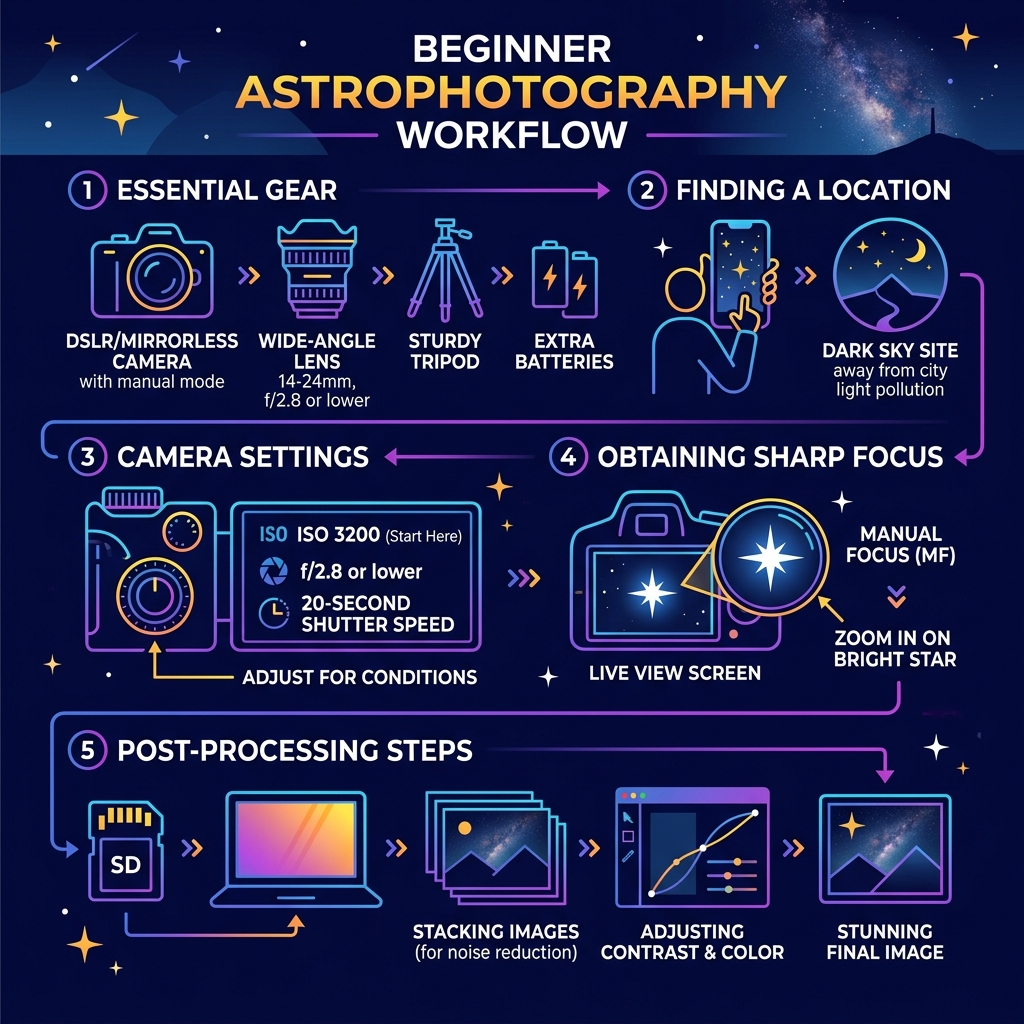
Essential Gear for the astrophotography beginner
When we first dive into stars, the sheer volume of equipment can feel like trying to count the grains of sand on a beach. But here is a secret: the “best” gear is often the gear you already have. For an astrophotography beginner, the most critical tool is a camera that allows for full manual control.
DSLR and Mirrorless Cameras
Whether you choose a DSLR or a mirrorless system, the goal is the same—you need to be able to control the shutter speed, aperture, and ISO independently. Mirrorless cameras are becoming the gold standard due to their lighter weight and excellent “Live View” capabilities, which make focusing on tiny stars much easier. However, a used DSLR is a fantastic budget-friendly entry point. Sensors that handle high ISO settings without creating excessive “noise” (that grainy look) are your best friends at 2:00 AM in a dark field.
Lenses: The “Glass” Matters More
In our experience, the lens is actually more important than the camera body. For wide-field shots like the Milky Way, you want a “fast” wide-angle lens. “Fast” simply means it has a wide maximum aperture, such as f/2.8 or even f/1.4. This allows the camera to collect as much light as possible in a short amount of time. A focal length between 14mm and 24mm is ideal for capturing those sweeping night-sky-photography-a-beginners-guide vistas.
The Unsung Hero: The Tripod
If there is one place not to skimp, it is the tripod. You are going to be taking exposures that last 15, 20, or even 30 seconds. Even a tiny vibration from a breeze can turn your sharp stars into blurry boomerangs. We recommend a sturdy tripod—carbon fiber is great for vibration dampening, but a heavy aluminum one works wonders on a budget.
Essential Accessories
- Remote Shutter Release: Touching the camera to take a photo causes shake. A cheap wired remote or using the in-camera 2-second timer is a must.
- Red Flashlight: White light ruins your night vision (and the vision of anyone else nearby). A red light allows you to see your dials without blinding yourself.
- Extra Batteries: Long exposures in the cold drain batteries faster than you’d believe. Always pack a spare!
For a deeper dive into the specific hardware, check out our astronomy-photography-a-beginner-friendly-guide.

Mastering Camera Settings and Star Tracking
Once you are out under the stars, the “Auto” mode on your camera becomes useless. The night sky is too dark for the camera’s computer to understand, so we have to take the wheel.
The Exposure Triangle for Stars
- Manual Mode: Switch that dial to ‘M’. This is non-negotiable.
- RAW Format: Always shoot in RAW. Unlike JPEGs, RAW files preserve all the data the sensor captures, which is vital for astrophotography-post-processing-for-beginners.
- Aperture: Set this to the lowest number your lens allows (e.g., f/2.8). This opens the “eye” of the lens wide to let in starlight.
- ISO: This is your sensor’s sensitivity. For a dark sky, start at ISO 3200. If the image is too noisy, drop to 1600. If it’s too dark, bump it to 6400.
- Shutter Speed: This is where it gets tricky. Because the Earth rotates, if your shutter is open too long, the stars will turn into lines.
The 500 Rule
To find your maximum shutter speed, use the 500 Rule: Divide 500 by your focal length. For example, if you are using a 20mm lens, 500 / 20 = 25 seconds. Any longer than 25 seconds, and you will see “star trails.”
| Feature | Milky Way Photography | Moon Photography |
|---|---|---|
| Aperture | Wide Open (f/1.4 – f/2.8) | Narrow (f/8 – f/11) |
| ISO | High (1600 – 6400) | Low (100 – 400) |
| Shutter Speed | Long (15 – 30 seconds) | Fast (1/125 – 1/250 second) |
| Tripod | Essential | Recommended |
Introduction to Star Trackers
If you want to take your images to the next level, you might consider an equatorial mount or a portable star tracker. These devices sit between your tripod and camera and rotate at the same speed as the Earth (sidereal tracking). This “cancels out” the Earth’s rotation, allowing you to take 2-minute or even 5-minute exposures without any trailing. This reveals deep-sky details like nebulae and galaxies that are invisible to the naked eye.
Planning and Focusing Your Night Sky Shoot
Success as an astrophotography beginner is 70% planning and 30% execution. You can’t just show up anywhere on any night and expect a masterpiece.
Planning Your Session as an astrophotography beginner
The biggest enemy of the stars is light pollution. We use tools like lightpollutionmap.info to find “Dark Sky Parks” or areas with low Bortle scale ratings (Bortle 1 is perfectly dark; Bortle 9 is downtown Manhattan).
You also need to watch the moon. A full moon is so bright it “washes out” the stars. The best time to shoot is during a New Moon or when the moon has already set. We also check the “transparency” and “seeing” of the atmosphere — basically, how much moisture and turbulence are in the air.
Apps like PhotoPills and Stellarium are game-changers. They allow us to use augmented reality to see exactly where the Milky Way will rise so we can compose our shot with a cool foreground element like a tree or a mountain. If you are starting with just your phone, don’t miss our mastering-mobile-astrophotography-a-beginners-guide.
Achieving Sharp Focus as an astrophotography beginner
Focusing at night is notoriously difficult because autofocus usually fails in the dark. Here is our foolproof method:
- Switch your lens to Manual Focus.
- Turn on Live View on your camera screen and find the brightest star in the sky.
- Use the digital zoom (magnify) on your screen to look at that star at 10x magnification.
- Slowly turn the focus ring until the star is the smallest, sharpest point possible.
- Don’t trust the “infinity” (∞) mark on your lens — it is often slightly off!
Avoid these and other common-beginners-mistakes-in-astrophotography-and-how-to-avoid-them to save yourself hours of frustration.
Image Stacking and Post-Processing Basics
When you look at your first RAW photo on the back of the camera, it might look a bit dark or “flat.” Don’t panic! The magic happens in post-processing.
Why We Stack Images
One of the most powerful techniques for an astrophotography beginner is image stacking. Even at ISO 3200, a single image has a lot of digital noise. By taking 10 or 20 identical photos of the same spot and using software like DeepSkyStacker or Sequator, we can “average” the frames. This increases the signal-to-noise ratio, making the sky look smooth and the stars look sharp.
Calibration Frames
To get professional results, we use calibration frames:
- Dark Frames: Photos taken with the lens cap on at the same settings as your stars. This helps the software identify and remove “hot pixels” caused by the sensor heating up.
- Flat Frames: These correct for “vignetting” (dark corners) and dust spots on your lens.
Stretching the Data
In software like Adobe Photoshop or Lightroom, we “stretch” the histogram. This involves bringing up the shadows and midtones to reveal the hidden colors of the Milky Way. We adjust the white balance (usually to a cooler 3800K–4200K) to get that natural “space” blue rather than a muddy orange from city lights. For more tips, see our night-sky-photography-a-complete-guide-for-beginners.
Frequently Asked Questions
Do I need an expensive telescope to start?
Absolutely not! In fact, we recommend starting with wide-field lenses. Telescopes act like giant telephoto lenses, and while they are great for deep-sky objects, they are much harder to use because they require perfect tracking. You can capture incredible star clusters, the Andromeda Galaxy, and even a-beginners-guide-to-photographing-meteor-showers with just a standard 50mm or 135mm lens.
Can I use my smartphone for astrophotography?
Yes, you can! Modern smartphones have “Night Mode” or “Pro” modes that allow for long exposures. While they won’t match a DSLR for detail, they are a great way to learn composition. You will need a tripod adapter to keep the phone still. For more on this, check out mobile-astrophotography-for-beginners.
How do I avoid star trails in my images?
The easiest way is to follow the 500 Rule or the even stricter 300 Rule (300 divided by focal length) for high-resolution sensors. If you want exposures longer than 30 seconds, you will need to invest in a motorized star tracker.
Conclusion
At Pratos Delícia, we believe that the night sky belongs to everyone. Becoming an astrophotography beginner is a journey of patience, but the reward of seeing a distant galaxy appear on your camera screen is unlike anything else in photography.
You don’t need the most expensive rig on day one. Start with what you have, focus on gradual learning, and practice consistently. Whether you are chasing the Milky Way or capturing your first nebula, every night under the stars is a chance to improve.
Start your astrophotography journey today and see what wonders you can find in the dark. Clear skies!
