
How to Capture Stunning Nebulae on a Budget
Why This Nebulae Imaging Beginner Guide Will Change How You See the Night Sky
A nebulae imaging beginner guide covers everything you need to start photographing deep-sky gas clouds — even on a tight budget, without a telescope.
Quick-start checklist for absolute beginners:
- Use a DSLR or mirrorless camera (no telescope required to start)
- Mount it on a sturdy tripod
- Point at a bright, easy target like the Orion Nebula (M42, magnitude 4.0)
- Shoot in RAW, manual mode, ISO 800–1600
- Keep exposures short (use the 500 Rule to avoid star trails)
- Capture 100+ frames and stack them with free software like DeepSkyStacker
- Stretch and process your stacked image in Photoshop or Siril
Here’s the truth most beginners don’t hear: you don’t need thousands of dollars of gear to photograph nebulae.
The Orion Nebula is the closest massive star-forming region to Earth — about 1,350 light-years away — and it shows up clearly in short exposures from a simple DSLR on a tripod. Photographers have captured M8 and M20 (the Lagoon and Trifid Nebulae) untracked, using hundreds of short 2.5-second exposures at ISO 4000. Others have shot Rho Ophiuchi with nothing more than an 85mm lens.
The barrier to entry is lower than you think.
What does take effort is understanding the workflow: the right settings, calibration frames, stacking, and a little post-processing. That’s exactly what this guide breaks down — step by step, in plain language.

Learn more about nebulae imaging beginner guide:
Essential Gear for Your Nebulae Imaging Beginner Guide
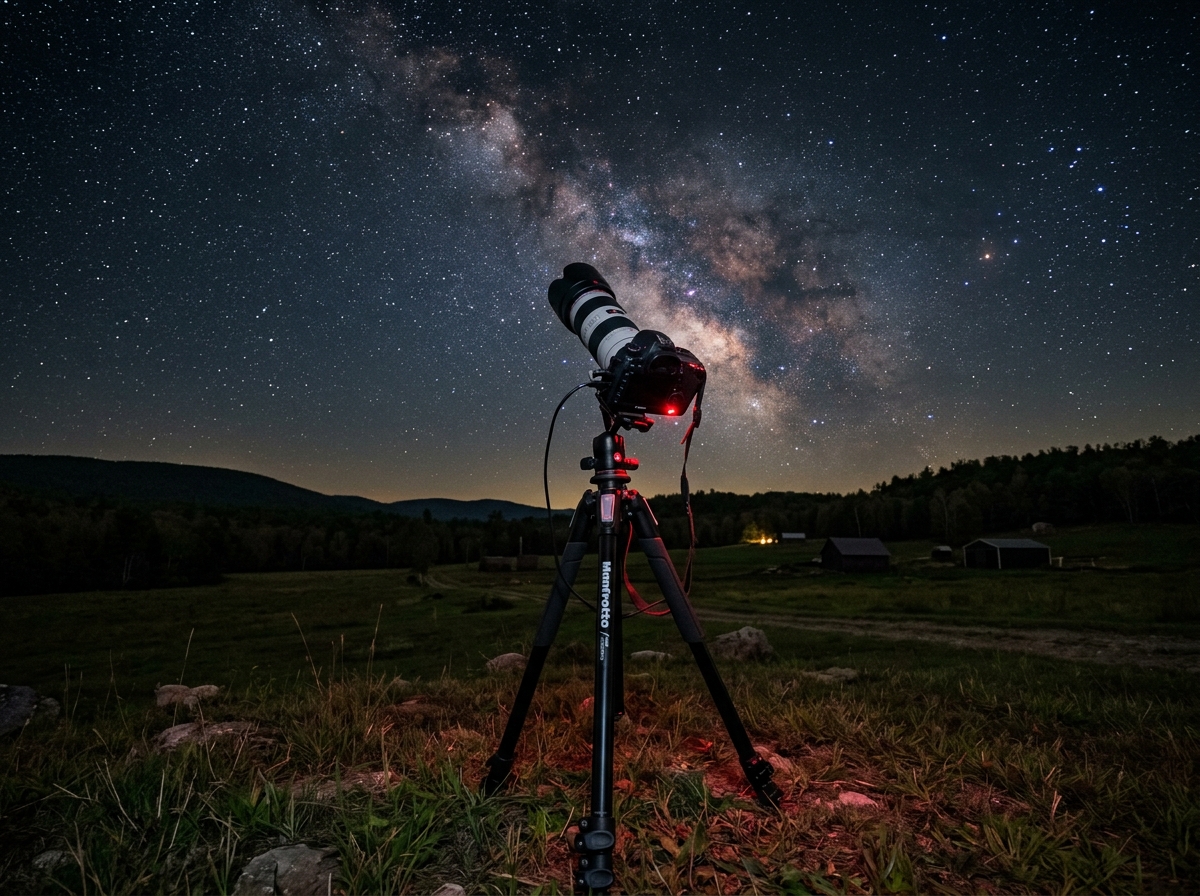
When we talk about deep-sky imaging, many people picture a massive observatory. In reality, our nebulae imaging beginner guide starts with the gear you likely already have in your closet. The goal is to collect as much light as possible over a long period. Because the Earth rotates, the stars appear to move, which is the biggest hurdle we face.
The Core Components
- DSLR or Mirrorless Camera: You don’t need the latest model. An older Canon Rebel or Nikon D-series works wonders. If you are serious about red emission nebulae, a “modified” camera (where the internal IR-cut filter is removed) is better, but a stock camera can still capture incredible images of M42 or the Pleiades.
- A Sturdy Tripod: This is non-negotiable. Even a slight breeze can ruin a long exposure. We recommend a tripod that can handle at least double the weight of your camera and lens.
- Intervalometer: This small device allows you to program a sequence of shots (e.g., 100 shots of 10 seconds each) without touching the camera, preventing vibrations.
- Star Tracker (Optional but Recommended): A star tracker, like the Sky-Watcher Star Adventurer, moves your camera at the same speed as the Earth’s rotation. This allows you to take 2-minute exposures instead of 2-second exposures, drastically improving your image quality.
Untracked vs. Tracked Imaging
To help you decide where to start, we’ve put together this comparison:
| Feature | Untracked (Tripod Only) | Tracked (Star Tracker/Mount) |
|---|---|---|
| Exposure Time | 1–5 seconds | 1–5 minutes |
| Complexity | Low (Point and shoot) | Medium (Requires Polar Alignment) |
| Cost | $0 (if you have a tripod) | $300–$600+ |
| Best Targets | Orion Nebula, Lagoon Nebula | Horsehead, Rosette, California |
| Star Shape | Risk of trailing | Pin-sharp stars |
Choosing the Right Focal Length for Your Nebulae Imaging Beginner Guide
One of the most common mistakes beginners make is trying to “zoom in” too far. High magnification magnifies your errors. If your tracking isn’t perfect, a 600mm lens will show blurry stars, while a 135mm lens might look perfect.
- 50mm to 85mm: Perfect for wide-field shots of entire constellations. You can capture the “Orion Molecular Cloud Complex” which includes the Orion Nebula, Barnard’s Loop, and the Horsehead all in one frame.
- 135mm to 200mm: This is the “sweet spot” for beginners. Lenses like the Samyang 135mm f/2 are legendary in the community because they let in a ton of light and are very forgiving.
- 300mm+: Great for smaller targets like the Dumbbell Nebula, but you will almost certainly need a star tracker to get sharp results at this length.
Do You Need a Telescope to Photograph Nebulae?
The short answer is: No. Many of the most famous nebulae are actually quite large in the sky. For example, the North America Nebula is four times the size of the full moon! A standard 200mm or 300mm telephoto lens is essentially a small telescope.
However, if you decide to upgrade, we recommend a small apochromatic (APO) refractor. These telescopes are designed to bring all colors of light to the same focus point, preventing “halos” around stars. A refractor with a focal length of 350mm to 450mm is much easier to handle than a giant reflector telescope when you’re just starting. Remember to use a field flattener to ensure your stars stay round even at the edges of your photo.
Top 5 Easiest Nebulae for Beginners to Photograph
If you’re looking for your first target, these five are the “greatest hits” of the night sky. They are bright, relatively easy to find, and look stunning even with modest gear.
- The Orion Nebula (M42): This is the undisputed king of beginner targets. It has a magnitude of 4.0, making it visible to the naked eye in dark skies. It is so bright that you can see color in a single 5-second exposure. For a deep dive into this target, check out How To Photograph The Orion Nebula.
- The Lagoon Nebula (M8) & Trifid Nebula (M20): These are spectacular summer targets. They sit close together in the constellation Sagittarius. An 85mm lens can capture both in the same frame, showing beautiful pink and blue hues.
- The Rosette Nebula (NGC 2244): A winter favorite that looks like a giant red rose in space. While it’s dimmer than Orion, it’s very large. Using a dual-band filter can make this pop even from a light-polluted backyard.
- Rho Ophiuchi Cloud Complex: Technically a mix of emission, reflection, and dark nebulae, this is one of the most colorful areas of the sky. It’s best shot with a wide-field lens (50mm–135mm) during the summer.
- The Dumbbell Nebula (M27): This is a “planetary nebula,” the remains of a dying star. It is bright and has a distinct shape that looks like an apple core. It’s a great target to practice your Deep-Sky Astrophotography How-To skills.
Seasonal Targets and Visibility
Timing is everything in astrophotography. You can’t shoot Orion in July (in the Northern Hemisphere) because it’s only up during the day!
- Winter (Oct–Mar): This is “Orion Season.” Look for the Orion constellation rising in the East. This is also the best time for the Rosette Nebula and the California Nebula in Perseus.
- Summer (Jun–Aug): This is “Milky Way Core Season.” Sagittarius is home to the Lagoon and Trifid nebulae. Cygnus (the Swan) is high overhead, containing the North America Nebula and the Pelican Nebula.
- Altitude Matters: Always try to photograph your target when it is at its highest point in the sky (the “meridian”). Shooting objects low on the horizon means you’re looking through more of Earth’s thick, turbulent atmosphere, which blurs your images.
Mastering Camera Settings and Field Techniques
Once you’re out under the stars, your camera settings will make or break your session. We always shoot in Manual Mode and RAW format. RAW files contain all the data the sensor captured, which is essential for the “stretching” process later.
Focusing: The Most Critical Step
Stars are tiny points of light. If your focus is off by a millimeter, they will look like blurry donuts.
- Turn off Autofocus and Image Stabilization.
- Use Live View and zoom in 10x on the brightest star you can find (like Sirius or Vega).
- Slowly turn the focus ring until the star is the smallest possible point.
- Pro Tip: Use a Bahtinov Mask. This is a cheap plastic filter you put over your lens that creates a “spike” pattern. When the center spike is perfectly centered, you are in perfect focus.
Calculating Exposure with the 500 Rule
If you are not using a star tracker, you need to know how long you can expose before the stars start to trail. The “500 Rule” is a classic starting point: 500 / (Focal Length × Crop Factor) = Max Shutter Speed.
For example, if you are using a 50mm lens on a Full Frame camera: 500 / 50 = 10 seconds. If you use a 100mm lens, you only get 5 seconds. This is why “shooting wide” is easier for beginners!
Using Filters in a Nebulae Imaging Beginner Guide
Do you need filters? Not at first. But if you live in a city, they are a lifesaver.
- Light Pollution Filters: These block the specific yellow/orange wavelengths of old streetlights.
- Narrowband/Dual-Band Filters: These are the “magic” filters for emission nebulae. They only let in the light from Hydrogen-alpha (red) and Oxygen III (blue/green). This allows you to photograph the Rosette Nebula even under a full moon or from a downtown balcony. For more on filter selection, see Nebula Photography the Best Gear, Filters, and Processing.
Stacking and Post-Processing Workflows
If you take a single 30-second photo of a nebula, it will likely look dark and noisy. The secret to those National Geographic-style images is stacking. By taking 100 photos and “averaging” them together, we cancel out the random electronic noise and boost the signal of the nebula.
The Four Types of Frames
To get a clean image, you need to capture more than just the nebula:
- Light Frames: Your actual photos of the nebula.
- Dark Frames: Photos taken with the lens cap on, at the same exposure/ISO/temperature as your lights. These record the sensor’s heat noise so software can subtract it.
- Flat Frames: Photos of an evenly lit white surface (like a T-shirt over the lens). these correct for vignetting and dust spots on your sensor.
- Bias Frames: The shortest possible exposure your camera can take with the lens cap on. These record the “read noise” of your camera’s electronics.
Software and Stretching
Once you have your frames, use free software like DeepSkyStacker (DSS) or Sequator to align and stack them. The output will be a 16-bit or 32-bit TIFF file that looks almost black. Don’t panic! The data is there; it’s just “squished.”
In a program like Photoshop or the free Siril, you perform “Levels and Curves” adjustments. This is called stretching. You slowly pull the data from the dark end of the histogram toward the light. Suddenly, the faint filaments of the nebula will appear. We also use noise reduction and color correction to bring out the natural pinks and blues of the gas clouds.
Frequently Asked Questions about Nebula Photography
Can I photograph nebulae from a light-polluted city?
Yes! While a dark sky is always better, many nebulae are bright enough to “punch through” the glow. Using a dual-band filter (like the Optolong L-eNhance) with a color camera can produce professional-looking results from a Bortle 7 or 8 backyard. Emission nebulae (like Orion, the North America, and the Lagoon) are the best targets for city dwellers.
How long does it take to get a good nebula photo?
It depends on your gear. With a star tracker and a fast lens (f/2.8), you can get a great image of the Orion Nebula in just 30 minutes of total “integration time.” For fainter targets like the Horsehead or California Nebula, we usually aim for 3 to 6 hours of total exposure to get a smooth, noise-free result.
Is a modified DSLR necessary for beginners?
No. While a modified DSLR is much more sensitive to the red light emitted by hydrogen gas, a stock camera can still capture plenty of detail. We recommend starting with a stock camera to learn the ropes. If you find yourself falling in love with “red” nebulae, you can eventually look into a dedicated cooled astronomy camera or having your DSLR modified.
Conclusion
At Pratos Delícia, we believe that the beauty of the universe should be accessible to everyone. Starting your journey with a nebulae imaging beginner guide is about more than just gear; it’s about persistence and the thrill of seeing something a thousand light-years away appear on your screen.
Don’t be discouraged by your first few attempts. Every expert astrophotographer started with a blurry, out-of-focus shot of the moon. The key is to keep practicing, find a dark patch of sky, and enjoy the quiet wonder of the night.
Ready to take your photography to the next level? More info about our services can help you find the inspiration you need for your next creative project. Clear skies!
