
How to Build a Pro Level Astro Rig on an Amateur Budget
You Don’t Need to Spend a Fortune to Photograph the Night Sky
The best budget astrophotography setup is one that balances tracking accuracy, optics, and camera sensitivity – all without draining your bank account. Here’s a quick breakdown to match your goals and budget:
| Setup Type | Typical Cost | Best For |
|---|---|---|
| Wide-field (camera + tracker) | ~$1,000 | Milky Way, large nebulae |
| Deep-sky rig (telescope + mount + camera) | ~$2,600-$2,800 | Galaxies, nebulae, star clusters |
| Smart telescope (all-in-one) | $399-$599 | Total beginners, zero setup |
Quick picks by budget:
- Under $1,000 – Sony a6400 + Rokinon 14mm f/2.8 + iOptron SkyGuider Pro tracker
- ~$2,600 – Sky-Watcher Star Adventurer GTi + Sky-Watcher Evolux 62ED + ZWO ASI585MC Pro + ASIAIR Mini
- ~$2,700 – Sky-Watcher EQ-AL55i + SVBONY SV550 + ZWO ASI585MC Pro + ASIAIR Mini
- Easiest entry – ZWO Seestar S30 Pro ($599) or DwarfLab DWARF Mini ($399)
Most people assume astrophotography requires a room-sized observatory and a second mortgage. It doesn’t.
Gear has improved dramatically in recent years. A complete, capable deep-sky rig now costs about $1,000 less than a comparable setup from just two or three years ago. That’s a big deal for beginners.
But here’s the thing – the gear alone won’t make your images great. How the pieces work together matters just as much as the price tag on each one. A cheap mount can ruin an expensive telescope. A great camera on a shaky tripod will still produce blurry stars.
The good news? With the right combination of equipment, free processing software, and a little patience, beginners are capturing images of nebulae and galaxies that look genuinely stunning.
This guide breaks down exactly what you need, at every budget level, to build a setup that actually works.
Defining the Best Budget Astrophotography Setup for Your Goals
When we talk about a “budget” in this hobby, we have to be realistic. While you can certainly snap a photo of the Moon with your smartphone, true deep-sky imaging—capturing the faint glow of nebulae or the spiral arms of distant galaxies—requires specialized gear. For most of us, a best budget astrophotography setup falls into three distinct price tiers based on what you want to see.
The $1,000 “Technical Tier” is the primary gateway. This usually consists of a used DSLR or mirrorless camera, a fast wide-angle lens, and a motorized star tracker. This setup is the “Lightweight King,” perfect for massive targets like the Milky Way or the North American Nebula.
If you want to zoom in on smaller targets like the Andromeda Galaxy or the Orion Nebula, you’ll need a dedicated deep-sky rig. These typically range from $2,000 to $3,000. While that sounds like a lot, just a few years ago, this level of performance would have cost $4,000+. Today, we can pair an 80mm triplet refractor with a cooled astronomy camera for roughly $2,710.
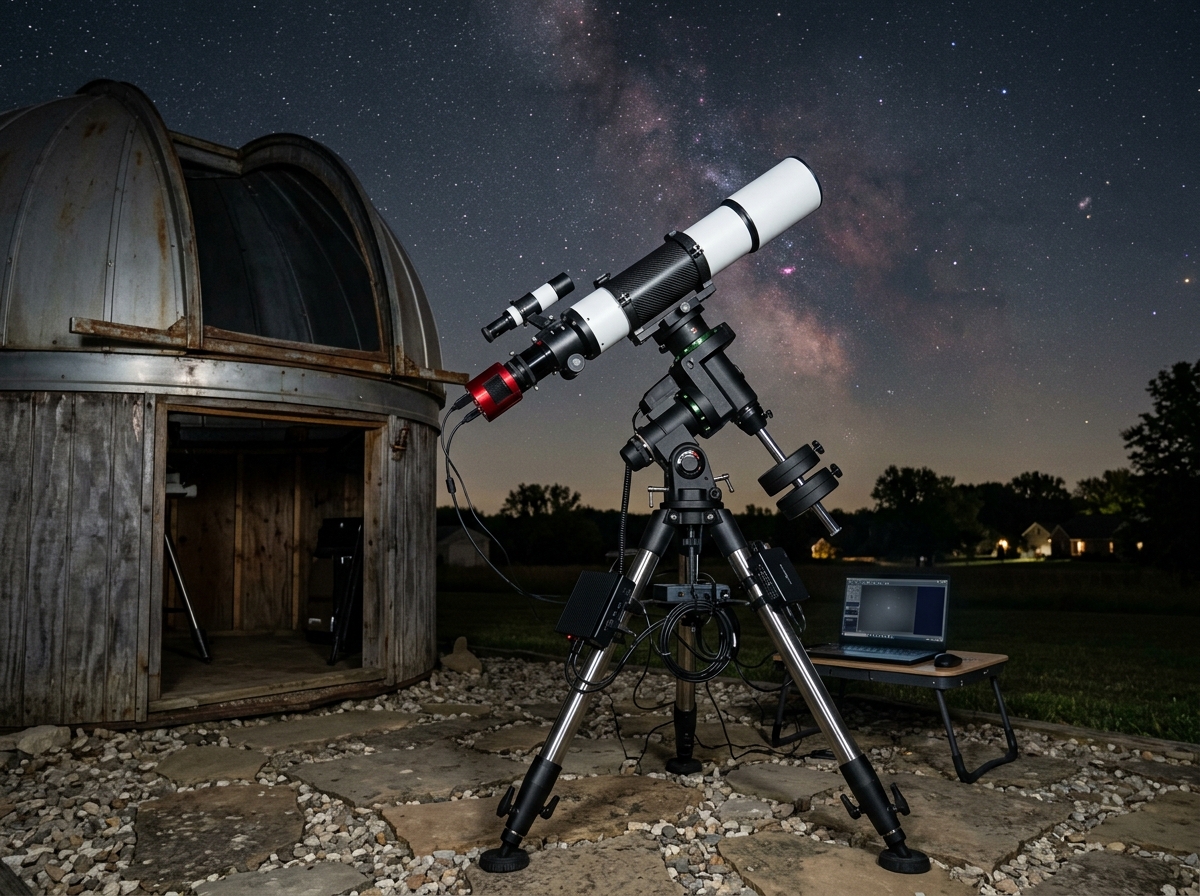
One metric we always watch is payload capacity. This is the maximum weight your mount can carry. For astrophotography, a golden rule is to use only 50% to 70% of the stated capacity to ensure the motors aren’t strained, which keeps your tracking smooth and your stars round. If you’re looking for a solid base to start, you can find more info about affordable tripods to ensure your foundation is rock-solid.
The Foundation: Why the Mount is Your Most Critical Investment
If we could give only one piece of advice, it would be this: Spend more on your mount than your telescope.
The Earth is constantly rotating. To take a long-exposure photo of a faint object, your camera must move in perfect synchronization with the stars. If your mount wobbles or drifts even a fraction of a millimeter, your photo will be a blurry mess of “star trails.” This is why building a deep-sky astrophotography kit always starts with the mount.
For budget seekers, there are three champions:
- Sky-Watcher Star Adventurer GTi (~$740): This is a “star tracker on steroids.” It offers full GoTo capability (meaning it finds targets for you) and has an 11-lb payload capacity.
- iOptron SkyGuider Pro (~$400): A palm-sized powerhouse. It’s incredibly portable and features a 20-hour rechargeable battery, making it the best choice for hikers and travelers.
- Sky-Watcher EQ-AL55i (~$760): A rising star for 2025. It handles double the load of the Star Adventurer (22 lbs) for nearly the same price, making it a fantastic intermediate-level option.
The key to success with these mounts is polar alignment—the process of pointing the mount’s axis exactly at the North Star (Polaris). Even a budget mount can track accurately for several minutes if aligned correctly.
Selecting Your Best Budget Astrophotography Setup Optics and Cameras
Once the mount is settled, we need something to gather light. For beginners, we almost always recommend a small Apochromatic (APO) Refractor. Why? Because they are “plug-and-play.” Unlike other telescope types, they don’t require constant adjustment (collimation) and they produce incredibly sharp, high-contrast images.
Top picks for a best budget astrophotography setup include:
- Askar 60F (~$499): An accessible entry point that offers a flat field right out of the box.
- SVBONY SV550 (~$730): An 80mm triplet that uses FPL-51 glass for excellent color correction. It’s a bit heavier (8.2 lbs) but offers great “reach” for smaller nebulae.
- William Optics RedCat 51 (~$843): Often called the “community favorite,” this tiny scope acts like a high-end 250mm camera lens. It’s legendary for its ease of use and “helical focuser” that makes focusing a breeze.
When imaging in the field, your mount and camera need power. Checking out reliable-battery-packs-for-long-astrophotography-sessions is essential to avoid your rig dying right as the “perfect shot” is about to happen.
Choosing a Camera for Your Best Budget Astrophotography Setup
You have two main paths here: a DSLR/Mirrorless camera or a Dedicated Cooled Astronomy Camera.
If you already own a camera like a Canon Rebel T7 or a Sony a6400, start there! They are versatile and have a shallow learning curve. However, standard cameras have “IR-cut” filters that block the beautiful red light from hydrogen-rich nebulae.
For those ready to get serious, the ZWO ASI585MC Pro (~$599) is a game-changer. It is a “cooled” camera, meaning it has an internal refrigerator that drops the sensor temperature to 35°C below the ambient air. This drastically reduces “thermal noise” (that grainy look in dark photos). You can find more details in our guide on the best-budget-cameras-for-astrophotography-dont-go-broke-for-the-stars.
Smart Telescopes as an All-in-One Alternative
If the idea of balancing mounts and connecting cables sounds like a nightmare, “Smart Telescopes” are your best friend. Devices like the ZWO Seestar S30 ($599) or the DwarfLab DWARF Mini ($399) are all-in-one robots. You set them on the ground, open an app on your phone, and tap “Orion Nebula.” The telescope finds it, tracks it, and “stacks” the images live on your screen. They are incredibly portable and eliminate the steep learning curve of traditional setups.
Essential Accessories and Software for Professional Results
To move from “amateur” to “pro-level” images, you’ll eventually want to add autoguiding. This involves a tiny secondary camera and scope (like the ZWO 30mm + ASI120MM Mini combo) that “watches” a single star. If that star moves even a tiny bit, the guider tells the mount to correct itself. This allows for 5-minute or even 10-minute exposures without any blur.
Another essential is a smart controller like the ASIAIR Mini ($199). This little red box replaces a laptop. It plugs into your mount, camera, and guider, allowing you to control your entire best budget astrophotography setup from a tablet or phone while sitting in your warm car.
Finally, don’t forget light pollution filters. The Optolong L-eNhance ($229) or L-Extreme are essentially magic. They block out city streetlights but let the light from nebulae pass through, allowing you to take stunning photos even from a suburban backyard.
Post-Processing with Free Software
You’ve spent all night gathering data—now you have to bake the cake. You don’t need a Photoshop subscription to get professional results.
- Siril (Free): A powerful tool for “stacking” your hundreds of short exposures into one master file.
- GraXpert (Free): An AI-powered tool that removes the “gradients” caused by light pollution. It can make a photo taken in a bright city look like it was taken in the middle of a desert.
Frequently Asked Questions about Budget Astrophotography
Do I need a telescope to start deep-sky imaging?
Absolutely not. Some of the most breathtaking images of the Milky Way and large nebulae (like the California Nebula) are taken with standard camera lenses. A 135mm or 50mm lens on a star tracker is often easier to use than a telescope because it is more forgiving of tracking errors.
What is the difference between a star tracker and a GoTo mount?
A basic star tracker (like the SkyGuider Pro) moves at the speed of the stars, but you have to find the targets yourself using a “ball head” and your eyes. A GoTo mount (like the Star Adventurer GTi) has a computer brain and internal motors. You tell it to find “M31,” and it automatically slews the telescope to the Andromeda Galaxy. GoTo mounts are heavier and more expensive, but they save a lot of time.
How can I save money by buying used equipment?
The astrophotography community is great about taking care of gear. Sites like AstroMart and Cloudy Nights are the “Gold Standard” for used equipment. You can often find flagship mounts or telescopes for 60-70% of their retail price. Just be sure to check the sensor of a used camera for scratches and ask for “dark frames” to see if the sensor has any major defects.
Conclusion
Building the best budget astrophotography setup is a journey of incremental upgrades. At Pratos Delícia, we believe the best gear is the gear you actually use. Don’t feel pressured to buy everything at once. Start with a camera and a tracker, learn the sky, and then add a telescope or a dedicated camera as your skills grow.
The technology available to us today is nothing short of miraculous. Whether you choose a $400 smart telescope or a $2,700 deep-sky rig, the ability to reach out into the cosmos from your own backyard is an experience like no other. Start your journey here and join a community that is looking up.
