
Budget Astrophotography: You Don’t Need NASA’s Wallet to Shoot the Stars
Budget astrophotography is the practice of capturing stunning night sky images — think the Milky Way, nebulae, and galaxies — using affordable gear, smart technique, and free software.
Here’s what you actually need to get started:
- A camera — a used DSLR or even a smartphone works fine
- A sturdy tripod — non-negotiable for sharp, shake-free shots
- A wide-angle lens — something fast like f/2.8 or wider
- A star tracker (optional but helpful) — keeps stars sharp in longer exposures
- Free post-processing software — tools like Siril, GraXpert, and DeepSkyStacker do the heavy lifting
A complete beginner setup can cost as little as $250 — or scale up to a capable deep-sky rig for around $2,700.
Most people assume astrophotography means owning a massive telescope and a five-figure camera. That’s a myth worth busting early.
The truth? Many of the most jaw-dropping space objects are enormous in the sky — the Andromeda Galaxy is five times the size of the full Moon, and the Orion Nebula is twice as wide. You don’t need high magnification to photograph them. A camera lens and a basic tracking mount can capture what no NASA download can replicate: your own image, from your own backyard.
The real challenges for beginners are Earth’s rotation (which blurs stars during long exposures), low-light camera settings, and knowing which gear actually matters. This guide cuts through the noise so you can start shooting — not just shopping.
There’s also a learning curve. But as one experienced astrophotographer put it: buying an expensive oven won’t make you a better cook. Learning the craft first — then upgrading gear gradually — is what actually gets results.
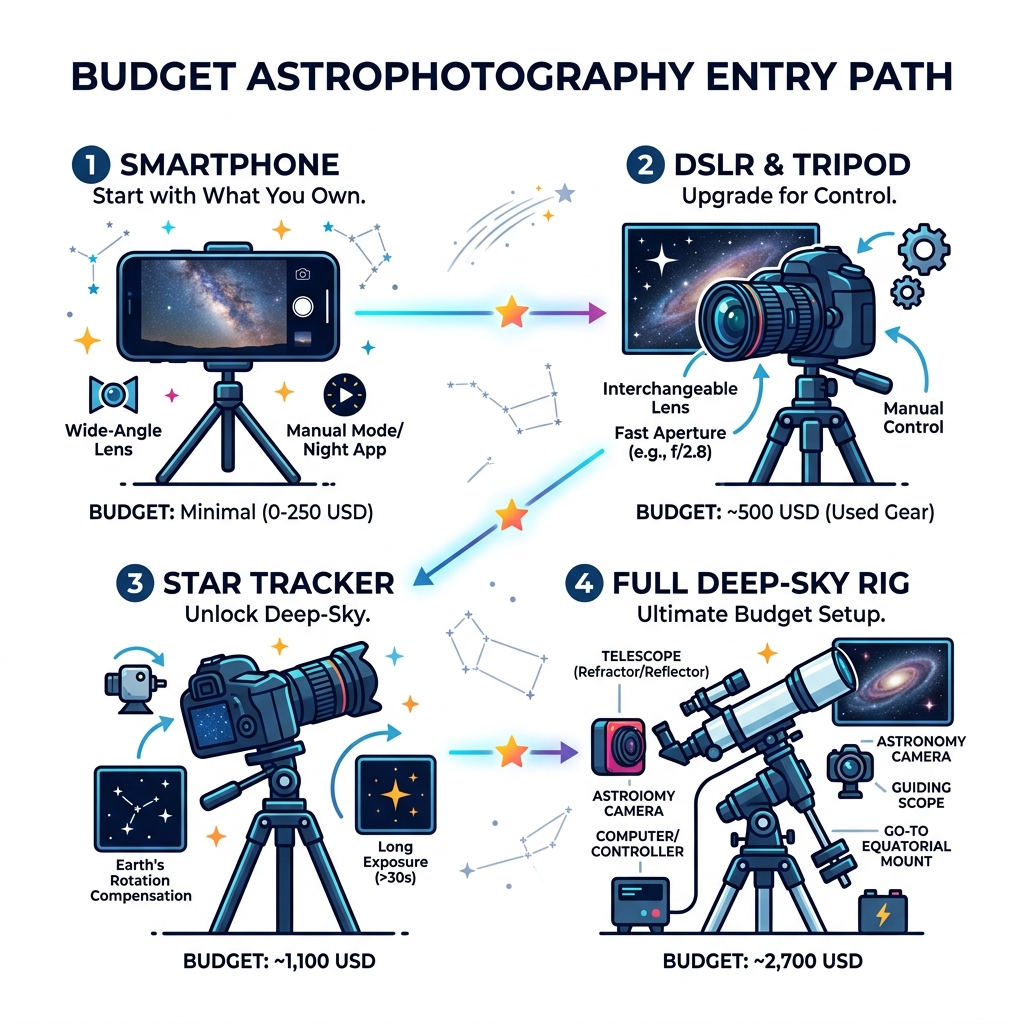
Essential Gear for Budget Astrophotography
When we talk about budget astrophotography, we aren’t talking about “cheap” gear that breaks after one use. We are talking about maximizing the value of every dollar. To capture the faint light of a nebula millions of light-years away, we need a specific foundation.
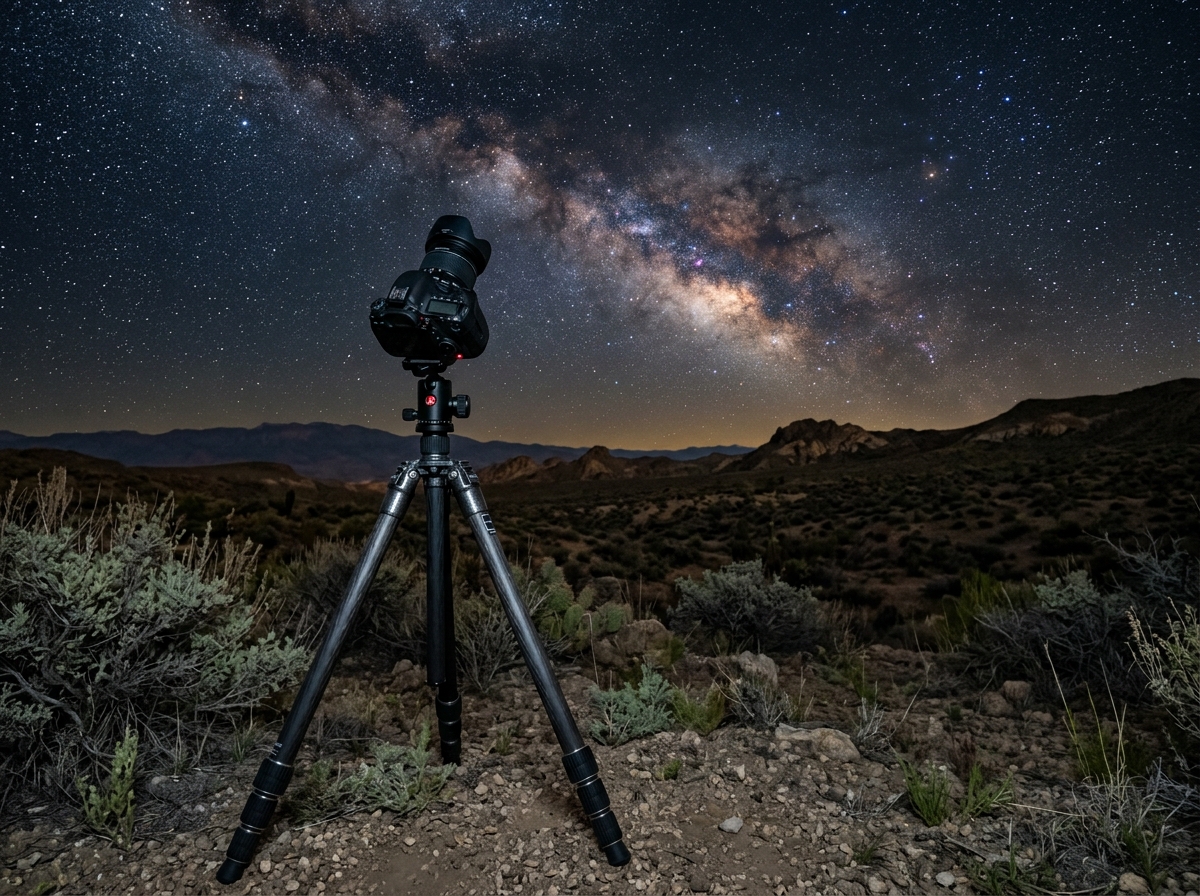
The core of your rig will likely be a DSLR or mirrorless camera. These are the workhorses of the hobby because they offer manual control over exposure, ISO, and focus—three things that are absolute requirements for night sky work. If you are looking for specific models that won’t break the bank, check out our guide on the Best Budget Cameras for Astrophotography: Don’t Go Broke for the Stars.
Beyond the camera, you need a way to keep it perfectly still. Even the slightest vibration from a breeze or a heavy footstep can ruin a 30-second exposure. This is why we emphasize Affordable Tripods for Night Sky Photography; look for something with a hook on the center column so you can hang your camera bag for extra weight and stability.
Finally, an intervalometer or remote shutter release is a small but mighty investment. These devices (often costing less than $20) allow you to trigger the camera without touching it, preventing “shutter shake.” They also let us program a sequence of 50 or 100 shots in a row, which is the secret sauce for high-quality final images.
Choosing a Camera for Budget Astrophotography
The used market is a goldmine for us. Cameras like the Canon EOS Rebel T3i or Nikon D5300 can often be found for under $200. While modern full-frame cameras offer incredible low-light performance, crop-sensor (APS-C) cameras are actually preferred by many for deep-sky work because they provide extra “reach” on distant targets.
When shopping, we look for two main things:
- Low Noise at High ISO: We want to be able to push the camera to ISO 1600 or 3200 without the image looking like a bowl of colorful static.
- Articulating Screen: Trust us, your neck will thank you when the camera is pointed straight up at the zenith.
One common upgrade is an “astro-modified” DSLR. These have a specific internal filter removed to allow the camera to “see” the red light (Hydrogen-alpha) emitted by many nebulae. To avoid other pitfalls, read up on Common Beginners Mistakes in Astrophotography and How to Avoid Them.
Affordable Lenses and Wide-Field Optics
You don’t need a telescope to start. In fact, we often recommend starting with Night Sky Photography Without a Telescope. Wide-field astrophotography using a standard 14mm or 24mm lens is the best way to capture the sprawling arc of the Milky Way.
For deeper targets, the “Nifty Fifty” (50mm f/1.8) is a legendary budget choice. If you want even more zoom, the Samyang/Rokinon 135mm f/2 is widely considered the “gold standard” for budget deep-sky imaging. It’s sharp, fast, and captures massive structures like the Orion Nebula or the Andromeda Galaxy with ease.
Don’t overlook vintage glass! Old Takumar or Nikon manual-focus lenses from the 1970s can be adapted to modern digital cameras for a fraction of the cost of new lenses. Since we focus manually on stars anyway, the lack of autofocus doesn’t matter one bit.
The Secret to Sharp Stars: Tracking and Stability
The Earth is spinning at about 1,000 miles per hour at the equator. This is why stars appear to “trail” or streak if your exposure is too long. To fix this, we use a star tracker—a motorized mount that rotates your camera at the exact same speed as the Earth, but in the opposite direction.
| Feature | Sky-Watcher Star Adventurer 2i | iOptron SkyGuider Pro | Sky-Watcher EQ-AL55i |
|---|---|---|---|
| Price (Approx) | $450 USD | $475 USD | $760 USD |
| Payload Capacity | 11 lbs | 11 lbs | 22 lbs |
| Battery Life | 72 hours (AA) | 20 hours (Internal) | External Power Required |
| Best For | Wide-field / Portable | Portability / Travel | Small Telescopes |
A star tracker like the Star Adventurer 2i is a game-changer for budget astrophotography. It allows us to take 2-minute or even 5-minute exposures without any star blurring. This lets the camera sensor soak up incredibly faint details that are otherwise invisible.
Improving Mount Stability for Budget Astrophotography
Stability is the foundation of every good shot. Even the best tracker will fail if the tripod is wobbly. One of our favorite tricks is using vibration suppression pads under the tripod legs—these are especially helpful if you are shooting from a wooden deck or a paved driveway.
If you find yourself in a situation where you forgot your gear, you can still Stabilize and Shoot: Night Sky Photography Without a Tripod by using beanbags, walls, or even the ground. However, for serious sessions, always ensure your tripod is level and the center of gravity is low. Hanging a weight (like a gallon of water or your camera bag) from the center column can make a $50 tripod perform like a $200 one.
Post-Processing: The Free Software Revolution
In the old days, you needed expensive subscriptions to edit space photos. Today, the most powerful tools are actually free. Post-processing is where we separate the “signal” (the light from the stars) from the “noise” (the graininess of the sensor).
The process usually follows these steps:
- Stacking: We use DeepSkyStacker or Siril to take 50 “light” photos and average them together. This cancels out the random noise and makes the faint details pop.
- Calibration: We use “dark frames” (photos taken with the lens cap on) to subtract the camera’s heat noise.
- Gradient Removal: Tools like GraXpert use AI to remove the orange glow of light pollution from your images.
- Stretching: This is the “magic” moment where we pull the faint data out of the darkness and into view.
If you’re just starting, our guide on Astrophotography Post-Processing for Beginners will walk you through these steps without the headache.
Frequently Asked Questions about Budget Astrophotography
Can I start with a smartphone?
Absolutely! We are big fans of Mobile Astrophotography for Beginners. Modern phones have “Night Mode” which essentially does stacking automatically. By using apps that allow manual control, you can choose your ISO and shutter speed just like a pro camera. For those who want to push their phone to the limit, we’ve put together a guide on Mastering Mobile Astrophotography: No Expensive Gear Required.
What is the “500 Rule” for untracked shots?
If you don’t have a star tracker yet, you need to know how long you can expose before the stars start streaking. The “500 Rule” is a simple math formula: 500 divided by the focal length of your lens.
For example, if you are using a 20mm lens: 500 / 20 = 25 seconds. If you shoot longer than 25 seconds, your stars will look like little sausages instead of pinpoints. For crop-sensor cameras, you need to multiply your focal length by the crop factor first (usually 1.5x or 1.6x). For more on this, check out our Long Exposure Tips for Smartphone Night Photos.
How can I save money on equipment?
The best way to save money is to buy used. Astrophotographers are notorious for “gear fever”—they constantly upgrade, meaning high-quality used gear is always hitting the market. Here are our favorite places to look:
- Cloudy Nights Classifieds: The most trusted community for used astro gear, found at Cloudy Nights.
- Astromart: A subscription-based marketplace for serious enthusiasts.
- MPB / KEH: Great for used DSLR bodies and lenses with warranties.
- Facebook Marketplace/Craigslist: Good for finding “attic finds,” but be sure to test the gear before paying.
Another great way to save is DIY. You can build a “barn-door tracker” for about $20 using some plywood, a hinge, and a threaded rod. It won’t be as accurate as a motorized mount, but it can handle 30-second exposures with ease.
Conclusion
Budget astrophotography is a journey, not a destination. It’s about the thrill of seeing a distant galaxy appear on your camera screen for the first time, knowing you captured it with a rig you built yourself. Don’t let the high-end gear intimidate you; some of the most beautiful images in the world were taken with second-hand cameras and a lot of patience.
At Pratos Delícia, we believe that the wonders of the universe should be accessible to everyone. By starting small, focusing on technique, and utilizing the incredible free resources available today, you can master the art of the night sky without breaking the bank.
Ready to take your first shot? For more tips and tricks on capturing the world around you, check out More info about our services. Clear skies!
