
Why Long Exposure Winter Waterfalls Are Worth the Challenge
Long exposure winter waterfalls are one of the most rewarding subjects in landscape photography — combining silky, flowing water with snow, ice, and frozen structures into a single dramatic frame.
Here’s a quick-start summary for capturing them:
- Shutter speed: 0.5s for texture, 1-4s for silky flow, 30s+ for an ethereal mist effect
- Aperture: f/11 to f/22
- ISO: 100 (as low as possible)
- Gear: Sturdy tripod, ND filters, weatherproof camera
- Best conditions: Overcast or low-light days for diffused, controllable light
- Safety: Watch for icy paths, unplowed access roads, and water spray
Winter transforms waterfalls into something almost unreal. Flowing water contrasts sharply with frozen edges and snow-covered rocks. That contrast is what makes these shots so striking.
But winter also brings real challenges. Cold drains batteries fast. Ice makes footing dangerous. Spray freezes on your lens. And bright snow can blow out your exposure in seconds.
The good news? With the right technique and a bit of preparation, even beginner photographers can capture stunning results.
This guide walks you through everything — gear, settings, composition, safety, and editing — so you can get the shot without the guesswork.

Essential Gear for Long Exposure Winter Waterfalls
When we head out to capture long exposure winter waterfalls, our gear list changes slightly from a standard summer hike. The conditions are harsher, and the light is trickier. Having the right tools isn’t just about image quality; it’s about making sure our equipment survives the trip.
The Sturdy Tripod
In winter, a tripod isn’t just a recommendation; it’s a requirement. To get that silky water effect, we need shutter speeds ranging from half a second to several minutes. Even the steadiest hands can’t hold a camera still for that long. We recommend a tripod with spiked feet if you’re standing on ice or packed snow, as standard rubber feet can slide.
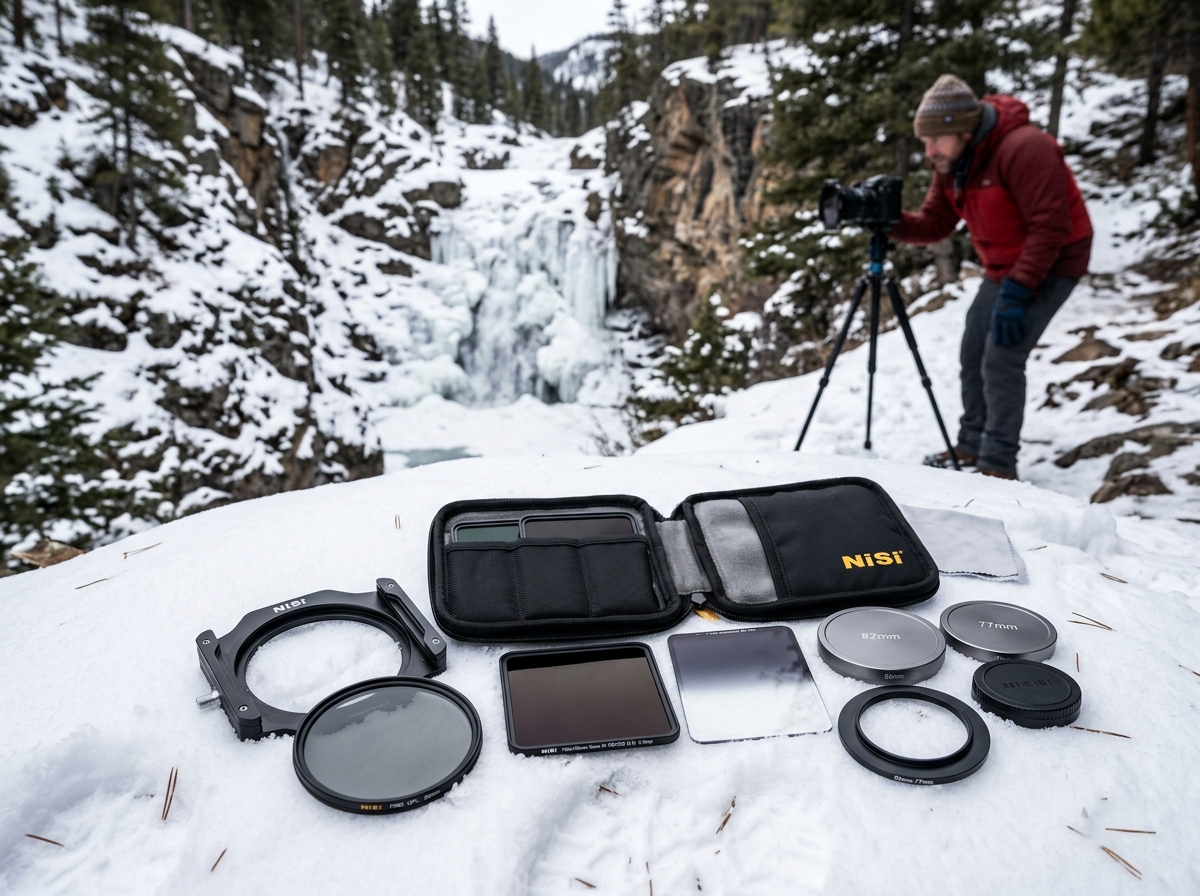
Neutral Density (ND) Filters
Snow acts like a giant softbox, reflecting light everywhere. Even on overcast days, the scene can be surprisingly bright. To slow down our shutter speed without overexposing the white snow, we use ND filters. These act like “sunglasses” for your lens.
- A 6-stop ND filter is great for slightly overcast days.
- A 10-stop ND filter is essential if you find yourself shooting in direct sunlight.
- You can also “stack” filters, such as a PROND8 and a PROND64, to achieve up to 9 stops of light reduction for those ultra-long exposures.
Circular Polarizer
This is our secret weapon for winter. A polarizer helps reduce the glare reflecting off ice and wet rocks. It also helps saturate the deep blues of the water and the greens of any pine trees in the frame. By cutting through the reflections, we can see the rocks beneath the water, adding depth to our composition.
Weatherproof Camera and Lens Cloths
Waterfalls create spray, and in winter, that spray turns into ice or slush the moment it hits your gear. We always carry multiple microfiber towels and lens cloths. A lens hood is also vital—it acts as a physical shield against falling snow and flying mist.
Protecting Your Gear from Snow and Ice
Cold weather is the enemy of electronics. To keep our gear running smoothly, we follow a few “pro” rules:
- Battery Warmth: Cold temperatures kill battery life. We keep spare batteries in an inside pocket close to our body heat until the moment we need them.
- Moisture Protection: When moving from the freezing outdoors to a warm car or house, condensation will form inside your lens. We place our camera in a sealed plastic bag before going inside, allowing it to reach room temperature slowly.
- Smartphone Photography: If you are using a phone instead of a DSLR, check out our guide on capture-the-night-long-exposure-smartphone-photography for tips on handling mobile sensors in challenging light.
Mastering Camera Settings for Icy Scenes
Getting the settings right for long exposure winter waterfalls is a balancing act. We want to blur the water while keeping the snow crisp and white—not gray or “blown out.”
Manual Mode is Your Friend
We always shoot in Manual Mode. This gives us total control over the three pillars of exposure: ISO, Aperture, and Shutter Speed.
- ISO: Set this to the lowest possible value (usually ISO 100). This ensures the cleanest image with the least amount of digital noise.
- Aperture: We typically aim for f/11 to f/16. This provides a deep depth of field, ensuring everything from the foreground ice to the distant falls is in focus. Going up to f/22 can help slow the shutter further, but be aware of “diffraction,” which can slightly soften the image.
- RAW Format: Always shoot in RAW. This format preserves all the data from the sensor, which is crucial for recovering details in the bright white snow during post-processing.
- Exposure Bracketing: Because snow is so reflective, cameras often get the exposure wrong. We recommend bracketing—taking one “normal” shot, one underexposed, and one overexposed—to ensure we capture all the details.
Ideal Shutter Speeds for Long Exposure Winter Waterfalls
The “right” shutter speed depends on the look we want to achieve.
- 0.5 Seconds: This is the sweet spot for “static” streams or smaller falls. It smooths the water but retains enough texture to show the power and direction of the flow.
- 1-4 Seconds: This creates the classic “silky” or “milky” look. It’s perfect for larger falls where we want to emphasize grace and movement.
- 30 Seconds or More: This creates a misty, ethereal effect. The water becomes a fog-like texture, which looks incredible when contrasted against sharp, jagged ice.
For those who want to experiment with advanced techniques, you can try image stacking. This involves taking multiple shorter exposures (like 43 individual shots) and merging them in software to create a single long exposure. This technique was used to create the stunning Kvarnbo Waterfall shot, resulting in a very clean, high-detail image.
Why Overcast Light is Best for Winter Long Exposures
While a sunny winter day looks beautiful to the eye, it’s a nightmare for long exposures. Direct sun creates harsh shadows and “hot spots” on the snow that are impossible to fix.
Overcast days provide diffused, even lighting. This acts like a giant softbox, reducing glare and allowing us to use longer shutter speeds without overexposing the highlights. If you’re shooting with a mobile device in these conditions, refer to our long-exposure-tips-for-smartphone-night-photos for advice on managing dynamic range.
Composition and Safety in Frozen Environments
Capturing long exposure winter waterfalls is as much about the “story” as it is about the settings. We want to show the viewer what it felt like to be there in the cold.
Composition Techniques
- Leading Lines: Use the edges of the frozen river or a snow-covered log to lead the viewer’s eye toward the waterfall.
- Foreground Interest: Don’t just shoot the waterfall. Find interesting ice formations, frozen bubbles, or snow-dusted rocks to place in the foreground. This adds a sense of 3D depth.
- Scale: Winter waterfalls often look larger or more imposing than they are. Including a person (at a safe distance) or a recognizable tree can provide a sense of scale. A classic example of this is the Long exposure of frozen Skogafoss waterfall covered in snow in winter in Iceland Stock Photo, ft. waterfall & snow – Envato, which uses the vastness of the landscape to create drama.
Safety Precautions for Icy Waterfall Treks
We cannot stress this enough: safety is your number one priority.
- Crampons/Microspikes: These are non-negotiable. Icy spray from the waterfall creates a “glaze” on every rock and path nearby. You need metal spikes on your boots to stay upright.
- Unplowed Roads: Many state parks and trailheads do not plow their parking lots in winter. As seen with Thunder Bay Falls in the snow, you may need to park further away and hike in. Always check road conditions before you leave.
- Water Spray: In sub-zero temperatures, spray can cause hypothermia if it soaks your clothes. Wear waterproof outer layers.
- The “Buddy System”: Never go out alone in extreme winter conditions. If you slip and twist an ankle, the cold becomes life-threatening very quickly.
Advanced Techniques and Post-Processing
Once we’ve captured our frames, the work moves to the digital darkroom. Winter photos often come out of the camera looking a bit blue or “flat.”
Single Exposure vs. Image Stacking
| Feature | Single Exposure | Image Stacking |
|---|---|---|
| Setup Time | Fast | Slow |
| Gear Needed | ND Filters Required | No Filters Needed |
| Noise Level | Standard | Extremely Low |
| Best For | Moving quickly, changing light | Fine art, high-resolution prints |
Editing Your Long Exposure Winter Waterfalls
When editing, we focus on three main areas:
- White Balance: Snow often looks blue in photos. We adjust the temperature slider toward the “warm” side to make the snow look pure white.
- The Dodge Tool: We love using the dodge tool (or a brightness brush) specifically on the moving water. By slightly increasing the brightness of the “silky” parts, we make the motion pop against the darker rocks.
- Highlight Recovery: We pull back the highlights to ensure we can see the texture in the snow banks.
If you’re editing on the go, there are several top-mobile-camera-apps-for-long-exposure-shots that offer powerful masking and color correction tools.
Frequently Asked Questions about Winter Waterfalls
Are ND filters necessary for daytime winter shots?
Generally, yes. Because snow is so bright, even at f/22 and ISO 100, your shutter speed might still be too fast (like 1/100th of a second) to blur the water. ND filters allow you to reach those 1-second or 5-second exposures. However, as seen in the Waterfall at Willow River State Park in Hudson Wisconsin in fall. Daytime long exposure, if you shoot during the “blue hour” (just before sunrise or after sunset), you might be able to get away without them.
Can I shoot long exposures handheld in the snow?
It is very difficult. Some modern cameras have incredible in-body image stabilization (IBIS) that allows for 0.5-second or even 1-second handheld shots. However, for anything longer, or if you want perfectly sharp ice crystals, a tripod is essential. If you don’t have a tripod, try resting your camera on a flat rock or a stuffed backpack. For mobile users, check out top-mobile-camera-apps-for-long-exposure-shots-2 for apps that use software to stabilize long exposures.
What are common mistakes to avoid in winter photography?
- Overexposure: It is very easy to “clip” the highlights in snow. Keep an eye on your histogram!
- Frozen Tripod Legs: If you put your tripod in the water, the locking mechanisms can freeze shut. Dry them off immediately after moving.
- Ignoring Spray: A single drop of water on your lens will turn into a blurry blob in a long exposure. Check your lens between every single shot.
Conclusion
Capturing long exposure winter waterfalls is a test of both your technical skill and your physical endurance. There is something deeply peaceful about standing in a frozen landscape, watching the water move while everything else is still.
At Pratos Delícia, we believe that the best photos come from those who are willing to brave the elements and see the world in a different light. The transformation of a familiar waterfall into a cathedral of ice is a sight few people get to witness in person—and even fewer manage to capture on film.
With the right gear, a solid understanding of your settings, and a focus on safety, you can bring home images that truly capture the “frozen beauty” of the season.
Ready to level up your photography even further? Explore our More photography guides for more tips on mastering the art of the long exposure. Happy shooting, and stay warm out there!
