
The Deep Sky Secret: Using H-Alpha Filters for Stars
Why H-Alpha Filters Are a Game-Changer for Night Sky Photography
H alpha filter stars are what you get when you use a specialized optical filter to isolate the deep-red light emitted by excited hydrogen gas — revealing glowing nebulae and cosmic structures that are completely invisible to a standard camera.
Here’s a quick overview of how H-alpha filters work for stars and astrophotography:
| What | Details |
|---|---|
| Wavelength targeted | 656nm (deep red) |
| What it reveals | Emission nebulae, hydrogen clouds, Milky Way structure |
| Works with stock cameras? | Yes, but longer exposures needed |
| Best bandwidth for beginners | 12nm–20nm |
| Safe for solar viewing? | No — never point at the Sun |
| Main benefit | Blocks light pollution, moonlight, and airglow |
You’ve probably looked at stunning photos of nebulae — those glowing red clouds of gas floating between the stars — and wondered how anyone captures them. The answer, almost every time, is an H-alpha filter.
Most cameras block the majority of hydrogen-alpha light by design. Manufacturers tune sensors to match how human eyes see color. The problem? Our eyes are almost blind to the deep red 656nm wavelength where hydrogen gas glows brightest.
An H-alpha filter flips this around. It blocks nearly everything except that precise wavelength, so your camera sensor captures the hydrogen glow directly — even from a backyard with moderate light pollution.
The result is dramatic. Nebulae that look like faint smudges in a regular photo transform into vivid, detailed structures with rich contrast.
This guide will walk you through exactly how to use one — from understanding the basic science to choosing the right filter for your camera and capturing your first nebula image.
What is an H-Alpha Filter and How Does it Work?
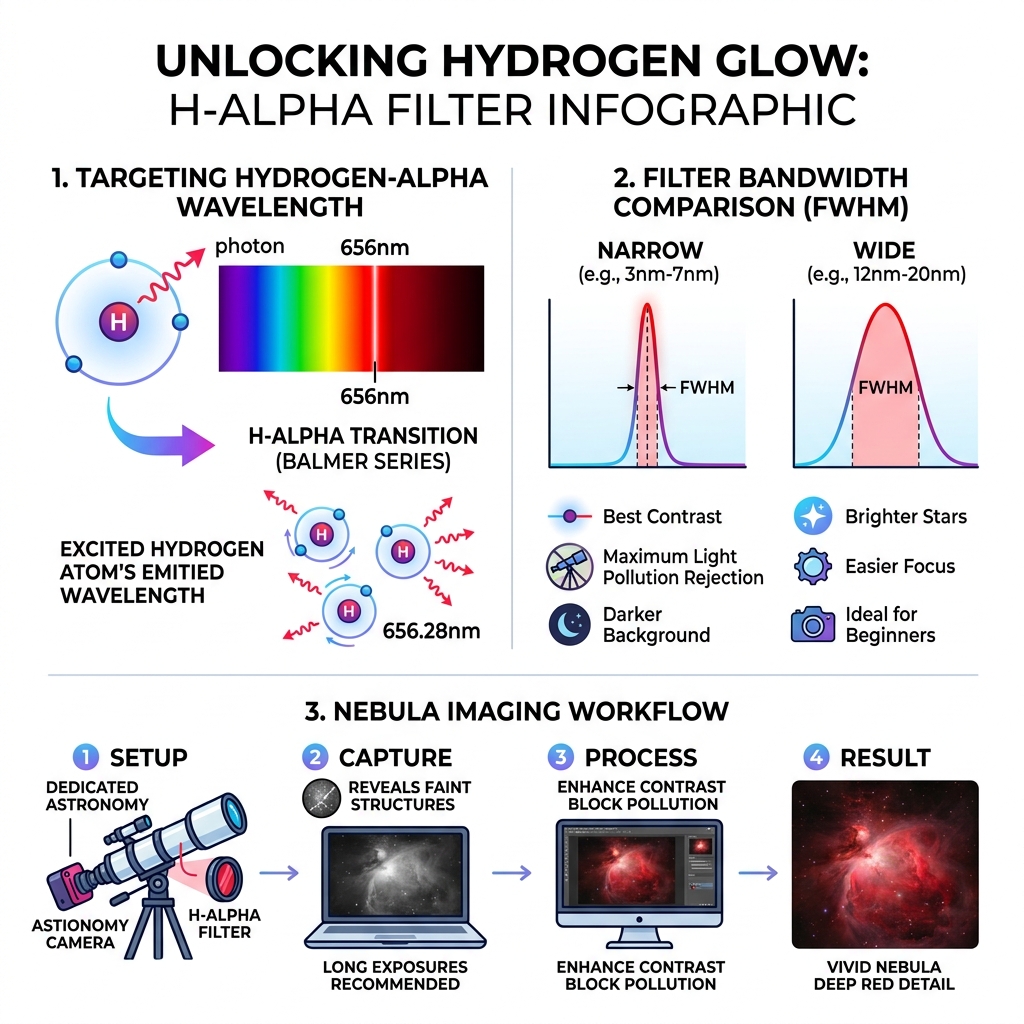
At its core, an H-alpha filter is a precision-engineered piece of glass designed to act as a “gatekeeper” for light. In the vast electromagnetic spectrum, visible light occupies a small sliver, and Hydrogen-alpha sits at the very edge of what our eyes can perceive—specifically at a wavelength of 656.28 nanometers (nm).
To understand why this specific number matters, we have to look at quantum mechanics. Hydrogen is the most abundant element in the universe. When a hydrogen atom’s single electron is energized—perhaps by the radiation of a nearby hot star—it jumps to a higher energy level. When that electron eventually “falls” back down from the third energy level to the second (a process known as the Balmer series transition), it releases a photon of light at exactly 656nm.
This deep red glow is the signature of the universe’s most spectacular nurseries: emission nebulae. An H-alpha filter works by using thin-film interference coatings to reflect away all other wavelengths of light—like the yellow glow of streetlights or the blue scatter of moonlight—allowing only that 656nm “hydrogen signature” to pass through to your camera sensor.

The Science of H Alpha Filter Stars
When we talk about H alpha filter stars, we are often looking for stars that are “excited.” In regions of active star formation, young, massive stars pump out massive amounts of ultraviolet radiation. This radiation ionizes the surrounding hydrogen gas, stripping electrons away. When those electrons recombine with protons, they cascade down energy levels, emitting H-alpha photons along the way.
In professional astronomy, H alpha photometry is used to measure the intensity of this light to understand stellar temperatures, magnetic fields, and even how fast a star is rotating. For us as photographers, these filters allow us to see the “hidden” structures of the Milky Way. By isolating this line, we can photograph the intricate tendrils of gas that connect stars, providing a sense of depth and scale that standard RGB photography simply cannot match.
Choosing the Right Bandwidth for Your Setup
One of the most confusing parts of buying a filter is the “bandwidth” or FWHM (Full Width at Half Maximum). This measurement, usually in nanometers (nm), tells you how “wide” the gate is. A narrower gate blocks more unwanted light but requires more precision.
| Bandwidth | Best For | Pros | Cons |
|---|---|---|---|
| 3nm – 5nm | Extreme light pollution, dedicated astro-cameras | Maximum contrast, tiny stars | Very expensive, hard to focus, “band shift” issues on fast lenses |
| 7nm – 12nm | Suburban skies, modified DSLRs | Great balance of contrast and light | Can still be dark for stock cameras |
| 20nm | Nightscapes, stock cameras, beginners | Easy to see stars, works with wide lenses | Lets in slightly more light pollution |
Narrower filters (3nm–7nm) are incredible for suppressing stars, making the nebula the undisputed hero of the shot. However, they can be tricky. On very fast lenses (f/2.8 or wider), the light hits the filter at an angle, which can actually shift the wavelength transmission—meaning you might miss the H-alpha line entirely! This is why many experts recommend a 12nm bandpass for camera lenses.
Why 20nm is the Sweet Spot for H Alpha Filter Stars
For those of us using standard camera lenses and stock (unmodified) DSLRs, a 20nm bandwidth is often the “Goldilocks” zone. Why? Because it is wide enough to let in enough light that you can still see bright stars on your camera’s “Live View” screen. This makes focusing—which is notoriously difficult in the deep red—much easier.
A 20nm filter also plays better with wide-angle lenses. Narrower filters often cause “vignetting” or strange color shifts at the edges of a wide-angle frame. A 20nm filter provides a much more uniform image across the sensor while still providing a massive boost in nebula contrast compared to no filter at all. It’s the perfect entry point for exploring H alpha filter stars without needing a degree in optical physics.
How to Use H-Alpha Filters for Nightscape Photography
Using an H-alpha filter for nightscapes—where you combine a beautiful foreground with the glowing Milky Way—is a relatively new frontier. Traditionally, these filters were used only with telescopes, but new hardware has changed the game.
Modern systems now offer magnetic mounting. Instead of fumbling with screw-on threads in the pitch black with frozen fingers, you can simply snap the filter onto a magnetic ring. Some even feature glow-in-the-dark grips (knurling) so you can find them in your gear bag without a headlamp. This ease of use is vital when you are trying to capture a fleeting alignment of stars over a mountain range.
If you’re just starting out with mobile setups, you might also find that affordable light pollution filters for smartphones offer a similar (though less specialized) boost in contrast for casual night sky shots.
Capturing H Alpha Filter Stars with Stock vs. Modified Cameras
This is the big question: “Do I need to break my camera to use this?”
Standard cameras have an internal “IR-cut” filter that blocks about 75% to 80% of H-alpha light. While this sounds bad, it doesn’t mean you can’t use an H-alpha filter. It just means you need to work harder.
- Stock (Unmodified) Cameras: You can absolutely capture H alpha filter stars. However, because your camera is fighting the filter, you will need significantly longer exposures—often 3 to 5 minutes per shot. This requires a star tracker to prevent the stars from trailing.
- Astro-Modified Cameras: Some photographers have the internal IR-cut filter removed or replaced. These cameras are 4x more sensitive to H-alpha light. You’ll get much cleaner images in less time, but the camera will look “reddish” if you try to take normal family photos with it.
For most beginners, starting with a stock camera and a 20nm filter is the best way to test the waters before committing to a permanent camera modification.
Advanced Techniques: HaRGB Blending and Calibration
Once you have your H-alpha data, the real magic happens in the “digital darkroom.” A common technique is HaRGB blending. This involves taking a standard color (RGB) photo of a nebula and then “stacking” your H-alpha data on top of it.
In Ha Photography techniques, the H-alpha data is often used as a “Luminance” layer or blended into the Red channel. Because the H-alpha filter has blocked all the light pollution and “star bloat,” your red channel becomes incredibly sharp and detailed. When you mix this back into your color image, the nebulae “pop” with a structural detail that looks almost three-dimensional.
Focusing and Indexing with Telephoto Lenses
Focusing through an H-alpha filter is a unique challenge. Because the filter is so dark, your viewfinder will be black, and even Live View might look grainy.
- Focus First: Focus on a bright star before putting the filter on. If you use a magnetic system, this is a breeze.
- Use a Bahtinov Mask: This simple plastic tool creates a “diffraction spike” pattern on stars. When the middle spike is perfectly centered, your focus is spot-on.
- Mechanical Indexing: Many older telephoto lenses have an “infinity” mark and a small red “R” or “IR” mark. H-alpha light often focuses somewhere between these two. You can create a paper scale on your lens barrel to mark exactly where your specific filter reaches sharpest focus.
If you are using shorter focal lengths for wide-field shots, check out our guide on affordable light pollution filters for smartphones 2 for tips on focusing in low-light environments.
Safety Warning: Night Sky vs. Solar H-Alpha Filters
We cannot stress this enough: Night-sky H-alpha filters and Solar H-alpha filters are NOT the same thing.
- Night-Sky Filters: These are designed to let in a tiny bit of light from faint nebulae. They do nothing to stop the heat and intense radiation of the Sun. If you look at the Sun through one of these, or point your camera at the Sun, you will suffer permanent eye damage and melt your camera sensor instantly.
- Solar Filters: These are incredibly complex systems using “etalons” and energy rejection filters. They are designed to block 99.999% of the Sun’s light, leaving only the tiny H-alpha signature of solar prominences.
Always double-check your gear. If it’s a filter that screws onto the front of a standard lens or drops into a camera body, it is for night use only.
Frequently Asked Questions about H Alpha Filter Stars
Can I use an H-alpha filter with an unmodified DSLR?
Yes! While a modified camera is more efficient, a stock DSLR can still capture beautiful H-alpha data. You will simply need to increase your exposure times (e.g., 180–300 seconds) and use a star tracker. When processing, you’ll find most of your data is in the red channel, which is exactly what we want.
Does an H-alpha filter block light pollution?
Absolutely. This is one of their primary uses. Because they only let in a 12nm–20nm “slice” of light, they naturally block the wavelengths emitted by sodium-vapor and mercury-vapor streetlights. They are also highly effective at blocking moonlight, allowing you to photograph nebulae even when the moon is at 70% or 80% illumination.
Why can’t I see anything through the viewfinder?
The H-alpha wavelength (656nm) is at the very edge of human vision. Our eyes are not very sensitive to it, especially in the dark. To see what you’re doing, turn your camera’s ISO up to its maximum setting (e.g., ISO 12,800 or higher) just for the “Live View” focusing stage, then turn it back down to a normal setting (ISO 800–1600) before you start your actual exposure.
Conclusion
At Pratos Delícia, we aim to share helpful, engaging educational content across a wide range of visual and creative topics. In astrophotography, using an H-alpha filter is like putting on a pair of “cosmic glasses”-suddenly, the empty black spaces between the stars are filled with the glowing red clouds of the Milky Way’s history.
Whether you are a landscape photographer looking to add a “wow” factor to your mountain shots or a deep-sky enthusiast trying to beat the light pollution of the city, H alpha filter stars can be a powerful tool. Start with a wider 20nm filter, grab a star tracker, and prepare to be amazed at what has been hiding in your photos all along.
Ready to dive deeper into night photography? Explore our photography guides for more tips on mastering the dark!
