
How to Use ZWO Cameras for Stunning Deep Sky Images
Why ZWO Camera Astrophotography Is the Best Way to Start Imaging the Night Sky
ZWO camera astrophotography gives you one of the most accessible and capable ways to photograph deep-sky objects, planets, and nebulae – without spending a fortune.
Here’s a quick overview of the most popular ZWO camera types and what they’re best for:
| Camera Type | Best For | Example Model |
|---|---|---|
| One-Shot Color (OSC) | Beginners, quick results | ASI533MC Pro |
| Monochrome | Advanced deep sky, max detail | ASI2600MM Pro |
| Planetary (uncooled) | Planets, Moon, Sun | ASI662MC |
| Autoguider (Mini) | Tracking correction | ASI Mini series |
| All-in-One (Air) | Portable, wireless imaging | ASI2600MC Air |
ZWO makes over 40 astronomy cameras, ranging from beginner-friendly color cameras to full-frame monochrome powerhouses like the ASI6200MM Pro with 61 megapixels. According to the official ZWO website, prices run from around $199 to $14,800, so there’s something for nearly every budget.
The brand has built a loyal following because its cameras combine high performance with a tightly connected ecosystem – including the ASIAIR controller, electronic filter wheels, and auto-focusers – all designed to work together out of the box.
Whether you want to capture your first galaxy or push into narrowband nebula imaging, there’s a ZWO camera built for the job. This guide walks you through the key models and what makes each one worth considering.
ZWO camera astrophotography vocab to learn:
Mastering ZWO Camera Astrophotography: Choosing Your Sensor
When we dive into ZWO camera astrophotography, the first hurdle is often the “alphabet soup” of model numbers. However, the logic is simpler than it looks. The choice of sensor is the most critical decision we make, as it dictates what we can actually see in the night sky.
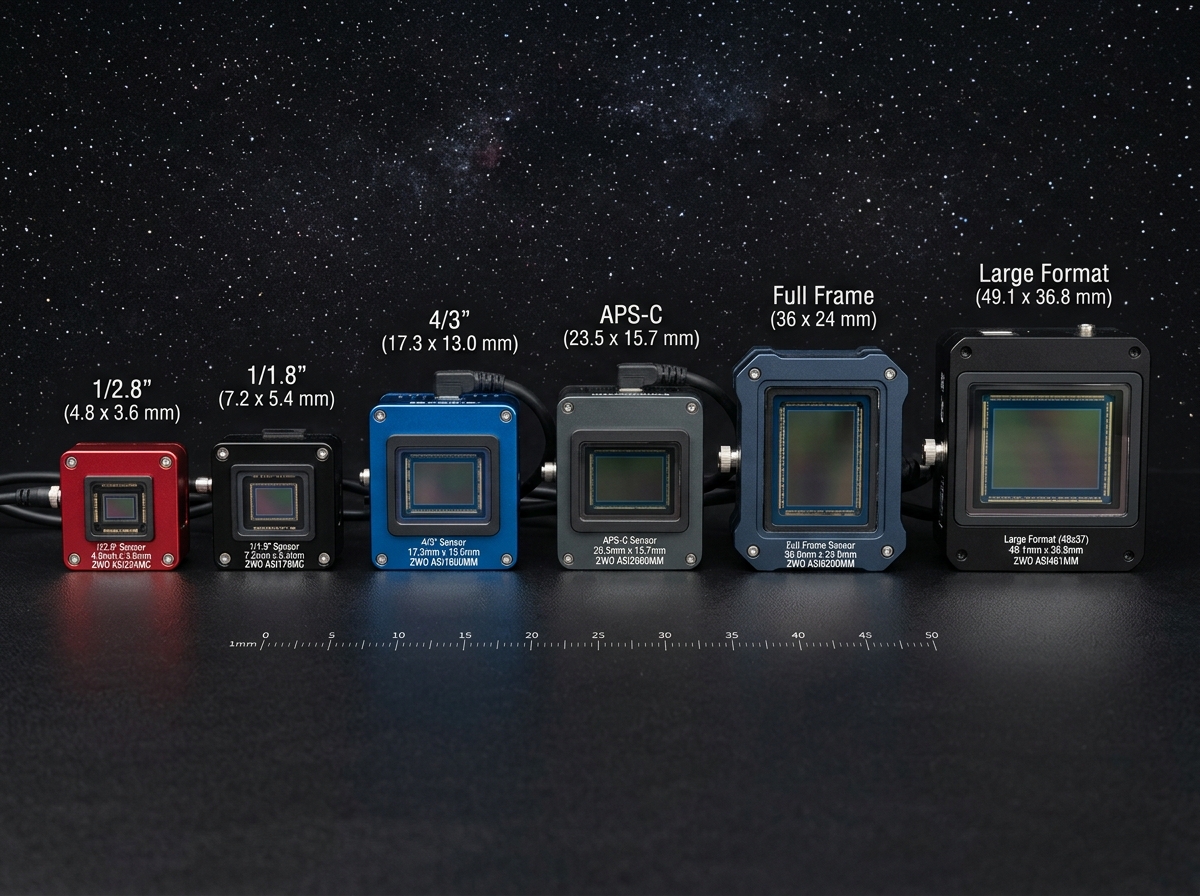
Sensor Size and Field of View
The sensor size determines your Field of View (FOV). A small sensor, like those found in the ASI224 or ASI662 series, acts like a “zoom lens,” which is perfect for tiny targets like Jupiter or Saturn. Conversely, a Full Frame sensor like the one in the ASI6200MM Pro provides a massive window into the cosmos, allowing us to capture entire nebula complexes in a single frame.
ZWO categorizes their cameras into three main buckets:
- Planetary/Solar System (Uncooled): Small sensors, high frame rates (up to 100+ FPS), and no cooling system.
- Deep-Sky (Cooled ‘Pro’ Series): Larger sensors (APS-C or Full Frame) with Thermoelectric Cooling (TEC) to keep noise low during long exposures.
- Autoguiders (Mini): Small, tube-shaped cameras designed to help your mount track stars accurately.
Pixel Scale and Resolution
Matching your camera to your telescope is a bit like pairing wine with dinner—it needs to be balanced. We use a concept called “critical sampling.” If your pixels are too large for your telescope’s focal length, your stars will look like squares (under-sampling). If they are too small, you won’t gain any extra detail but will suffer from bloated file sizes and lower signal (over-sampling).
A good rule of thumb for planetary work is that your focal ratio should be roughly five times your pixel size in microns. For deep-sky imaging, we generally aim for a pixel scale of around 1.0 to 2.0 arcseconds per pixel. For example, the popular ASI2600 series features 3.76μm pixels, which is widely considered the “sweet spot” for most modern refractors and reflectors.
Getting Started with ZWO Camera Astrophotography for Beginners
If you are just starting out, we almost always recommend a One-Shot Color (OSC) camera. Models like the ASI533MC Pro are legendary for a reason. They feature a square sensor that is incredibly easy to frame and, most importantly, they produce a color image in a single shot.
When we use an OSC camera, we don’t have to worry about buying expensive filter wheels or spending hours merging different color channels in software. This simplicity helps in avoiding common beginner mistakes like improper calibration or losing track of which filter was used for which frame.
For those on a tighter budget, uncooled cameras can be used for short-exposure deep-sky work, but be warned: without cooling, “thermal noise” will start to show up as grainy spots in your images as the sensor warms up during the night.
Advanced ZWO Camera Astrophotography: Monochrome vs. Color
Once you’ve mastered the basics, the siren song of monochrome imaging usually starts to call. The ASI2600MM Pro is the gold standard here.
Why go monochrome?
- Quantum Efficiency (QE): Monochrome sensors are more sensitive. The ASI2600MM Pro achieves a staggering 91% peak QE, meaning it catches almost every photon that hits it.
- Detail: Because there is no color “Bayer matrix” over the pixels, every single pixel records pure light data, leading to sharper images.
- Narrowband Imaging: This is the big one. With a monochrome camera and a filter wheel, we can use Ha (Hydrogen-alpha), OIII (Oxygen-III), and SII (Sulfur-II) filters to create the famous “Hubble Palette.” This allows us to image even from light-polluted city centers.
While color cameras are great for speed, monochrome setups offer the highest possible signal-to-noise ratio, which is the secret sauce for those smooth, “deep” images of distant galaxies.
Key Technical Specifications for Deep Sky Success
To understand why ZWO camera astrophotography produces such clean images, we have to look under the hood at the technical specs. Modern CMOS sensors have essentially replaced older CCD technology because they offer lower noise and higher speeds at a fraction of the cost.
| Specification | ASI2600MC Pro (APS-C) | ASI6200MM Pro (Full Frame) |
|---|---|---|
| Resolution | 26 Megapixels | 61.2 Megapixels |
| Pixel Size | 3.76μm | 3.76μm |
| ADC | 16-bit | 16-bit |
| Full Well Capacity | 50ke- | 51.4ke- |
| Read Noise | 1.0 – 3.3e | 1.2 – 3.5e |
| Amp Glow | Zero | Zero |
Read Noise and HCG Mode
Read noise is the “static” created by the camera’s electronics when it reads the data from the sensor. ZWO cameras feature an “HCG” (High Conversion Gain) mode. When you increase the gain to a certain point (usually 100 on the ASI2600), the read noise drops significantly while maintaining a high dynamic range. This is a game-changer for capturing faint nebulosity.
Zero Amp-Glow and 16-bit ADC
Older CMOS sensors often suffered from “amp glow”—a bright magenta flare in the corners of long exposures. Modern ZWO “Pro” cameras use specialized circuitry to eliminate this entirely. Furthermore, a native 16-bit ADC (Analog-to-Digital Converter) provides 14 stops of dynamic range, ensuring that the transition from the bright core of a galaxy to the dark background of space is smooth and natural.
Understanding these specs is vital for post-processing for beginners, as cleaner data from the camera makes the editing process much more enjoyable and less about “fixing” mistakes.
Optimizing Your Imaging Train and Accessories
A camera by itself is just a shiny paperweight; it needs an ecosystem to thrive. One of the biggest advantages of ZWO camera astrophotography is the “ASIAIR” ecosystem.
The ASIAIR Ecosystem
The ASIAIR Plus is a small computer that sits on top of your telescope. It replaces your laptop, allowing you to control the camera, mount, Electronic Filter Wheel (EFW), and Electronic Automatic Focuser (EAF) all from your smartphone or tablet. It handles polar alignment, plate solving (finding where the scope is pointing), and even “Live Stacking,” where you can watch the image build up in real-time.
The 55mm Back Focus Standard
If your stars look like seagulls in the corners of your image, you likely have a back focus issue. Most focal reducers and field flatteners require exactly 55mm of distance between the metal shoulder of the reducer and the camera sensor.
ZWO makes this easy by including a specific set of spacers (21mm and 16.5mm) with their cooled cameras. When combined with the camera’s internal 17.5mm distance, you hit that magic 55mm number perfectly.
Power Requirements
Cooled “Pro” cameras are hungry for power. While the camera’s logic can run off a USB cable, the TEC cooling system requires a dedicated 12V 3A to 5A power supply. We recommend using a high-quality AC/DC adapter or a lithium battery pack to ensure the cooling remains stable throughout the night.
Frequently Asked Questions about ZWO Cameras
Are monochrome cameras better than color cameras for deep sky?
“Better” is a relative term! Monochrome cameras provide pure data, higher resolution, and the ability to do narrowband imaging, which is superior for detail and working in light pollution. However, they require a filter wheel and multiple sets of exposures (Red, Green, Blue). Color cameras (OSC) are much more convenient and are now so good that models like the ASI2600MC Pro can rival monochrome results in many situations.
Do I need a cooled camera for planetary imaging?
Generally, no. Planetary imaging uses “lucky imaging,” where we take thousands of very short exposures (milliseconds) and stack only the sharpest ones. Because the exposures are so short, thermal noise doesn’t have time to build up. This is why uncooled cameras like the ASI662MC or ASI224MC are the preferred tools for the Moon and planets.
How do I calculate the correct back focus for my ZWO camera?
Most ZWO cooled cameras have a “flange focal distance” of 17.5mm. To reach the standard 55mm required by most telescopes:
- Start with the 17.5mm in the camera.
- Add the included 21mm extender.
- Add the included 16.5mm extender.
- Total = 55mm. If you add a filter drawer or a filter wheel, you must subtract the thickness of those accessories from your spacers to maintain that 55mm total.
Conclusion
Stepping into ZWO camera astrophotography is one of the most rewarding moves an amateur astronomer can make. Whether you choose the simplicity of a One-Shot Color camera or the technical precision of a monochrome powerhouse, the results speak for themselves.
At Pratos Delícia, we know that equipment longevity is key. To keep your ZWO camera performing at its peak, always store it in a dry environment with desiccant tablets to prevent internal frost, and keep your firmware updated via the ZWO website. With a bit of care and the right accessories, your ZWO setup will be capturing the wonders of the universe for years to come.
Explore more at Pratos Delícia to find more guides on mastering your night sky gear!
