
Why So Many Beginners Struggle With Astrophotography (And What to Expect)
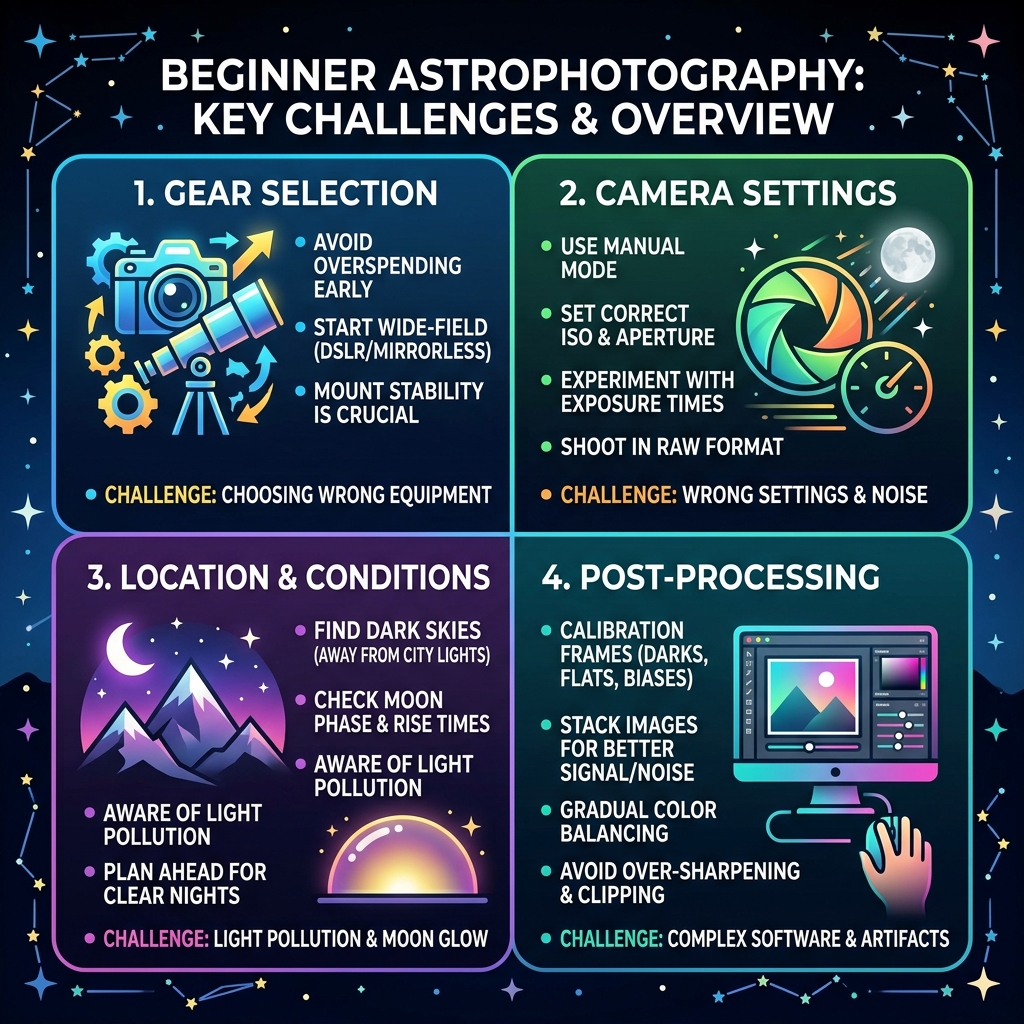
The top astrophotography challenges for beginners include these core hurdles:
- Gear confusion – overspending or buying the wrong equipment first
- Camera settings – wrong ISO, aperture, shutter speed, or shooting in JPEG instead of RAW
- Focusing in the dark – autofocus fails on stars; manual focus is tricky
- Light pollution – shooting from the wrong location kills your results
- Lunar interference – the moon’s brightness washes out faint targets
- Calibration frames – skipping darks, flats, and biases leaves noise and artifacts in your images
- Too little exposure time – most beginners stop at under an hour; 2-4 hours makes a dramatic difference
- Post-processing mistakes – clipping blacks, wrong colors, and over-sharpening ruin otherwise good data
- The learning curve – frustration from early failures causes many to quit too soon
Astrophotography looks like pure magic from the outside. You see a stunning image of the Milky Way arching over a desert landscape and think: I want to do that.
Then you go out on your first night, come home with blurry, noisy, washed-out frames, and wonder what went wrong.
You’re not alone. Almost every astrophotographer has been there. One common experience captures it perfectly: stumbling around in the dark, questioning every life decision, staring at a camera screen full of grainy nothing.
The good news? Most of these problems are completely fixable. They’re not about talent or expensive gear. They’re about knowing what mistakes to avoid and in what order to tackle them.
This guide walks you through each challenge clearly, so you can stop wasting clear nights and start capturing the sky you came for.
The Gear Trap: Avoiding Overspending on Your First Rig
One of the most common top astrophotography challenges for beginners is the belief that you need a NASA-sized budget to see the stars. We’ve seen many enthusiastic newcomers drop thousands of dollars on a high-end telescope, only to realize they don’t have the mount to support it or the knowledge to align it.
The reality of a deep-sky astrophotography rig is that it is difficult to build a high-performing system for under $2000. This includes the telescope, a dedicated camera, and the most important piece: the mount. However, you don’t need to start there. If you already own a DSLR or mirrorless camera, you have the heart of a “wide-field” setup.
Wide-field targets, like the Milky Way or large constellations, are much more forgiving. Instead of a $3000 telescope, a wide, fast lens (f/2.8 or faster) will do wonders. If you are looking to save money, check out our Budget Astrophotography: A Beginner’s Guide to the Galaxy for tips on using what you already have.
Essential Gear for Starters
If we were building a “starter kit” today, here is what we would prioritize:
- A Sturdy Tripod: At night, even a tiny breeze can turn your stars into blurry disco balls. A tripod that doesn’t wobble is non-negotiable.
- An Equatorial Tracking Mount: While not strictly necessary for your very first night, this is the single most important upgrade. It rotates your camera at the same speed as the Earth, allowing for exposures lasting minutes instead of seconds.
- Red-Light Headlamp: White light ruins your night vision (and the vision of anyone near you). A red light allows you to see your gear without blinding yourself.
- Remote Shutter or Self-Timer: Even the act of pressing the button on your camera causes vibration. Use a 2-second or 5-second timer to let the camera settle.

Top Astrophotography Challenges for Beginners: Mastering the Settings
Once you’re standing in the dark, the second hurdle hits: the camera settings. Daytime “Auto” mode is your enemy here. To capture the faint light of distant suns, you must take full control of the “Exposure Triangle.”
For a standard 20mm or wider lens, a great starting point is setting your aperture to f/2.8, your shutter speed to 13 seconds, and your ISO to 3200.
The RAW Truth
Always shoot in RAW format. JPEGs are processed by the camera, which throws away about 80% of the data you need for editing later. RAW files are “ugly” and flat out of the camera, but they contain the hidden details of nebulae and star colors that you’ll bring out in post-processing.
White Balance and ISO
Many beginners leave White Balance on “Auto,” which results in inconsistent colors between frames. We recommend a custom setting of around 4300K. This produces natural-looking night sky tones that aren’t overly blue or unnaturally orange. Regarding ISO, don’t be afraid of high numbers. While ISO 3200 or 6400 looks noisy on your screen, modern stacking software can clean that up later.
Avoiding Star Trails: The 500 vs. 300 Rule
If your shutter stays open too long without a tracker, the stars will “trail” because the Earth is rotating. To prevent this, photographers use simple math.
| Rule | Formula | Example (24mm Lens) | Result |
|---|---|---|---|
| 500 Rule | 500 / Focal Length | 500 / 24 = 20.8 seconds | Decent, but might see slight trailing |
| 300 Rule | 300 / Focal Length | 300 / 24 = 12.5 seconds | Much sharper, pinpoint stars |
For more depth on these numbers, see The Ultimate Guide to Best Settings for Stars Photography.
Overcoming Focus and Composition: Top Astrophotography Challenges for Beginners
You can have the most expensive camera in the world, but if your focus is off by a millimeter, your photo is ruined. Autofocus simply does not work on stars.
The Live View Trick:
- Switch your lens to Manual Focus (MF).
- Turn on “Live View” on your camera screen.
- Find the brightest star in the sky and center it.
- Use the digital zoom (magnification) on your screen to 10x.
- Slowly turn the focus ring until the star is a tiny, sharp point. If it looks like a “disco ball,” you’re out of focus.
For even more precision, we suggest using a Bahtinov mask. This is a cheap plastic filter you place over the lens that creates a specific light pattern (diffraction spikes). When the spikes intersect perfectly, you are in focus. Once you find that “sweet spot,” use a piece of gaffer tape to lock the focus ring in place so it doesn’t nudge during the night.
Composition and the Rule of Thirds: Don’t just point at the sky. Great astrophotography usually includes a foreground element—a tree, a mountain, or an interesting rock. Use the Rule of Thirds to place your horizon or your main celestial target (like the Milky Way core) off-center for a more balanced, professional look. You can find more focusing hacks in our guide on Focus Peaking and Other Tricks for Perfect Star Focus.
Environmental Hurdles: Dark Skies and Lunar Phases
You could have perfect gear and settings, but if you’re shooting from a suburban backyard, you’re fighting an uphill battle. Light pollution is the “invisible wall” of astrophotography.
The Bortle Scale
The Bortle Scale measures how dark a location is, ranging from Class 9 (Inner City) to Class 1 (Pristine Dark Sky). Most beginners are shocked to find that driving just an hour away from the city can improve their image quality by 500%. Use light pollution maps or apps like Gaia to find “Dark Sky Places” near you. For a quick overview of sky quality classes, see the Bortle scale.
The Moon: Your Brightest Enemy
The moon is beautiful, but it is a giant light bulb in the sky. If you try to shoot the Milky Way during a Full Moon, the sky will look blue and washed out, and the stars will disappear.
- The Best Time to Shoot: The window from the Last Quarter moon, through the New Moon, and up to the First Quarter (roughly a two-week window).
- The Exception: If you want to light up your foreground (like a mountain range) without using a flashlight, a small crescent moon low in the sky can provide a soft, natural glow.
For more on finding the perfect spot, check out our Location Scouting Tips for Night Sky Photos.
The Invisible Enemy: Calibration and Post-Processing Errors
When you look at a raw photo of a nebula, it often looks like a faint, grainy smudge. The “magic” happens during stacking and processing. However, this is where many of the top astrophotography challenges for beginners occur—specifically, the neglect of calibration frames.
The Holy Trinity of Calibration
To get a high Signal-to-Noise Ratio (SNR), you need to take “extra” photos that help the software understand what is a star and what is just sensor junk.
- Dark Frames: Take these with the lens cap ON, using the exact same settings and temperature as your star photos. These record the “thermal noise” of your sensor so it can be subtracted later.
- Flat Frames: These are taken by pointing the camera at an even light source (like an iPad screen covered with a white shirt). They map out dust spots on your lens and vignetting (dark corners).
- Bias Frames: These are the fastest possible exposures with the lens cap on. They record the electronic “read noise” of the camera.
Common Post-Processing Blunders
Processing is an art form, but beginners often go too far. The most common error is clipping the black point. In an attempt to hide noise, beginners will slide the shadows to 0 until the sky is pitch black. Real space isn’t pitch black; it’s full of faint dust and light. Clipping the blacks makes the image look “crunchy” and unnatural.
Another mistake is over-sharpening or over-saturating. If your stars have dark rings around them or look like neon dots, you’ve pushed the sliders too far. For a step-by-step walkthrough, visit Astrophotography Post-Processing for Beginners.
Managing the Learning Curve: Top Astrophotography Challenges for Beginners
Perhaps the biggest challenge of all is patience. In our world of instant gratification, astrophotography is a “slow hobby.”
Integration Time is Key: A single 30-second photo will never look like the ones you see in magazines. Most professional-looking images are the result of “long integrations.” While a beginner might stop after 30 minutes, extending that to 2, 3, or 4 hours of total exposure time makes a world of difference. The more data you have, the smoother and more detailed your final image will be.
Don’t Go It Alone: The learning curve is steep, and you will have nights where everything goes wrong—the battery dies, the dew fogs your lens, or you forget your tripod plate at home. This is why community support is vital. Join a local astronomy club or online forums. Seeing how others have failed and recovered is the fastest way to learn. If you’re feeling overwhelmed, read our guide on How to Shoot the Stars Without Losing Your Mind.
Frequently Asked Questions about Beginner Astrophotography
What is the most important piece of gear for a beginner?
While a good camera is nice, the mount (or a very sturdy tripod) is the most important. You cannot take long exposures if your camera is shaking or cannot follow the stars. A reliable equatorial tracker will do more for your photos than a $5,000 camera body on a cheap tripod.
How do I find a dark sky location near me?
Use tools like Light Pollution Map or DarkSky International’s interactive map. Look for areas labeled “Bortle 1, 2, or 3.” Also, use apps like PhotoPills to plan where the Milky Way will be before you drive out into the middle of nowhere.
Why are my stars blurry even when using a tripod?
There are three likely culprits:
- Focus: You might be slightly off “Infinity” focus. Use Live View to magnify a star and double-check.
- Star Trailing: Your exposure is too long for your focal length. Try a shorter shutter speed using the 300 Rule.
- Vibration: Even the wind or your footsteps can cause blur. Use a remote shutter or the camera’s built-in self-timer.
Conclusion: Embracing the Journey
At Pratos Delícia, we believe that astrophotography is more than just a technical challenge—it’s a way to connect with the universe. Yes, the top astrophotography challenges for beginners can be frustrating. You will forget gear, you will get the settings wrong, and you will spend hours editing a photo that you eventually delete.
But then, one night, everything will click. You’ll see the Orion Nebula or the Andromeda Galaxy appear on your tiny camera screen, and the frustration will vanish. The key is persistence. Treat every “ruined” photo as a lesson, and keep track of your progress. Comparing your shots from month to month is the best way to stay motivated.
Ready to take the next step? Explore our complete library of astrophotography guides to master everything from smartphone stars to deep-sky processing. Clear skies!
