
A Guide to Smartphone SAR Values and Safe Distancing
What Your Smartphone SAR Value Guide Actually Tells You
A smartphone sar value guide is the clearest way to understand how much radiofrequency (RF) energy your phone absorbs into your body during normal use. Here’s a quick summary of what you need to know:
- SAR stands for Specific Absorption Rate – measured in watts per kilogram (W/kg) of body tissue
- US FCC limit: 1.6 W/kg (averaged over 1 gram of tissue)
- EU/ICNIRP limit: 2.0 W/kg (averaged over 10 grams of tissue)
- Lowest recorded phone SAR: ZTE Blade V10 at 0.13 W/kg
- Highest recorded phone SAR: Motorola Edge at 1.79 W/kg
- How to check your phone right now: Dial *#07# on most Android phones
Every smartphone sold legally must stay below these limits. But the gap between the lowest and highest SAR values is enormous – nearly 1,277% difference between the best and worst performers.
The science here is straightforward. When you hold a phone to your ear, it emits RF energy. Some of that energy gets absorbed by your head and body. SAR measures exactly how much. Labs test phones at their maximum certified power output, so real-world exposure is often lower – because phones automatically use only the minimum power needed to reach the nearest cell tower.
That said, there are situations where your actual exposure can spike significantly. A phone struggling for signal in a parking garage or elevator can emit 5 to 10 times more radiation than the values shown in official lab tests.
This guide walks you through everything – from reading SAR labels and comparing flagship phones, to simple daily habits that meaningfully reduce your exposure.
Understanding the Smartphone SAR Value Guide: Limits and Measurements
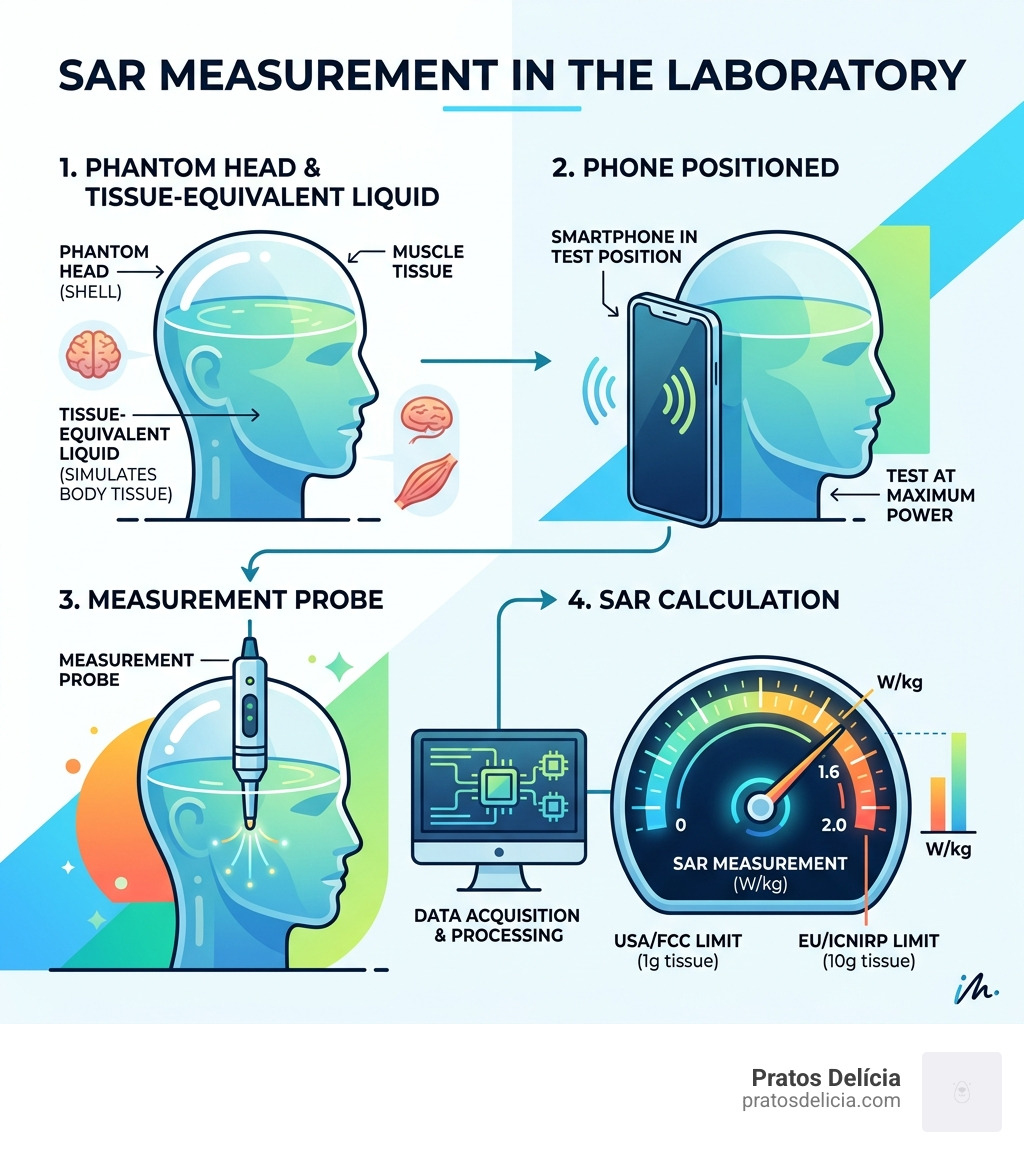
When we talk about smartphone radiation, we aren’t talking about X-rays or gamma rays (ionizing radiation). We are talking about Radiofrequency (RF) energy. To ensure this energy doesn’t cook our tissues or interfere with biological processes, regulatory bodies have set strict “speed limits” for how much energy our bodies can absorb.
In the United States, the Federal Communications Commission (FCC) sets the standard. According to the Cell Phones and Specific Absorption Rate guide, the exposure limit for the general public is 1.6 Watts per kilogram (1.6 W/kg). This is a rigorous threshold designed to provide a huge margin of safety. Across the Atlantic, the European Union follows guidelines from the International Commission on Non-Ionizing Radiation Protection (ICNIRP), which sets the limit slightly higher at 2.0 W/kg.
However, it’s not just the number that differs; it’s the math. The US averages that 1.6 W/kg over just 1 gram of tissue, while the EU averages its 2.0 W/kg over 10 grams of tissue. Because of these different “sampling sizes,” you cannot directly compare a US SAR rating to an EU SAR rating – it’s like trying to compare a speed limit in miles per hour to one in kilometers per hour without a calculator.
How to Read a Smartphone SAR Value Guide for Your Device
If you look up your phone on a SAR lookup – RFSafe.org, you’ll notice that there isn’t just one single number. A comprehensive smartphone sar value guide usually lists several different values based on how you use the device:
- Head SAR: Measured when the phone is held directly against the ear.
- Body-worn SAR: Measured when the phone is in a pocket or a holster, usually at a distance of 5mm to 15mm from the skin.
- Hotspot SAR: Measured when the phone is acting as a Wi-Fi router for other devices.
- Simultaneous Transmission SAR: This is often the highest value. It measures the radiation when the cellular radio, Wi-Fi, and Bluetooth are all transmitting at the exact same time. For example, the Samsung Galaxy S25 Ultra can reach a simultaneous head SAR of 1.59 W/kg – perilously close to the 1.6 W/kg limit.
Global Differences in SAR Safety Standards
Standardized testing is the backbone of the mobile industry. In Germany, the Federal Office for Radiation Protection (BfS) maintains an extensive SAR List – for Mobile Phones that consumers can use to compare models. They use “phantom” heads – plastic molds filled with a liquid that mimics the electrical properties of human tissue – to measure energy absorption.
While every phone on the market is “legal,” some manufacturers prioritize lower emissions more than others. Samsung, for instance, has historically dominated the low-radiation charts, often occupying over a third of the spots in the “Top 30 Lowest Radiation” lists. This isn’t by accident; it’s the result of specific antenna engineering designed to direct energy away from the user’s head.
Comparing Radiation Levels Across Popular 2024-2026 Flagships
As we move into the era of the iPhone 16, Galaxy S25, and Pixel 9, the hardware is becoming more complex. More antennas are needed for 5G, satellite connectivity, and high-speed Wi-Fi. This complexity often leads to higher SAR values compared to older, simpler 3G or 4G phones.
| Smartphone Model | Head SAR (W/kg) | % of FCC Limit |
|---|---|---|
| ZTE Blade V10 | 0.13 | 8.1% |
| Samsung Galaxy S25 | 1.12 | 70.0% |
| Apple iPhone 16 | 1.08 | 67.5% |
| Google Pixel 9 | 1.15* | 71.8% |
| Motorola Edge | 1.79 | 111.8% (International) |
Note: Some independent tests for the Pixel 9 series have shown body-contact SAR levels exceeding 2.0 W/kg in specific high-power scenarios.
When looking at a Smartphone SAR Comparisons List, you’ll see that “Premium” doesn’t always mean “Lower Radiation.” In fact, because flagship phones pack so many radios into such thin frames, they often have higher SAR values than budget phones that use simpler, lower-power hardware.
Identifying High and Low Radiation Models in Your Smartphone SAR Value Guide
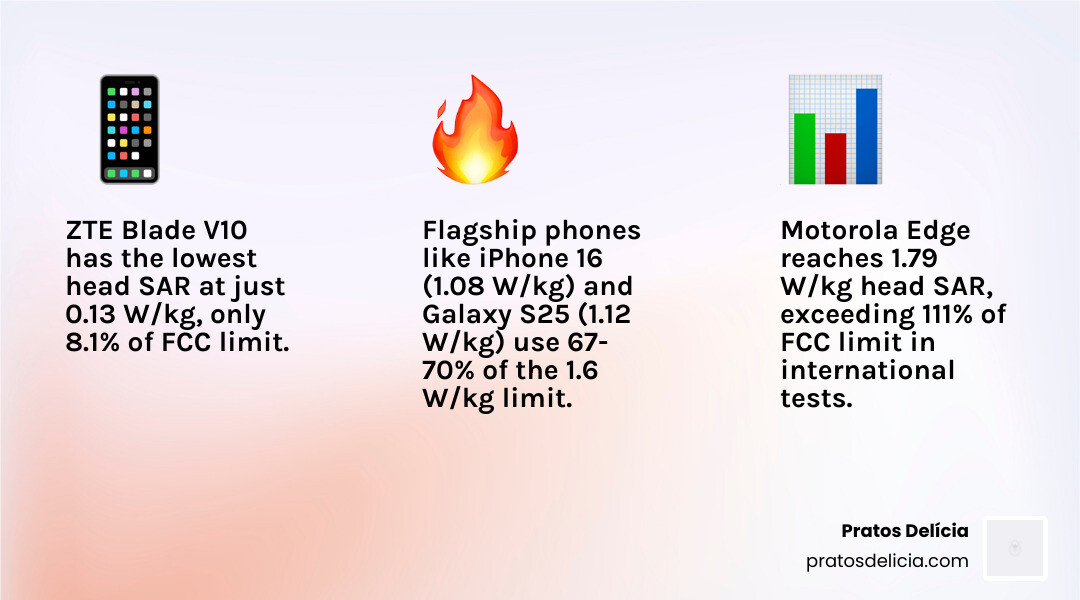
If you are shopping with radiation safety in mind, the data is quite revealing. On one end of the spectrum, we have the Motorola Edge, which has held a “dubious distinction” for having one of the highest head SAR values recorded at 1.79 W/kg (based on certain international testing standards).
On the other end, the ZTE Blade V10 is the gold standard for low emissions at a mere 0.13 W/kg. Samsung also performs exceptionally well; the Samsung Galaxy A16, a budget-friendly model, boasts a head SAR of only 0.51 W/kg, which is roughly 32% of the legal limit. You can find a deep dive into these rankings at Smartphone Specs & Radiation Levels.
Factors That Influence Real-World Radiation Exposure
The number in your smartphone sar value guide is a “worst-case scenario” lab result. In the real world, your exposure is a moving target. The most significant factor is signal strength.
When you have “full bars,” your phone is “whispering” to the cell tower. It uses the absolute minimum power necessary to maintain the connection. However, when you enter a basement, a rural area, or a moving vehicle, your phone starts “shouting.” To prevent the call from dropping, the phone ramps up its transmitter power. In poor signal areas, a phone can emit 5 to 10 times more radiation than it does in a high-signal area.
Other variables include:
- The Inverse Square Law: This is a fancy physics term that means radiation drops off incredibly fast as you move away from the source. Doubling the distance between your head and the phone reduces your exposure to one-fourth of the original level.
- Moving Vehicles: If you are on a train or in a car, your phone is constantly “handing off” the signal from one tower to the next. Every time it switches towers, it sends out a high-power pulse to establish the new connection.
- Network Congestion: In a crowded stadium, your phone has to work harder to “be heard” over the digital noise of thousands of other devices.
Practical Tips for Reducing Your Daily RF Exposure
We don’t need to throw our phones in the river to stay safe. Simple habit shifts can reduce your RF absorption by over 90% without costing a dime.
- Distance is Your Best Friend: Use the speakerphone or a wired headset. By keeping the phone just a few inches away from your head, you drastically reduce the SAR impact on your brain.
- Text More, Talk Less: Holding the phone at waist level to send a text message results in much lower head exposure than a 30-minute voice call.
- The “One Bar” Rule: If your signal is weak, avoid making calls. Wait until you have a better connection so your phone doesn’t have to transmit at maximum power.
- Airplane Mode at Night: If you use your phone as an alarm clock, put it on Airplane Mode. This turns off the cellular, Wi-Fi, and Bluetooth transmitters entirely.
- Avoid Pockets: Try not to carry a transmitting phone in your pocket or tucked into a bra. Use a bag or purse, or ensure the screen (the side with the least shielding) is facing away from your body.
For more detailed strategies, the Phone Usage Guide offers a masterclass in “distance-based safety.”
Protecting Children from Smartphone Radiation
This is perhaps the most important section of any smartphone sar value guide. Children are not just “small adults.” Their physiology makes them much more vulnerable to RF energy:
- Thinner Skulls: A child’s skull is thinner and less dense than an adult’s, allowing radiation to penetrate deeper into the brain tissue.
- Higher Water Content: Children’s tissues have a higher water and salt content, which absorbs RF energy more readily.
- Developing Systems: Their nervous systems are still growing, making them more susceptible to external influences.
We recommend strict screen time limits and encouraging children to use tablets or phones on a table rather than on their laps. When they do use a phone for a call, the speakerphone should be the default.
Frequently Asked Questions about Smartphone Radiation
Does a lower SAR value mean a phone is 100% safe?
Not necessarily. A lower SAR value means the phone passed the regulatory “thermal” test with flying colors. However, some researchers argue that the current SAR limits – which were mostly set in 1996 – only account for the heating of tissue. They don’t necessarily account for “non-thermal” biological effects that might occur over decades of use. Staying within the limits is essential, but practicing “Prudent Avoidance” (reducing exposure where possible) is the smartest path.
How can I check my phone’s SAR value instantly?
You don’t always need an online database.
- The Secret Code: Open your phone’s dialer and type *#07#. On many modern smartphones, this will instantly pull up a regulatory page showing your model’s SAR values.
- Settings Menu: Go to Settings > About Phone > Legal Information > RF Exposure.
- FCC ID: Look for the small FCC ID number on the back of your phone (or in the digital “About” menu). You can plug this ID into the FCC’s official database to see the full lab reports.
Do 5G phones emit more radiation than 4G models?
It’s a “yes and no” situation. 5G uses “beamforming” technology, which is actually more efficient – it aims the signal directly at the tower rather than spraying it in every direction. However, 5G phones often have more transmitters active at once (Simultaneous Transmission). While the individual pulses might be more efficient, the total “duty cycle” or the amount of time the phone is transmitting can be higher. Most 2025/2026 flagships show SAR values that are slightly higher than the 4G flagships of five years ago, but they still remain within the legal 1.6 W/kg limit.
Conclusion
At the end of the day, a smartphone sar value guide is a tool for empowerment. It allows us to make informed choices about the devices we bring into our homes and hold against our heads. By choosing phones with lower SAR ratings—like many of the latest Samsung models—and adopting simple habits like using speakerphone and avoiding low-signal calls, we can enjoy the benefits of modern technology while minimizing our risks.
Safety isn’t about fear; it’s about awareness. Here at Pratos Delícia, we believe that staying informed is the first step toward a healthier digital lifestyle. Explore more technology safety techniques to keep your family protected in our ever-connected world.
