
Is Your Coma Corrector Lens Edge Blemished? What to Look For
Is Your Coma Corrector Lens Edge Ruining Your Astrophotos?
The coma corrector lens edge is one of the most overlooked factors when buying a corrector for astrophotography — and it can make or break your star images.
Here’s a quick look at what to check before you buy:
| What to Evaluate | Why It Matters |
|---|---|
| Anti-reflective lens coatings | Reduces internal reflections and improves contrast |
| Image circle size | Must cover your sensor (40–42mm for APS-C/full-frame) |
| Backfocus distance | Must match your camera-to-corrector spacing |
| Focal ratio compatibility | Correctors are optimized for specific f-ratios (e.g., f/4, f/5) |
| Introduced aberrations | Poor designs add spherical aberration or astigmatism |
Picture this: you’ve spent hours under a dark sky capturing a wide-field nebula shot. You open the image on your screen and the center looks perfect — sharp, pinpoint stars. Then your eye drifts to the corners.
Comet-shaped blobs. Smeared streaks. Stars that look like they’re melting off the edge of the frame.
That’s coma — an optical aberration that plagues fast Newtonian reflectors, especially at focal ratios like f/4 or faster. It happens because parabolic mirrors, while great at focusing light on-axis, distort star shapes progressively toward the edge of the field.
A coma corrector is designed to fix exactly that. But not all correctors are equal. A corrector with poor lens edge coatings, the wrong image circle, or an incompatible backfocus distance can actually make things worse — or simply fail to correct the edges where it matters most.
The good news: once you know what to look for, choosing the right one gets a lot easier.

Understanding Coma Aberration and the Coma Corrector Lens Edge
To understand why we need a coma corrector lens edge to be pristine, we first have to look at the Newtonian telescope itself. Most modern Newtonians use a parabolic primary mirror. This shape is fantastic because it brings all incoming parallel light rays to a single focal point-at least in the center of the field.
However, as you move off-axis (toward the edges of your eyepiece or camera sensor), those light rays no longer meet at a single point. Instead, they create a “comet-like” tail that points away from the center. This is coma. In “fast” telescopes (those with focal ratios like f/4 or f/5), this effect is aggressive. Without correction, the diffraction-limited field-the tiny area where stars are actually sharp-might only be a few millimeters wide. For a broader overview of the aberration itself, the Wikipedia article on coma) is a useful reference.
Evaluating Coma Corrector Lens Edge Coatings for Astrophotography
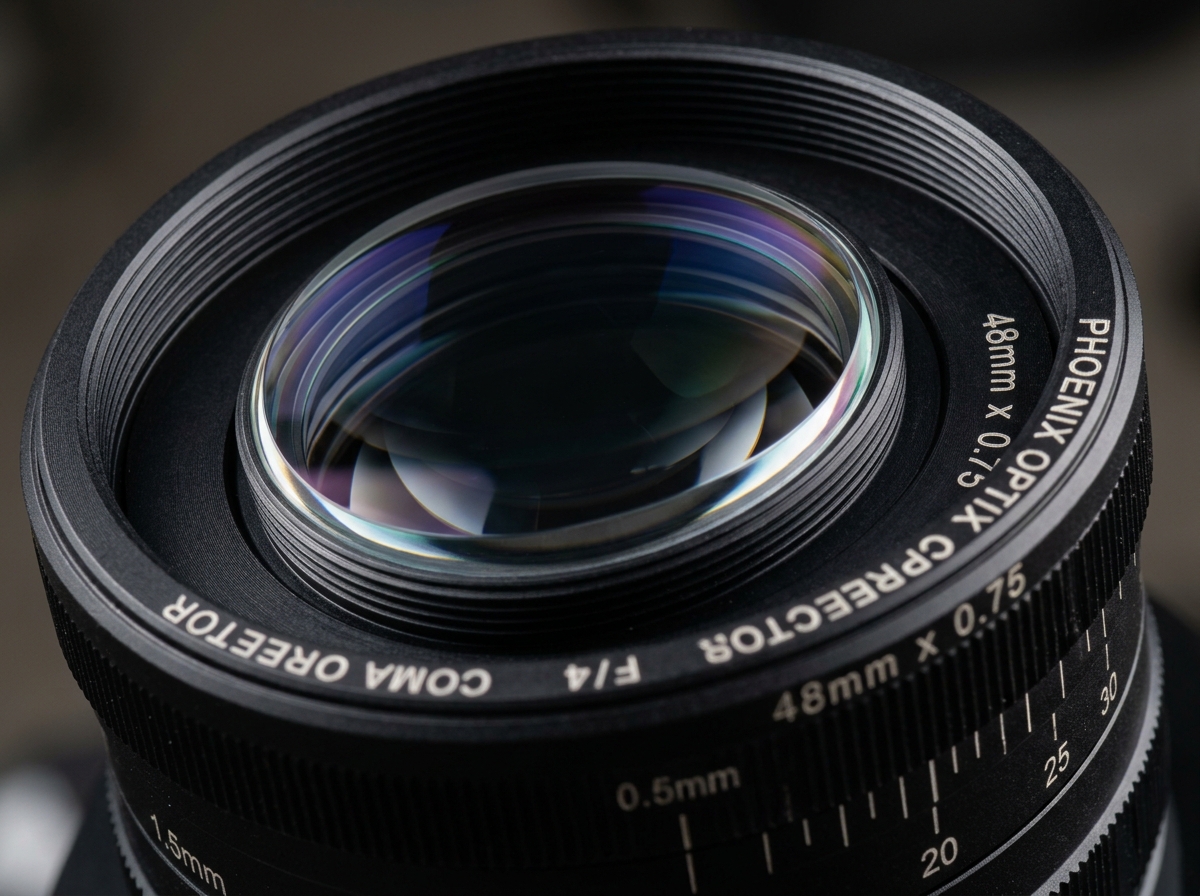
When we talk about the coma corrector lens edge, we aren’t just talking about the glass itself, but how it’s treated. High-quality correctors utilize advanced anti-reflective coatings. Premium models, for instance, use specialized multi-layer coatings on all air-to-glass surfaces.
Why does this matter? Because in astrophotography, internal reflections are the enemy. If the lens edges aren’t properly blackened or coated, light can bounce around inside the corrector housing, creating “halos” or “ghosts” around bright stars. This is a common issue when using clip-on-lenses-for-astrophotography-a-review or lower-end correctors that skimp on edge finishing. A well-designed coma corrector lens edge ensures that light transmission is maximized while stray reflections are suppressed.
Visual vs. Imaging Coma Corrector Lens Edge Performance
There is a significant divide between correctors meant for your eyes and those meant for your camera.
- Visual Correctors: These prioritize ergonomics and ease of use. A high-quality visual corrector, for example, is a gold standard here, expanding the diffraction-limited field by over 3 times.
- Imaging Correctors: These are all about the “image circle” and “backfocus.” An imaging corrector needs to project a flat, corrected field across a large sensor.
| Feature | Visual Corrector | Imaging Corrector |
|---|---|---|
| Primary Goal | Sharp stars across the eyepiece | Flat field across a digital sensor |
| Backfocus | Generally flexible/adjustable | Extremely critical (often 55mm) |
| Sensor Support | N/A (Human eye) | APS-C or Full-Frame (40mm+ circle) |
| Connection | Eyepiece holder (1.25″ or 2″) | Threaded (M48 or T2) |
For those interested in mobile setups, checking out smartphone-lens-adapters-for-milky-way-photography can show how even small-scale optics struggle with these same edge distortions.
Key Optical Designs and Their Impact on Image Quality
Not all correctors use the same “recipe” of glass. The design of the coma corrector lens edge and the internal elements determines how much “extra” trouble the corrector introduces.
- Ross Corrector: A classic two-element design. It’s compact and doesn’t change your focal length (1:1 scale), but it can introduce a small amount of spherical aberration in very fast scopes.
- Wynne Triplet: A three-element design often used in high-end astrographs. It provides excellent correction but usually extends the focal length by about 10-15%.
- Aplanatic GPU Design: This is a modern 4-element design. Because it uses four elements, it can correct coma without introducing spherical aberration, providing a 40mm fully corrected image circle.
Matching Correctors to Telescope Focal Ratios
Your telescope’s “speed” (f-ratio) dictates which corrector you should buy.
- f/3.5 to f/4: These are “super fast.” You need a high-performance 4-element corrector. These are optimized to handle the steep light cones of an f/4 astrograph.
- f/5 to f/6: These are more forgiving. A standard 2-element Ross-type corrector will often suffice.
Statistics show that a 20mm coma-correcting eyepiece can reduce star image sizes near the edge by 5 times compared to a standard eyepiece in an f/4 scope. That is the power of matching the right glass to your focal ratio.
Managing Secondary Aberrations and Focal Length
A common fear is that adding more glass will ruin the image. While a coma corrector lens edge helps with coma, a poorly designed one might introduce chromatic aberration (color fringing) or astigmatism.
High-quality models maintain a 1:1 image scale, meaning they don’t change your magnification. Others, like the Wynne-type, might increase your focal length slightly. The goal is always to achieve “diffraction-limited” performance across the whole field, meaning the optics are so good that the only thing limiting your sharpness is the physics of light itself.
Installation, Backfocus, and Mechanical Considerations
You can buy the most expensive coma corrector lens edge in the world, but if you don’t install it at the right distance from your sensor, it won’t work. This distance is called backfocus.
- The 55mm Standard: Most correctors are designed for a 55mm backfocus. This is the standard distance for a DSLR with a T-ring.
- The Outliers: Some correctors require a massive 75mm of backfocus. Other specialized models are even longer at 91.5mm, which is great if you want to use a filter wheel or an off-axis guider (OAG).
If you are using mobile devices, you might find that smartphone-lens-adapters-for-milky-way-photography require similar precision in alignment to avoid edge blur.
Optimizing the Coma Corrector Lens Edge for Large Sensors
If you have a full-frame camera, you need a corrector with a large clear aperture. A standard 2-inch corrector might start to “vignette” (darken the corners) on a full-frame sensor. High-performance variable coma correctors feature a large diameter body to help support full 2″ field illumination. When the coma corrector lens edge is wide enough, you can achieve a 40mm to 42mm image circle, covering almost any modern CMOS sensor.
Mechanical Flexure and Secure Mounting
Weight is a factor. A heavy camera hanging off a corrector can cause “flexure,” where the whole assembly tilts slightly. This ruins your collimation. Look for features like:
- Three-thumbscrew systems: To grip the corrector evenly.
- Threaded connections: M48 threads are much more secure than “push-fit” adapters.
- Textured grips: For handling the corrector in the cold with gloves.
For those capturing the night sky with smaller gear, smartphone-lens-adapters-for-capturing-the-milky-way often face these same mechanical stability challenges.
Advanced Solutions for SCTs and Specialized Optics
While we usually talk about Newtonians, Schmidt-Cassegrain Telescopes (SCTs) also suffer from aberrations. Specialized large-format reducers and coma correctors are available for these systems.
These optics can be incredibly powerful, reducing the RMS spot size at the edge of the field from 106 microns (on a native C14) down to just 13 microns. That is a 9x improvement in sharpness! If you’re looking for optimal-lenses-for-smartphone-milky-way-photos, you’ll notice that professional-grade correction always leads to these massive statistical jumps in quality.
Integrated Coma-Correcting Eyepieces
One of the most innovative solutions recently is the integrated coma-correcting eyepiece. Instead of putting a corrector in your focuser and then an eyepiece on top, the correction is built directly into the eyepiece lenses.
- Pros: No extra bulk, no mechanical flexure, and no “tuning” the distance.
- Field of View: These offer a massive 86-degree apparent field of view with sharp stars right to the coma corrector lens edge.
Frequently Asked Questions about Coma Correctors
Does a coma corrector change the focal length of my telescope?
It depends on the design. Ross-type correctors are usually 1:1, meaning they don’t change the focal length. Wynne-type correctors and other specialized designs typically increase focal length by about 10-15% (turning an f/4 scope into an f/4.6, for example). Reducer/correctors, like those for SCTs, will decrease the focal length.
Can I use a Newtonian coma corrector on a refractor or SCT?
Generally, no. Coma correctors for Newtonians are specifically designed to counteract the aberration created by a parabolic mirror. Refractors suffer from different issues like field curvature or chromatic aberration, which require a “Field Flattener” or “Reducer,” not a coma corrector.
How critical is the backfocus distance for edge-of-field sharpness?
Extremely critical! If you are off by even 1-2mm, you will see the coma returning at the edges of your image. Most manufacturers provide a specific distance (e.g., 55mm from the base of the threads). You use “spacer rings” to get this distance exactly right.
Conclusion
At Pratos Delícia, we know that the difference between a “good” photo and a “breathtaking” one often lies in the smallest details. The coma corrector lens edge is exactly that kind of detail. By choosing a corrector with high-quality aplanatic designs, superior anti-reflective coatings, and the correct backfocus, you can transform a fast Newtonian into a world-class imaging machine.
Whether you are looking for diffraction-limited performance or just want your stars to look like stars again, investing in the right corrector is the single best move you can make for your telescope.
For more tips on perfecting your setup, check out our more info about astrophotography services to see how we can help you capture the cosmos.
