
Why Every Food Photographer Needs a Bean Bag Support
The Surprisingly Simple Tool That Makes Food Close-Ups Look Professional
Food photography bean bags are small, flexible cushions filled with material like buckwheat hulls or dried beans that cradle your camera or lens to keep it perfectly still — no tripod needed.
Quick answer — best uses for food photography bean bags:
- Macro and close-up shots — holds your camera rock-steady for sharp detail
- Low-angle shots — sits flat on a table or floor for ground-level food angles
- Propping ingredients — tucks behind plates, bottles, or props to hold them at an angle
- Stabilizing lights and reflectors — weighs down small stands in tight studio spaces
- Overhead flat lays — supports a lens pointed straight down without bulky gear
Getting sharp food close-ups is hard. Even the tiniest camera shake turns a beautiful macro shot into a blurry mess.
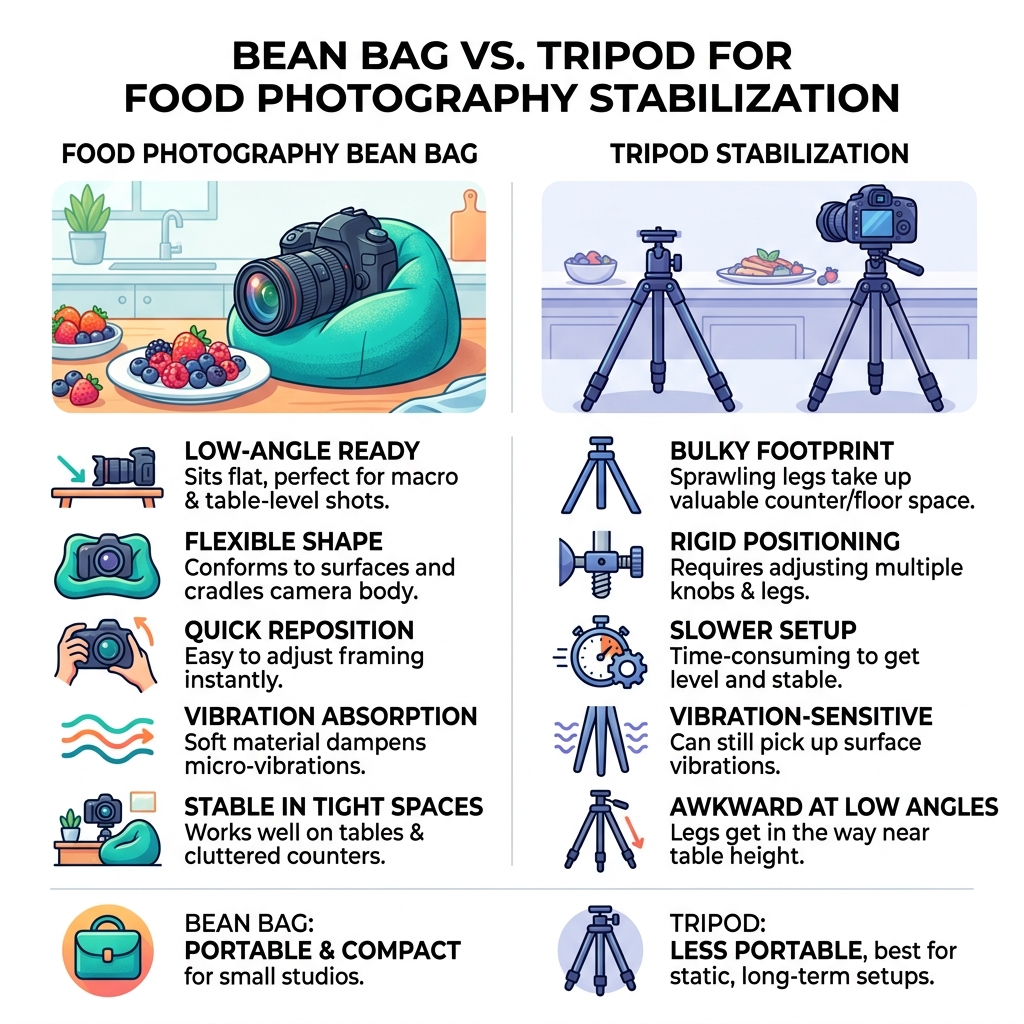
Most beginner food photographers reach for a tripod — but tripods are awkward in tight spaces, slow to reposition, and useless when you need a low angle inches from the table.
That’s where a bean bag changes everything.
It’s soft, so it molds to any surface. It’s heavy enough to absorb vibrations. And it costs a fraction of what a decent tripod does. One photography writer put it simply: a bean bag is “sturdier, lighter, simpler to use, and more versatile than most three-legged support systems.”
Whether you’re shooting steaming soup from above or capturing the crumb structure of a sourdough slice at table level, a bean bag gives you stability exactly where you need it — without fighting with a tripod in a cramped kitchen.
Below, we break down the best options, what to look for, and how to use them.
What are Food Photography Bean Bags and Why Use Them?
At its core, a photography bean bag is a heavy-duty fabric sack filled with granular material. While wildlife photographers have used them for decades to stabilize massive lenses on car windows, we find them equally indispensable in the kitchen studio. Unlike a rigid tripod, a bean bag is “fluid.” It conforms to the shape of your camera body or the barrel of your macro lens, creating a custom-molded cradle that eliminates micro-vibrations.

Stabilizing Close-ups with Food Photography Bean Bags
When we shoot macro food photography—think of the glistening oil on a roasted pepper or the delicate crystals on a salt-rimmed glass—the depth of field is incredibly shallow. Even the movement of a wooden floorboard as you step can cause a blur. Food photography bean bags excel here because they provide a broad surface area of contact. This contact dampens vibrations far more effectively than the three thin points of a tripod leg. For those of us using bellows or heavy macro lenses, a bean bag provides a “shock-free” support system that ensures every crumb is tack-sharp.
Versatility in Tight Studio Spaces
Kitchens are notoriously cramped. If you’ve ever tripped over a tripod leg while trying to adjust a garnish, you know the struggle. Bean bags have a tiny footprint. You can set one on a cutting board, a window sill, or even the edge of a shelf to get an angle that would be physically impossible for a tripod. They allow for “ground-level” shooting—what some call a “bug’s-eye view”—which is perfect for making a stack of pancakes look like a towering mountain.
Choosing the Right Fill and Material for Kitchen Environments
In food photography, we aren’t just worried about camera stability; we’re worried about hygiene. A bean bag used near a splashing sauce or a dusting of flour needs to be rugged and easy to clean.
Optimal Fill Materials for Food Photography Bean Bags
The “beans” inside your bag matter more than you might think. While the name suggests legumes, many professionals have moved toward more specialized fills.
- Buckwheat Hulls: Many experts consider these the gold standard. They are lightweight, have an irregular shape that “locks” together for better stability, and they don’t attract pests as easily as food grains.
- Plastic Pellets (Polyethylene): These are great for kitchen use because they are moisture-resistant. If you spill soup on the bag, you don’t have to worry about the inside turning into a fermented mess.
- Rice and Dried Beans: These are the classic DIY choices. They provide excellent weight and “moldability,” but they are heavy and can attract rodents if stored in a pantry.
- The “Edible” Option: As noted in The Incredible, Edible Bean Bag Tripod – Mother Earth News, you could technically fill a bag with trail mix or popcorn for a shoot and eat it afterward—though we recommend sticking to non-perishables for your permanent gear!
Durable Fabrics for Handling Food Spills
The outer shell should be a “workhorse” material. We look for:
- Cordura: A high-tenacity nylon that is water-resistant and incredibly tough.
- Leather or Suede: These provide a natural “anti-skid” grip, ensuring your camera doesn’t slide mid-shot.
- Wipeable Surfaces: Some modern bags use a coated canvas that can be cleaned with a damp cloth—essential when working with oils and syrups.
- Quality Hardware: Look for YKK zippers and double-stitched seams. The last thing you want is 5 pounds of rice exploding across your set during a live shoot.
How to Use a Bean Bag for Creative Food Styling and Angles
A bean bag isn’t just a camera stand; it’s a styling tool. Because it can be squished into almost any shape, it’s like having an extra pair of hands on set.
Creative Propping with Food Photography Bean Bags
Sometimes a plate needs a 5-degree tilt to catch the light perfectly, or a wine bottle keeps rolling away. A small, under-filled bean bag can be tucked under a prop to hold it at a precise angle. We also use them to stabilize light stands. If you’re using a small LED panel on a tabletop stand, draping a bean bag over the base prevents it from tipping over if someone bumps the table.
Best Practices for Positioning and Maintenance
To get the most out of your food photography bean bags, follow these “pro” tips:
- The “Punch” Technique: Before setting your camera down, give the bag a firm punch to create a divot. This seats the camera securely.
- Avoid the Focus Ring: Ensure the bag isn’t pressing against your lens’s manual focus ring. If it is, it might shift your focus as the bag settles. Some photographers disable “full-time manual focus” when using a bag for this reason.
- Water-Resistant Sprays: If your bag is made of fabric, treat it with a water-repellent spray. This makes it much easier to wipe off the inevitable flour or sugar dust.
- Storage: If you use organic fill like rice, store your bag in an airtight plastic bin to keep it dry and pest-free.
| Feature | Bean Bag | Traditional Tripod |
|---|---|---|
| Minimum Height | 0 inches (Table level) | ~6-12 inches |
| Setup Speed | Instant | 1-2 minutes |
| Vibration Dampening | Excellent (High mass) | Good (Depends on build) |
| Footprint | Very Small | Large |
| Precision | Manual adjustment | Geared/Ball head precision |
DIY vs. Commercial: Finding Your Perfect Camera Support
Do you buy a professional bag or make one during your lunch break? Both have their merits.
Making a DIY Support with Household Items
If you’re on a budget, you can create a fantastic support using a section of an old pair of jeans. Simply cut a 10-inch section of the leg, sew one end shut, fill it with rice or buckwheat, and sew the other end (or install a zipper). This is a great way to recycle and customize the size to your specific camera. As suggested in Using a Bean Bag for Wildlife Photography, sourcing buckwheat hulls from local health food stores or online can give your DIY bag a professional, lightweight feel.
When to Invest in Professional Grade Supports
Commercial bags often offer features a DIY version can’t match. “Pro” models might include an integrated mounting plate (made of aircraft-grade aluminum) that allows you to attach a ball head or gimbal directly to the bag. This gives you the stability of a bean bag with the tilting precision of a tripod. Professional bags also often feature non-slip “grippy” bases that stay put on slick marble or stainless steel countertops.
Frequently Asked Questions about Bean Bag Supports
Are bean bags more stable than mini-tripods for macro food shots?
Yes, in many cases. Mini-tripods have a higher center of gravity and can be “top-heavy” with a DSLR and macro lens. A bean bag has a 100% contact surface with the table, meaning there is zero chance of “leg flex” or tipping. For micro-vibration dampening, the mass of the bean bag wins every time.
How do I prevent mold if I use organic fillers like rice or beans?
Moisture is the enemy. Always ensure your bag is completely dry before storing it. If you work in a humid environment, consider adding a few silica gel packets inside the bag. Alternatively, switch to synthetic polyethylene beads which are completely immune to mold.
Can I use a bean bag for overhead “flat lay” food photography?
While a bean bag can’t hold a camera in mid-air, it is an excellent counterweight. If you are using a C-stand or a tripod with a horizontal arm for flat lays, hanging a bean bag from the opposite end of the arm provides a soft, safe weight that won’t scratch your gear if it bumps into it. You can also use a “U-shaped” bag to cradle a lens pointing straight down if you are resting it on a glass surface or a custom rig.
Conclusion
At Pratos Delícia, we believe that the best tools are the ones that get out of your way and let your creativity shine. A bean bag might not be the flashiest piece of gear in your kit, but it is arguably one of the most practical. It protects your expensive lenses from hard surfaces, gives you the freedom to shoot from impossible angles, and ensures your close-ups are professional and sharp.
Whether you’re sewing your own from an old pair of jeans or investing in a professional Cordura support, you’ll quickly find that a bean bag is the “silent partner” your food photography has been missing.
Ready to upgrade your studio setup? Check out more info about equipment services to see how we can help you capture the perfect shot.
