
Why Low Light Shutter Speed Is the Setting That Changes Everything
Low light shutter speed is the single most important camera setting to get right when shooting in dim conditions — and getting it wrong is the #1 reason photos come out blurry, dark, or both.
Here’s a quick reference to help you choose the right shutter speed for common low-light situations:
| Situation | Recommended Shutter Speed |
|---|---|
| Still subjects (handheld) | 1/50s – 1/60s |
| Walking people / casual events | 1/125s – 1/200s |
| Active performers / faster movement | 1/250s – 1/500s |
| Fast action or sports | 1/1000s or faster |
| Night street photography | 1/80s – 1/200s |
| Creative light trails (tripod) | Several seconds or more |
Quick answer: For most handheld low-light shooting, stay at or above 1/60s. For moving subjects, never go below 1/125s. Compensate for the reduced light by raising ISO (800–6400) and widening your aperture (f/1.4–f/2.8).
Low-light photography is frustrating for a lot of beginners. You point your camera at a beautiful night scene, press the shutter, and get back something blurry, grainy, or pitch black. Sometimes all three.
The good news? It’s almost always a shutter speed problem — and it’s very fixable.
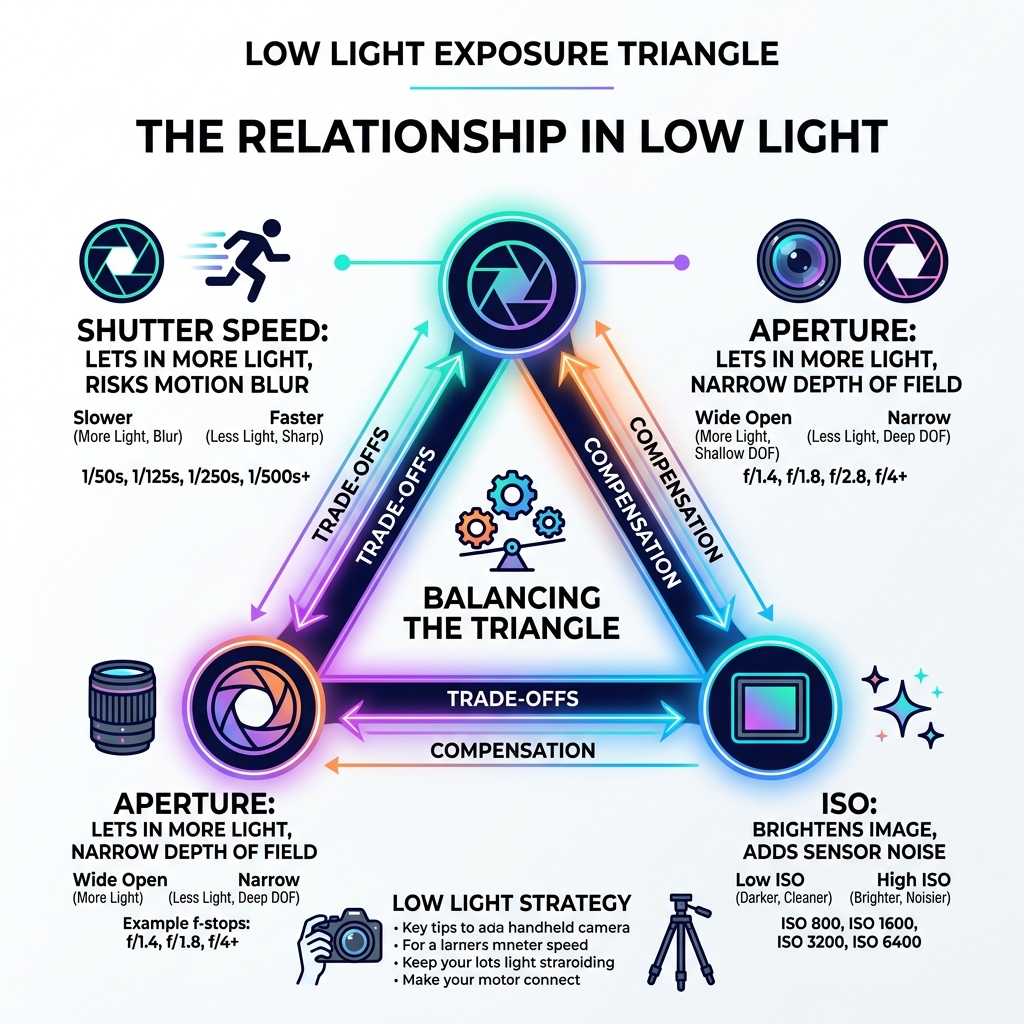
Shutter speed controls two things at once: how much light hits your sensor and whether moving subjects look sharp or blurry. In low light, those two goals pull in opposite directions. A slower shutter lets in more light but risks blur. A faster shutter freezes motion but darkens the image.
That tension is what makes low-light photography feel tricky. But once you understand how shutter speed works together with aperture and ISO — the three settings of the exposure triangle — you can make smart trade-offs instead of guessing.
This guide walks you through exactly how to do that, from basic settings to creative techniques like light trails and flash drag.
Low light shutter speed vocab to learn:
Mastering Low Light Shutter Speed and the Exposure Triangle
When we step into a dimly lit room or a moonlit street, our camera’s job becomes significantly harder. To understand how to manage low light shutter speed, we first have to look at the “Exposure Triangle.” This is the delicate balance between shutter speed, aperture, and ISO.
Think of it like a three-legged stool. If we shorten one leg (use a faster shutter speed to freeze motion), the stool will tip over (the image becomes too dark) unless we lengthen the other two legs (widen the aperture or increase the ISO). In low light, we are constantly making these compromises.
A common mistake is letting the camera decide these settings in Auto mode. Cameras are programmed to avoid dark images, so in low light, they often choose a shutter speed that is far too slow for handheld shooting, resulting in a blurry mess. By switching to Manual mode or Shutter Priority, we take back control. We can set a “safe” speed—like 1/125s—and then force the other settings to compensate.
For a deeper dive into the mechanics of time and light, check out this essential guide for photographers on shutter speed. Mastering these camera settings for low light is the first step toward professional-quality night shots.

Balancing Aperture and ISO for Faster Low Light Shutter Speed
To keep our low light shutter speed fast enough to prevent blur, we need to find light elsewhere. The first place we look is the aperture. Using a “fast” lens with a wide aperture (like f/1.4, f/1.8, or f/2.8) allows a massive amount of light to flood the sensor. For instance, an aperture of f/1.8 lets in about 16 times more light than f/11. This extra light is what gives us the “permission” to use a faster shutter speed.
However, even with the widest aperture, we often still find our images too dark. This is where ISO comes in. ISO determines how sensitive the sensor is to the light it receives. While high ISO can introduce “noise” (that grainy look), modern cameras are incredibly good at handling it. We often tell our students: a sharp, noisy photo is infinitely better than a clean, blurry one. You can fix noise in post-processing, but you can’t fix motion blur.
Don’t be afraid to push your ISO to 3200, 6400, or even 12800 if it means you can maintain a sharp low light shutter speed. For more on this, read why you should stop fearing high ISO and explore these tips for optimizing camera settings.
Recommended Low Light Shutter Speed Ranges for Different Scenarios
Choosing the right speed depends entirely on what is in front of your lens. If you are photographing a static building, you can get away with a much slower speed than if you are shooting a dance floor.
| Subject Type | Recommended Range | Why? |
|---|---|---|
| Architecture / Landscapes | 1/30s – 1/60s | Still subjects allow for slower speeds if you are steady. |
| People standing/talking | 1/125s – 1/160s | Prevents blur from head tilts or hand gestures. |
| Night Street Photography | 1/80s – 1/200s | Balances ambient light with moving pedestrians. |
| Concerts / Events | 1/200s – 1/500s | Performers move quickly; you need speed to freeze them. |
For those specifically interested in the urban environment, learning how to choose the right shutter speed for night street photography is essential. We’ve found that for events, we rarely go below 1/200s if we want to guarantee sharp faces under ambient light.
Overcoming Challenges: Motion Blur and Camera Shake
The two biggest enemies of low light shutter speed are subject motion blur and camera shake. Subject motion blur happens when the person you are photographing moves while the shutter is open. Camera shake happens when you move.
To combat camera shake, we use the “Reciprocal Rule.” This old-school rule of thumb suggests that your shutter speed should be at least 1 divided by your focal length. If you are using a 50mm lens, your minimum handheld speed should be 1/50s. If you’re using a 200mm zoom lens, you need at least 1/200s. In low light, this rule is your safety net.
When you cross these limits, the results are almost always disappointing. If you find yourself needing to shoot at very slow speeds, you’ll need to learn how to do long exposure photography without losing your mind. You can also check out this discussion on minimum shutter speeds for portraits to see what other pros recommend.
Using IBIS and Stabilization to Maintain a Low Light Shutter Speed
Modern technology has given us a massive advantage: In-Body Image Stabilization (IBIS). This feature allows the sensor to physically move to counteract your shaky hands. With a good IBIS system, some photographers can shoot handheld at speeds as slow as 1/10s or even 1/2s and still get sharp results—provided the subject doesn’t move!
However, IBIS has its limits. It cannot stop a person from walking or a bird from flying. For truly sharp images of moving subjects, there is no substitute for a fast low light shutter speed.
When the light gets truly scarce, we turn to tripods. A tripod allows you to use shutter speeds of several seconds or even minutes. This is how those “silky” waterfall shots or crisp cityscapes are made. For a comprehensive look at this, see these low-light photography tips or our complete guide to long exposure photography.
Creative Techniques: Shutter Drag and Light Trails
Low light isn’t just a challenge to be overcome; it’s a playground for creativity. By intentionally choosing a slow low light shutter speed, we can capture things the human eye can’t see.
Light trails are the classic example. By setting your camera on a tripod and using a shutter speed of 10 to 30 seconds, the headlights of passing cars turn into glowing ribbons of color. This same technique can be used for star trails or even night photography on your smartphone.
Combining Flash with Specific Low Light Shutter Speed Settings
One of our favorite “pro secrets” is a technique called shutter drag. This involves using a slow shutter speed (like 1/4s or 1/10s) combined with a flash.
The flash fires at the beginning or end of the exposure, “freezing” your subject in sharp detail. Meanwhile, the shutter stays open longer to drink in the colorful ambient lights of the background. If you move your camera slightly during the exposure, the background lights will blur into artistic streaks while your subject remains crisp.
To get this right, we recommend using “Rear Curtain Sync.” This tells the flash to fire at the very end of the exposure, ensuring that any motion trails appear behind the subject rather than in front of them. For more creative ideas, check out these 5 tips for capturing images in low light.
Essential Gear and Advanced Camera Features
While you can take great photos with almost any camera, certain gear makes managing low light shutter speed much easier.
- Fast Primes: Lenses like a 35mm f/1.8 or 50mm f/1.8 are affordable and allow much more light in than standard kit lenses.
- Auto ISO with Minimum Shutter Speed: This is a “game-changer” setting. You can tell your camera, “Don’t let the shutter speed go below 1/125s, and adjust the ISO automatically to make it happen.” This allows you to focus on the moment rather than the dials.
- Memory Functions: Many cameras allow you to save “Low Light” presets. We often have one mode set for high ISO ambient shooting and another for flash photography.
Understanding that one camera setting changes everything can save your shoot. And if you’re looking at the stars, you’ll want to dial in specific astrophotography settings to ensure your shutter isn’t open so long that the stars start to blur into “trails” (unless that’s what you want!).
Frequently Asked Questions about Low Light Photography
How do I stop my low light photos from being blurry?
The most common cause of blur is a low light shutter speed that is too slow for handholding. Follow the Reciprocal Rule: keep your shutter speed at 1/focal length. If you are at 50mm, stay at 1/50s or faster. Also, ensure your autofocus isn’t “hunting” by focusing on high-contrast edges or using an AF-assist lamp. For more answers, see these 9 commonly asked questions.
Is a high ISO better than a slow shutter speed?
In almost every case where the subject is moving: Yes. High ISO creates noise, but noise can be managed. A slow shutter speed creates motion blur, which is permanent. Modern software can remove grain remarkably well, but it cannot reconstruct a face that moved during a 1/10s exposure. Learn more in this ISO and shutter speed guide.
What is the best shutter speed for night street photography?
We recommend starting at 1/125s. This is fast enough to freeze most people walking but slow enough to keep your ISO at a reasonable level (usually between 1600 and 6400). If you have a very steady hand and great IBIS, you might drop to 1/80s, but you’ll risk subject blur. Check out these long exposure tips for mobile if you’re shooting with a phone.
Conclusion
At Pratos Delícia, we believe that mastering your camera in the dark is one of the most rewarding skills a photographer can have. It turns “bad light” into a creative opportunity. By understanding how low light shutter speed interacts with the rest of your settings, you move from taking snapshots to creating art.
Don’t be afraid to experiment. Go out tonight, set your camera to Manual, and see how high you can push your ISO before the noise bothers you. Test your own “handheld limit” to see how slow you can go before the blur kicks in.
The night is waiting. Start capturing the night today and show us what you can create!
