
The Best Cameras for Astrophotography Budget: Why Your Choice Matters More Than You Think
The best cameras for astrophotography budget come down to a handful of proven options that deliver real results without draining your savings. Here’s a quick look at the top picks:
| Camera | Type | Price Range | Best For |
|---|---|---|---|
| Canon EOS Rebel T7/T7i | DSLR | $200-$350 used | Wide-field deep sky, beginners |
| Canon EOS 6D Mark I | Full-frame DSLR | Under $300 used | Nightscapes, Milky Way |
| Nikon D5300 | DSLR | Under $300 used | Deep sky, astro-mod ready |
| ZWO ASI585MC Pro | Dedicated CMOS | ~$300-$400 | Planetary, deep sky |
| SVBony SV305 Pro | Dedicated CMOS | ~$200 | Planetary, budget option |
| Seestar S30 | Smart telescope | ~$349 | All-in-one beginner system |
Picking your first astrophotography camera feels overwhelming. There are hundreds of options, wildly different price points, and a lot of conflicting advice online.
Here’s the honest truth: you don’t need expensive gear to start capturing the night sky. Many astrophotographers got their start with a used Canon Rebel T3i for under $400 and came away with stunning shots of the Orion Nebula. The barrier to entry has never been lower.
But choosing the wrong camera — even a cheap one — can mean wasted money and frustrating results. The gap between a camera that works for astrophotography and one that doesn’t isn’t always about price. It’s about the right specs for the right job.
This guide cuts through the noise so you can make a confident, informed choice — even on a tight budget.
Essential Specs for the Best Cameras for Astrophotography Budget
When we look for the best cameras for astrophotography budget, we aren’t just looking at the price tag. We are looking at how the sensor handles the extreme conditions of long-exposure photography. Unlike daytime photography, where autofocus and burst rate matter, astrophotography is all about signal-to-noise ratio.
Understanding the Technical Jargon
To get the most bang for your buck, you need to understand a few key specifications:
- Read Noise: This is the “grain” introduced by the camera’s electronics when it reads the data from the sensor. For budget users, finding a camera with low read noise (ideally under 2.0e-) is vital because it allows you to see faint details in nebulae that would otherwise be buried in electronic static.
- Quantum Efficiency (QE): This measures how effectively the sensor converts incoming light (photons) into electrical signals. A higher QE means you gather more “signal” in less time. Modern budget CMOS sensors often boast QE ratings of 80% or higher.
- ISO Invariance: This is a fancy way of saying the camera produces the same amount of noise whether you brighten the image in the camera (high ISO) or later in software. Cameras like the Nikon D5300 or Z6 are famously ISO invariant, which gives you more flexibility during processing.
- Sensor Cooling: Dedicated astro cameras often feature Thermo-Electric Cooling (TEC). This drops the sensor temperature (sometimes to -20°C), which drastically reduces “thermal noise”—that red/green speckling you see in long exposures on hot summer nights.
DSLR vs. Dedicated CMOS
Standard DSLRs are versatile and easy to find used, but dedicated astronomy cameras are built specifically for the cold, dark world of space imaging.
| Feature | DSLR / Mirrorless | Dedicated Astro Camera (CMOS) |
|---|---|---|
| Cooling | None (Passive) | Active TEC Cooling |
| Ease of Use | High (Screen/Buttons) | Requires Laptop/Controller |
| Sensitivity | Filtered (Blocks H-Alpha) | Unfiltered/High Sensitivity |
| Versatility | Use for family photos too | Astro only |
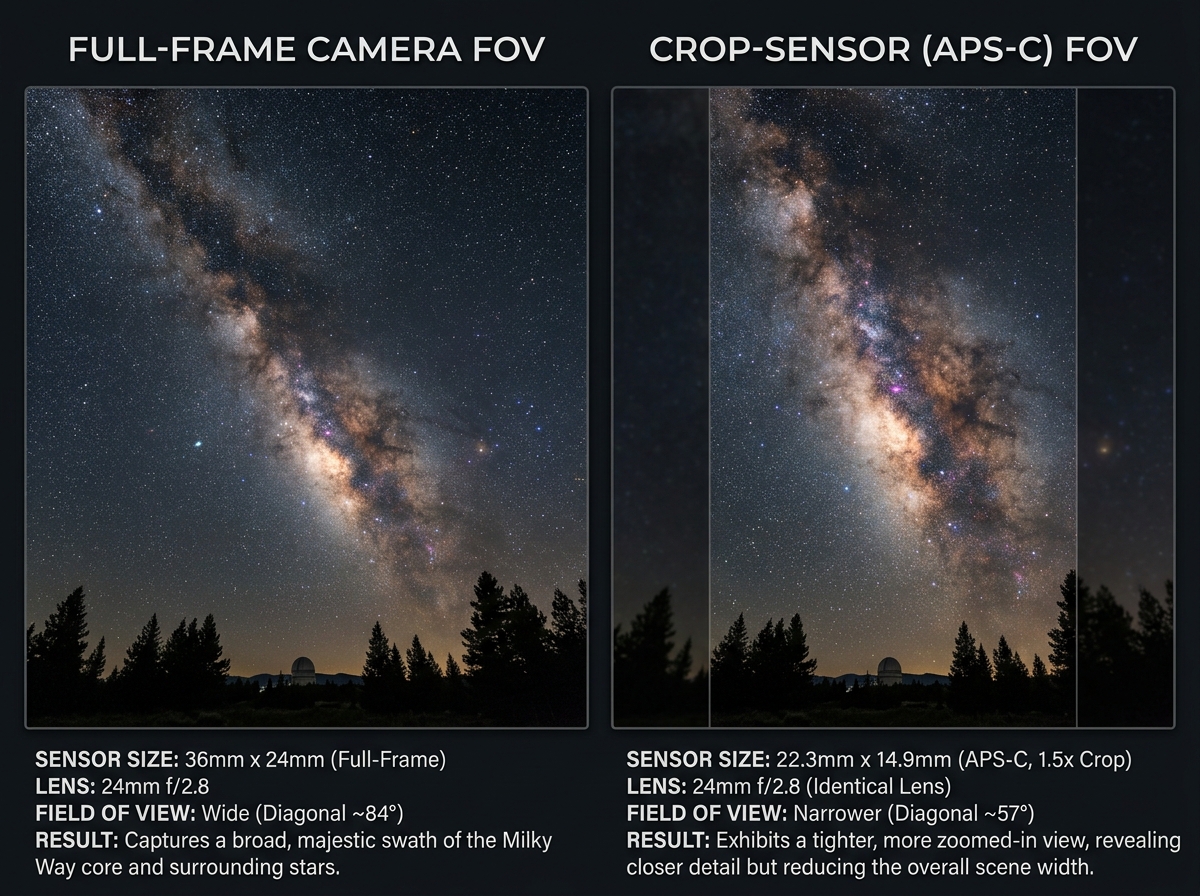
One major decision for budget buyers is the sensor size. A full-frame sensor (like in the Canon 6D) offers a massive field of view, perfect for the Milky Way. However, a crop-sensor (APS-C) is often cheaper and more forgiving if your telescope has slight distortions at the edges. If you are curious about how your current phone stacks up, check out our guide on comparing smartphones for astrophotography quality.
Top Used DSLR and Mirrorless Picks Under $500
If you want the absolute best cameras for astrophotography budget without spending four figures, the used market is your best friend. Many legendary cameras from five to ten years ago are still powerhouse performers for the stars.
The All-Rounder: Canon Rebel T7 / T7i
The Canon Rebel series is arguably the most popular entry point in history. A used T7 or T7i can often be found for $200–$350. We love the T7i specifically because of its articulating (tilt) LCD screen. Trust us, when your telescope is pointed straight up at the zenith, you do not want to be kneeling in the mud trying to see a fixed screen. These cameras are widely supported by almost every piece of astro-software on the planet.
The “ISO King” on a Budget: Nikon D5300
The Nikon D5300 is a cult classic. It features a 24MP sensor with no optical low-pass filter, meaning it captures incredibly sharp star images. More importantly, its sensor is remarkably clean and ISO invariant. You can find these used for under $300, and they are a top choice for those looking to perform an “H-alpha modification” (removing the internal filter to see red nebulae).
The Nightscape Legend: Canon EOS 6D Mark I
If your goal is the Milky Way arching over a mountain, the Canon 6D is the gold standard for budget full-frame. You can frequently find the Mark I version for under $300. Its large pixels soak up light like a sponge, and it has very low read noise for its age. It’s a “buy once, cry once” budget option that will last you years.
For more deep dives into affordable bodies, see our article on best budget cameras for astrophotography dont go broke for the stars. If you’re still hunting for deals, community threads like What are some good (ideally cheaper) cameras for … are great places to see what others are currently buying.
Best Budget Cameras for Astrophotography Budget for Nightscapes
For nightscapes, we prioritize a full-frame sensor and a wide-angle lens. The Nikon D610 is another fantastic used option, often sitting around $500. It provides excellent dynamic range, allowing you to pull detail out of the dark foreground while keeping the stars crisp. Pairing a used D610 or Canon 6D with a budget-friendly Rokinon 14mm f/2.8 lens is a “pro-level” setup for under $700 total.
Dedicated Astro Cameras and Smart Telescopes
As you progress, you might find that a standard camera’s limitations—like the lack of cooling and the built-in IR-cut filter—start to hold you back. This is where dedicated cameras and smart telescopes come in.
The Rise of Dedicated CMOS
Cameras like the ZWO ASI585MC Pro represent the new wave of budget imaging. For around $300–$400, you get a sensor designed specifically for the stars. These are “One-Shot Color” (OSC) cameras, meaning they work just like a regular camera but without the bulky body, shutter, or mirrors.
If you are looking for the absolute lowest entry point into dedicated gear, the SVBony SV305 Pro is a game-changer. For roughly $200, it offers a Sony IMX662 sensor that is perfect for planetary imaging (Jupiter, Saturn, Moon) and even basic auto-guiding. While it lacks cooling, its aluminum body dissipates heat well. For a deeper look, check out this Svbony SV305 Pro Review 2026: Best Budget Planetary Camera? .
The “Easy Button”: Smart Telescopes
For those who want to skip the complex setup of mounts, wires, and laptops, the Seestar S30 is the ultimate budget solution. Priced at approximately $349, it is an all-in-one “pocket observatory.” It includes the telescope, the camera, and the tracking mount in one tiny package.
While it won’t match the raw quality of a dedicated DSLR and a large telescope, the Seestar S30 Pro is a fantastic way to learn the sky and get social-media-ready photos of the Moon and bright nebulae in minutes. You can find more details on the Seestar S30 Pro – ZWO ASTRO USA product page.
Best Budget Cameras for Astrophotography Budget for Deep Space
Deep space imaging (galaxies and nebulae) requires long exposures, which generate heat. If your budget allows, moving to a cooled camera like the ZWO ASI533MC Pro (around $800) is a massive leap. It features a square sensor, which is actually a budget “hack”—it means you don’t have to worry about the orientation of the camera as much, and it fits perfectly within the corrected image circle of cheaper telescopes.
When matching a camera to a telescope, we use a calculation called Image Scale.
- Formula: (Pixel Size / Focal Length) x 206.265.
- Goal: You want a number between 1.0 and 2.0. If your number is too high, your stars look blocky (undersampled). Too low, and they look bloated (oversampled).
Frequently Asked Questions
Should I prioritize a better camera or a star tracker?
If you have $500 to spend, buy a star tracker first. A used $200 Canon T7 on a $300 star tracker (like the iOptron SkyGuider Pro) will always outperform a $2,000 camera sitting on a stationary tripod. Tracking allows you to take 2-minute exposures instead of 2-second exposures, which is the secret to those “glowy” nebula shots.
Is modifying a standard DSLR worth the cost?
Standard cameras have a filter that blocks “Hydrogen-alpha” light—the specific red wavelength emitted by almost all nebulae. Modifying a camera (removing that filter) makes it roughly 4x more sensitive to these objects.
- DIY: Possible, but very risky (tiny ribbons and screws!).
- Professional: Costs about $200–$300.
- Verdict: If you plan on sticking with a DSLR for more than a year, it is absolutely worth it for deep-sky imaging.
What free software is best for processing budget camera images?
You don’t need a Photoshop subscription to get started. We recommend:
- DeepSkyStacker (DSS): The gold standard for combining (stacking) your individual photos to reduce noise.
- Siril: A powerful, free tool for “stretching” the data and removing light pollution gradients.
- GIMP: A free alternative to Photoshop for final touch-ups and color balancing.
Remember to always shoot “Calibration Frames” (Darks, Flats, and Biases). These are “throwaway” shots that help the software remove sensor noise and dust spots from your final masterpiece.
Conclusion
Finding the best cameras for astrophotography budget is about choosing the right tool for your specific goals. If you want to capture the Milky Way while camping, a used Canon 6D is your best bet. If you want to dive into deep-space nebulae, a used Nikon D5300 or a ZWO ASI585MC will serve you well.
At Pratos Delícia, we believe that the beauty of the universe should be accessible to everyone. You don’t need a NASA-sized budget to see the rings of Saturn or the spiral arms of the Andromeda Galaxy. Start simple: grab a used DSLR, a sturdy tripod, and a remote shutter release. The most important “spec” for any astrophotographer isn’t the camera’s resolution—it’s the willingness to stand outside under the stars and learn.
Ready to see what’s out there? Start your astrophotography journey today and clear skies!
